This article may contain affiliate links. If you buy through them, I may earn a small commission at no extra cost to you.
Asamushi vs Fukamushi: How Steaming Time Changes Sencha
Published 2026-08-05
Buy sencha from two different shops and you can end up with two different teas. One pours a clear pale gold, smells like fresh leaves, and asks you to wait two minutes. The other pours an opaque deep green in thirty seconds and coats your tongue. Same plant, same tea category, same word on the label.
The difference is one production step: how long the fresh leaf was steamed. Short steaming is called asamushi (浅蒸し, “light-steamed”). Long steaming is fukamushi (深蒸し, “deep-steamed”). I covered the deep-steamed side in detail in What Is Fukamushi Sencha? This article puts the two styles side by side and helps you pick. I live in Japan and work with the people who grow and sell Japanese tea, and most of what Japanese producers say about light steaming has never been translated. The light-steamed side is where English coverage is thinnest, so that is where this guide digs deepest.
Who should NOT read this
- You have never brewed loose-leaf sencha. Start with How to Brew Sencha. The asamushi-fukamushi choice matters much less than water temperature does.
- You are deciding between sencha and matcha. That is a different fork in the road. Read Sencha vs Matcha instead.
- You just want one safe bag of everyday tea. Buy a fukamushi from Shizuoka, get a teapot with a fine mesh strainer, steep it thirty seconds. Done. Come back when you want to choose on purpose.
How I evaluated these
Three criteria, in order of weight.
1. What Japanese sources say, not what English articles repeat. English write-ups quote confident steaming times that contradict each other: one says asamushi is 20 to 30 seconds, another says 30 to 40, a third draws the line under 20. So I went to the Japanese layer underneath: the industry labeling standard, the agriculture ministry’s brewing manual, prefectural guides, and producers in both camps, from asamushi growers in Kawane and Uji to the deep-steamed heartland around Makinohara.
2. Measured data over marketing. Claims about what deep steaming does to the tea’s compounds follow fukamushi everywhere. Two Japanese studies actually measured it, one from the national tea research station in 1987 and one co-authored by NARO researchers in 2020. Their results contradict a claim you will find all over English tea sites, and they settle the comparison on facts.
3. Daily practicality. Brewing forgiveness, teapot requirements, cleanup, cold brew. The tea you keep drinking is the one that fits your kitchen.
The comparison at a glance
| Asamushi (light-steamed) | Fukamushi (deep-steamed) | |
|---|---|---|
| Steaming time | Roughly 10 to 40 seconds, depending on who you ask | 60 seconds or more; the standard says at least 2x regular |
| Official definition | None. A trade term | Yes, defined in Japan’s green tea labeling standard |
| Leaf shape | Intact, needle-like | Fine, broken, partly powdery |
| Liquor | Clear gold to pale green | Opaque deep green |
| Taste | Brisk, aromatic, defined edges | Mellow, thick, rounded |
| Aroma | High, fresh, held in the leaf | Quieter by design |
| First steep | About 1 to 2 minutes at 70°C | About 30 seconds, forgiving on temperature |
| Later steeps | Opens slowly; 2nd and 3rd steeps evolve | Extracts fast; 2nd steep in about 10 seconds |
| Teapot | Almost any, including ceramic-hole strainers | Fine mesh needed, ideally a wide obiami band |
| Cleanup | Easy; leaves lift out whole | Fine particles catch in the mesh |
| Typical regions | Mountain valleys: Honyama, Kawane, Uji | Sunny plateaus: Makinohara, Kakegawa, Kikugawa |
”Asamushi” has no official definition. That is the first thing to know
Japan’s green tea labeling standard, published by the Japan Tea Central Association, defines sencha as tea made by steaming, rolling, and drying the leaf. It defines fukamushi sencha as the same process “with a leaf-steaming time at least twice that of sencha.” Those are the only two entries on the steaming axis. I checked the full 25-page standard: the words asamushi, chumushi (medium-steamed), tokumushi (extra-steamed), and even “regular sencha” appear nowhere in it. The standard also names no seconds at all. The only numeric anchor in Japanese tea law-adjacent labeling is “twice as long as sencha.”
So asamushi is a retronym. Deep steaming spread from the 1960s onward, and tea sellers needed a word for the tea that was not deep-steamed. “Light-steamed” and “regular” filled the gap, and every producer draws the lines their own way:
- Satoen, a Shizuoka maker, treats asamushi and regular steaming as the same thing: 30 to 40 seconds, with fukamushi at 60 seconds to 2 minutes.
- Matsushimaen, an asamushi grower in Kawane, calls anything from 10 seconds to 1 minute asamushi, and 1 to 3 minutes fukamushi.
- Arai Seicha, a Sayama wholesaler, sells a five-step ladder: asamushi, regular, medium, deep, extra-deep.
If you compared these numbers against the steaming spectrum table in my fukamushi guide, you would find the ranges overlap but never quite agree. That is not sloppiness on anyone’s part. There is no rulebook to agree with. When an English article gives you one exact cutoff, it is quoting one shop.
One more distinction worth keeping: steaming depth is not a quality grade. A premium first-flush tea can be steamed light or deep. The two axes are independent, and confusing them is the most common mistake in English sencha writing.
Why the land decides the steam
Here is the part English articles skip, and it is the actual answer to “why do both styles exist?”
Steaming style follows leaf thickness, and leaf thickness follows geography.
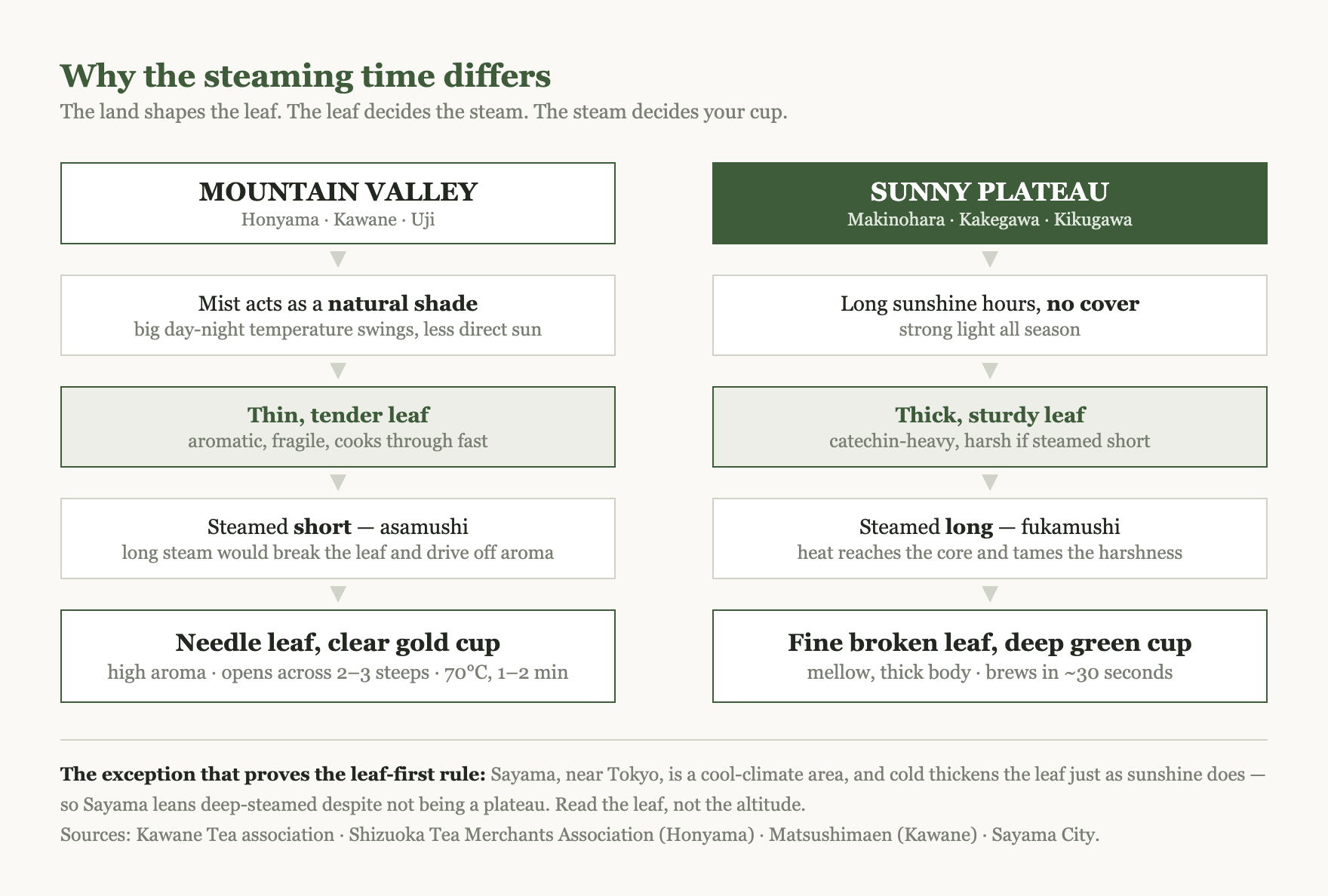
Mountain valleys grow thin leaves. The Kawane tea association describes its river-valley tea this way: large day-night temperature swings, high humidity, and mountain mist that acts as a natural cover blocking direct sun. The Shizuoka tea merchants’ association says the same about Honyama, the historic growing area along the Abe River: the gardens sit wrapped in river mist, and the leaves grow visibly thinner than lowland leaf. Thin, tender leaves cook through quickly. Steam them long and, as the Kawane grower Matsushimaen puts it, the leaf fibers break down, the liquor clouds to dark green, and the aroma escapes. So mountain producers steam short, keep the needle shape, and protect the fragrance their terroir gave them. Honyama has traded on exactly that character for a while: the merchants’ association records it as the tea Tokugawa Ieyasu drank, supplied to the shogunate as official-use tea from 1681.
Sunny plateaus grow thick leaves. This is the Makinohara story from my fukamushi guide, so one line here: long sunshine hours make thick, catechin-loaded leaves that taste harsh under short steaming, and deep steaming was developed to tame them. The Kawane association states the mechanism plainly: plateau leaf is harder than mountain leaf, so you lengthen the steam to soften it.
Uji sits on the light-steamed side. Seisenen, a Uji tea wholesaler, is blunt about it: deep steaming is fashionable, but “the mainstream of Uji tea is not fukamushi.” Uji’s mountain-valley leaf suits short-to-regular steaming, and the classic Uji cup is what they call a clear, pale yamabuki gold. Another Uji house, Hoshunen, adds the practical consequence: a tightly rolled, unbroken leaf opens slowly, so the first, second, and third steeps each taste different. That slow unfolding is the asamushi experience in one sentence.
Now the exception that keeps the rule honest. If mountains meant light and flat meant deep, Sayama, the cool-climate growing area near Tokyo, would be confusing. Sayama’s city government explains that the cold climate thickens the leaf, which feeds the tea’s signature body. And a Sayama dealer interviewed by the Tokyo tea association says it directly: thick leaf, strong flavor, “so the tea here is mostly fukamushi,” finished with the region’s trademark high-heat firing. Cold does to a leaf what sunshine does: toughens it. The real rule is leaf-first, not altitude-first. Thin tender leaf, steam short. Thick sturdy leaf, steam long. Geography only matters because it shapes the leaf.
The market has voted, by the way. Matsushimaen estimates deep-steamed tea now accounts for about 80 percent of sencha distribution in Japan. Light-steamed sencha is the minority style, which is exactly why overseas shops that stock it tend to say so on the label.
What steaming actually changes, according to people who measured it
English tea sites often claim deep steaming increases catechins, or releases more nutrients, or makes the tea “stronger” in some chemical sense. Japan’s tea research station tested this in 1987, steaming the same leaf for 30, 60, and 150 seconds and analyzing the results. The finding: total nitrogen, tannins (catechins), caffeine, free sugars, hot-water extract, and free amino acids stayed essentially unchanged across all three steaming times. Vitamin C dipped slightly. At 150 seconds the tea picked up a faint boiled note and the liquor shifted toward red-brown. The one clear chemical change was pectin: total pectin held steady, but the water-soluble fraction rose as steaming lengthened.
A 2020 study co-authored by a NARO researcher filled in what that means in the cup. Comparing deep-steamed and regular-steamed leaf from the same region, the deep-steamed tea released twice the pectin into the brew, 34 percent extracted over two steeps versus 16 percent. Catechin extraction was identical, around 44 percent for both.
Put those together and the folklore collapses into something more interesting:
- Deep steaming does not add anything. The leaf’s main compounds are the same going in and coming out.
- Fukamushi’s thick, mellow body is pectin plus particles. Dissolved pectin rounds the texture, and the suspended leaf fragments carry the color and weight.
- Asamushi is not a weaker tea. It carries the same compounds; the intact leaf just releases them slowly, across several steeps, with the aromatics kept in.
Choose between them on texture, aroma, and workflow. The chemistry is a wash.
Asamushi, reviewed
Who it is for: people who drink tea for the smell as much as the taste, and enjoy the brewing itself.
What is good. The aroma logic runs in asamushi’s favor: aroma compounds are volatile, and Satoen’s explanation of why fukamushi smells quieter, long exposure to high-temperature steam drives fragrance off, is also the explanation of why asamushi smells louder. Less steam, more of the leaf’s own scent left in. The cup is clear gold-green, the leaf stays needle-shaped, and it opens across steeps: the Uji houses sell exactly this, a first steep, a second, a third, each with a different balance. Practical bonuses: the intact leaf works in nearly any teapot, including the ceramic-hole sasame strainers that deep-steamed tea jams shut, and spent leaves lift out in one clean mass.
One honest complaint. Asamushi punishes carelessness. The standard Japanese guidance for fine sencha, 70°C water and a one-and-a-half to two-minute wait, applies with full force here, and hot water tips it into harshness fast. It is also simply harder to find: specialist retailers describe it as a minority product, and much of what is sold as asamushi is premium single-region tea priced accordingly.
Why choose it: you want Japanese tea as an aromatic, unfolding, multi-steep experience, and you are willing to give it a thermometer’s worth of attention.
Fukamushi, reviewed
Who it is for: people who want a rich cup, right now, most days.
What is good. Thirty seconds and the cup is ready; that number is from the agriculture ministry’s own manual, which also flags deep-steamed leaf as well suited to cold brewing. It tolerates hotter water, the everyday-grade guidance runs at 90°C, so there is no ceremony on a rushed morning. The thick, sweet body that made deep steaming a national habit is, as covered above, a pectin-and-particle effect the light-steamed style physically cannot produce. It is my daily tea, and I made the full case for it in the fukamushi guide.
One honest complaint. The aroma is quieter by design, the price of the steam that mellowed it. The fine leaf demands a mesh-lined teapot and leaves sediment in the cup, and cleanup means rinsing particles out of mesh. One more caution from a maker’s own mouth: Satoen notes the opaque deep-green color comes from suspended leaf particles and “does not necessarily mean the tea is high quality.” Do not let the prettiest green in the shop make the decision for you.
Why choose it: you drink tea daily, you value speed and forgiveness, and you like a cup with weight.
Brewing them side by side
The steeping rule is an inverse ladder: the longer the leaf was steamed at the factory, the shorter your steep at home. The steam already did part of the extraction work by breaking the leaf’s structure.
| Source | Light-steamed / fine sencha | Deep-steamed |
|---|---|---|
| MAFF brewing manual | 2–3 g per person, 70°C for fine grades, about 90 seconds; 2nd steep about 45 seconds | 2 g per 60 ml cup, about 30 seconds |
| Shizuoka Prefecture | 70°C for fine, 90°C for everyday; about 60 seconds | Same temperatures; about 30 seconds; 2nd steep about 10 seconds |
| JA Shizuoka City | Fine sencha 70°C, 2 minutes | 90°C, about 30 seconds |
| Arai Seicha’s five-step ladder | Asamushi 90 s → regular 60 s | → medium 40–50 s → deep 30 s → extra-deep 20–30 s |
Two details worth stealing from the Japanese guidance. First, the temperature axis follows grade more than steaming: fine teas of either style get 70°C, everyday grades get 90°C. Some English guides print the opposite, low temperatures for fukamushi and high for asamushi, which reverses the Japanese official tables. Second, whichever style you brew, drain the pot completely; the last drops are the concentrated ones, and leftover water ruins the next steep. My brewing guide covers the full routine, including the water-hardness problem that quietly sabotages sencha outside Japan.
Recommendation by use case
- You drink tea all day, fast → fukamushi. Thirty seconds, forgiving, rich.
- You want the aroma and the ritual → asamushi. Cool the water, wait, and it repays you across three steeps.
- You cold brew → fukamushi first. The ministry manual itself points deep-steamed leaf at cold brewing.
- You own only a basket-infuser mug or a coarse-holed pot → asamushi, or buy a fine-mesh kyusu before going deep-steamed.
- You hate sediment in the cup → asamushi. The cloud is the point of fukamushi, and it is not for everyone.
- You are buying your first-ever sencha → fukamushi for ease, asamushi if the smell of tea is what pulled you in.
- You want to actually taste what steaming does → buy one of each from the same region and brew them in parallel. The side-by-side is the whole lesson in two cups.
How to find each one
For fukamushi, the label says 深蒸し or fukamushi, and Shizuoka’s plateau regions, Kakegawa, Makinohara, Kikugawa, are the heartland. For asamushi, search “asamushi” or “light steamed sencha”; several overseas specialist shops maintain dedicated light-steamed categories, and O-Cha and Yunomi both do. Region names work as a proxy too: Kawane and Honyama for Shizuoka mountain tea, or Uji houses that advertise the traditional clear-gold style. If a listing names no steaming style at all, assume regular-to-deep; the light-steamed minority almost always says so, because it is a selling point.
What would make me change this recommendation
Three things would move my lines.
First, if you cannot control water temperature at all, no kettle with settings, no patience for cooling, the asamushi recommendation collapses and fukamushi wins every use case; temperature control is the entry fee for light-steamed tea. Second, my aroma reasoning leans on producer explanations of volatile loss, which are consistent across makers, but I have not found a Japanese study that quantifies aroma compounds by steaming time the way the 1987 study quantified catechins. If measured data lands, I will update this piece to match it. Third, if your water is hard, the steaming question is secondary; mineral-heavy water flattens either style, and fixing water buys you more flavor than switching styles ever will.
Related reading
- What Is Fukamushi Sencha? The deep-steamed style in full: history, the Makinohara story, and the teapot problem.
- How to Brew Sencha Temperature, timing, and the water problem outside Japan.
- Sencha vs Matcha The other fork: steeped leaf versus powdered shaded leaf.
Sources
Standards and public institutions:
- Japan Tea Central Association, Green Tea Labeling Standards (PDF): https://www.nihon-cha.or.jp/pdf/hyoujikijyun.pdf
- Ministry of Agriculture, Forestry and Fisheries, tea brewing manual (PDF): https://www.maff.go.jp/j/seisan/tokusan/cha/attach/pdf/ocha-1.pdf
- Shizuoka Prefecture, “How to Brew Delicious Tea”: https://www.pref.shizuoka.jp/kensei/introduction/soshiki/1002123/1041029/chanomiyako/1040637/1027281.html
- JA Shizuoka City, brewing guide: https://ja-shizuokashi.or.jp/speciality/green-tea/howtomake
- Sayama City, characteristics of Sayama tea: https://www.city.sayama.saitama.jp/kankou/sayamacha/tya2.html
Research (J-STAGE):
- Takayanagi, Anan, Ikegaya, “Changes in physicochemical properties of tea by degree of steaming,” Chagyo Kenkyu Hokoku No. 65 (1987): https://www.jstage.jst.go.jp/article/cha1953/1987/65/1987_65_81/_article/-char/ja/
- Hirono, Goto, Aiba, “Analysis of water-soluble pectin and catechin content in sencha of different steaming degrees,” Nippon Shokuhin Kagaku Kogaku Kaishi 67(8) (2020): https://www.jstage.jst.go.jp/article/nskkk/67/8/67_264/_article/-char/ja/
Regional associations and producers:
- Shizuoka Tea Merchants Association, about Honyama tea: https://www.ocha.or.jp/about/
- Kawane Tea portal, on mountain tea and steaming: https://www.kawane-cha.jp/various/
- Matsushimaen (Kawane), why they steam lightly: https://kawanecha.net/tea/asamushi/
- Satoen, asamushi vs fukamushi explained: https://www.satoen.co.jp/blog/sencha-fukamushi-chigai/
- Seisenen (Uji), on Uji tea and steaming: https://seisenen.com/ujicha.html
- Hoshunen Iwai Kanzo (Uji), on traditional light-steamed Uji tea: https://hoshunen-iwaikanzo.com/aisatsu.html
- Tokyo Tea Association, Sayama tea report: https://tokyo-cha.or.jp/article/report-sayama-cha.html
- Arai Seicha (Sayama), steeping times by steaming degree: https://araiseicha.com/blog/2303/
- Ito En, customer FAQ (fine-mesh kyusu for deep-steamed tea): https://www.itoen.jp/customer/faq/ocha/4950/5018/page/2/
Retail (availability of light-steamed sencha in English):
- O-Cha, light-steamed asamushi category: https://www.o-cha.com/loose-leaf-green-tea/sencha/light-steamed-asamushi-tea/
- Yunomi, asamushicha collection: https://yunomi.life/collections/asamushicha