This article may contain affiliate links. If you buy through them, I may earn a small commission at no extra cost to you.
Sencha vs Matcha: What Actually Separates Them
Published 2026-08-01
You are standing in front of two green things. One is a bag of loose leaves. One is a tin of bright green powder that costs four times as much. Both say Japanese green tea. Nobody in the shop explains why the powder costs what it does.
English articles on this question tend to end in a tie. Sencha is refreshing, matcha is concentrated, drink whichever you prefer. That is true and it is useless.
The real split happens on the farm, weeks before harvest, and it decides everything that follows: the price, the caffeine, the color, and whether you swallow the leaf or throw it away. I live in Japan and work with the people who grow and sell Japanese tea. What follows comes from Japan’s labeling standards, the national food composition tables, and government production statistics, most of which have never been translated.
Who should not read this
If you want to know whether ceremonial grade beats culinary grade, this article will frustrate you. Those two terms have no basis in Japanese labeling standards. Japanese makers sort matcha by intended use, thin tea and thick tea for drinking, and a separate line for food processing. The English grade vocabulary was built for export.
If you want a ranking of health benefits, look elsewhere. Health claims are a poor reason to choose between two teas that are both mostly the same plant.
If you want permission to declare one of them better, you will not get it here. They are different products. The question worth answering is which one belongs in your kitchen this month.
How I judged this
Three tests, chosen because they are the three places English coverage tends to go wrong.
What the official definitions actually say. Not what tea shops say. The Japan Tea Central Association publishes the labeling standard that decides what may legally be called matcha in Japan, and it is narrower than most people expect.
Whether the numbers are being compared fairly. Most caffeine comparisons you have read are broken. They put 100 g of matcha powder next to 100 g of brewed sencha liquid. One is dry powder. One is 99.4 percent water. That comparison tells you nothing.
What it costs before it reaches a shop. Retail prices mix in branding, packaging, and importer margin. Japan publishes the price farmers actually receive per kilogram, by tea type. That number is the clean measure of how much harder one of these is to produce.
The short version
| Sencha | Matcha | |
|---|---|---|
| Grown | Mostly full sun | Shaded 2 to 3 weeks before harvest |
| Rolled after steaming | Yes | No |
| What you buy | Whole leaves | Powder ground from tencha |
| How you drink it | Steeped, leaves discarded | Whisked, leaf consumed |
| Share of Japan’s crude tea output | 48.1% | 8.6% |
| Price at the farm gate | 1,746 yen/kg | 8,562 yen/kg |
| Caffeine per serving | about 30 mg | about 64 mg |
Those last three rows are the article in miniature. Matcha is roughly a twentieth of what Japan grows, costs about five times as much as raw material, and delivers about twice the caffeine per cup.
The word missing from every English comparison
Matcha is not ground green tea. It is ground tencha, and tencha is a distinct product with its own definition.
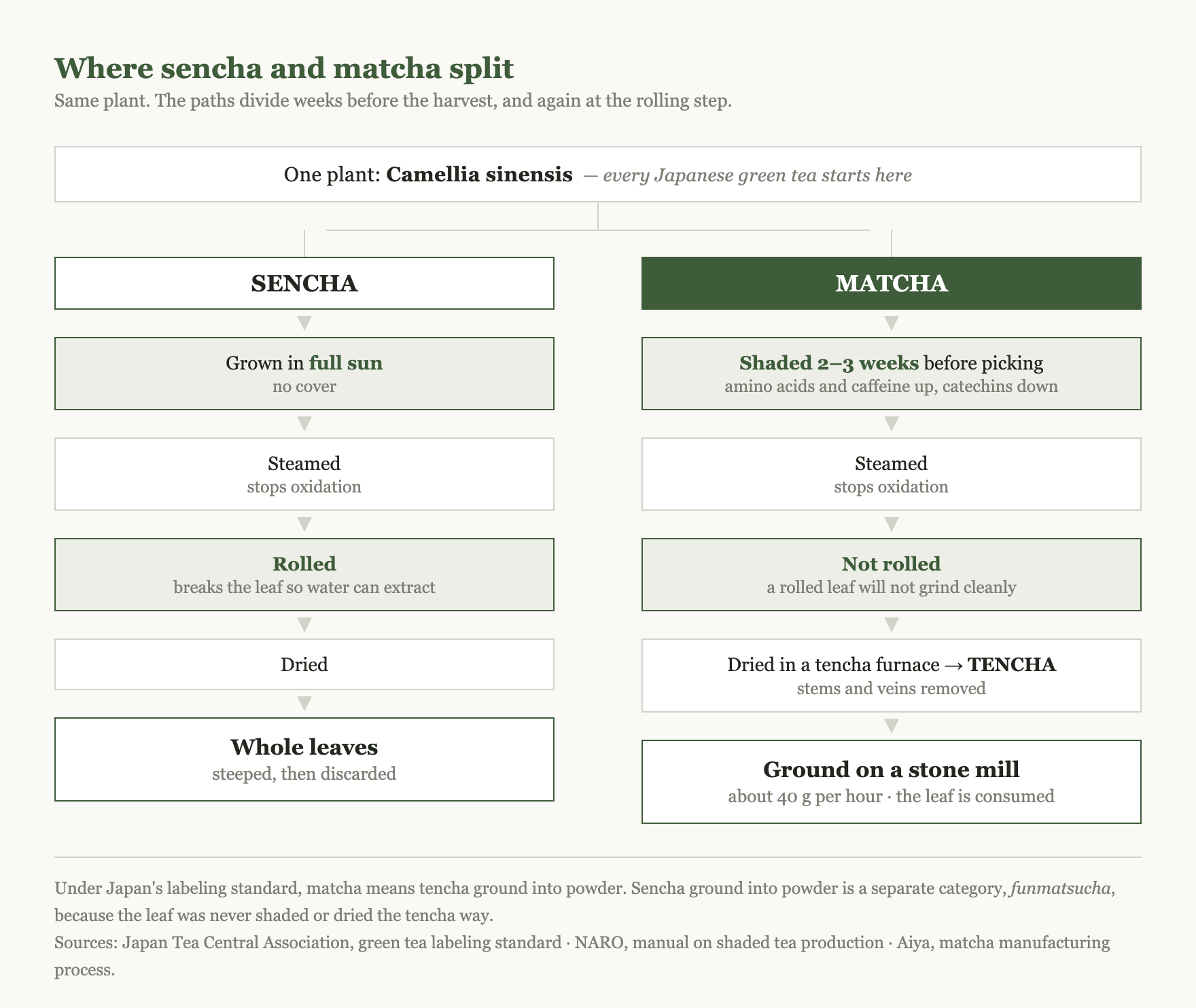
The Japan Tea Central Association defines matcha as tencha manufactured into a fine powder using a tea mill or equivalent. Tencha is defined separately: leaves picked from a garden covered for roughly two to three weeks before harvest, steamed, then dried without rolling in a tencha furnace.
Two conditions, and both must hold. Shade the garden. Skip the rolling.
The same standard defines a different category, funmatsucha, as tea made into powder by a grinder. Powdered sencha lands there. It looks like matcha in the bag. It is not matcha under the standard, because the leaf was never grown or dried the tencha way.
This matters to you at the point of purchase. Green powder is now sold worldwide with no reference to tencha at all. The standard is the tool that tells you whether the product in your hand is the thing the price implies. I built a full verification guide on it, covering labels, certifications, and the price arithmetic.
Sencha’s definition, by contrast, fits in one line: leaves steamed, rolled, and dried.
Rolling is the fork in the road. Rolling breaks the leaf structure so that hot water can pull flavor out in sixty seconds. Tencha skips it, because a rolled leaf will not grind cleanly into powder. Every difference below follows from that single choice.
What shade does, and what it does not
Japan’s national agriculture research organization, NARO, publishes a manual on shaded tea production. It contains a table of what changes in the leaf under cover. That table is more specific than anything in circulation in English.
Under shade, free amino acids increase. Theanine increases. Caffeine increases. Total catechins decrease. Chlorophyll increases, which is where the color comes from. Leaves grow thinner, wider, and rounder.
Read the caffeine line again. Shading raises caffeine. English articles routinely explain matcha’s caffeine by saying you drink the whole leaf, which is true, but incomplete. The growing method pushes it up before anyone grinds anything.
Then there is the line that undoes a popular claim. NARO reports that EGCG, the catechin most cited in health writing, does not change under shade. EGC decreases. Total catechins decrease. EGCG holds.
So the familiar English framing, that shading boosts antioxidants, does not survive contact with the Japanese source. Shading raises the amino acids that produce savory sweetness. It lowers some catechins. The famous one stays put.
One more entry in that table is worth knowing because it names a smell you have tasted without having a word for. Dimethyl sulfide increases under shade. Japanese tea people call the result ooika, cover aroma, and describe it as resembling green laver seaweed. If your matcha has ever reminded you faintly of the sea, that is the compound, and it is a marker of proper shading rather than a flaw.
How long is the shading? Three answers, all correct, at different levels of precision. The labeling standard says roughly two to three weeks. NARO says traditional gyokuro and tencha use high-blocking material for twenty to thirty days. Shorter covers exist for other teas: ten to fifteen days for kabusecha, about a week for simple color improvement. If an article gives you a single fixed number of days, it is quoting one farm.
The numbers, compared honestly
Japan’s Standard Tables of Food Composition list matcha and sencha separately. Here is the part that gets misused.
Per 100 g of dry matter, so powder against dry leaf:
| Per 100 g dry | Sencha leaf | Matcha powder |
|---|---|---|
| Caffeine | 2,300 mg | 3,200 mg |
| Tannins | 13,000 mg | 10,000 mg |
| Vitamin C | 260 mg | 60 mg |
| Dietary fiber | 46.5 g | 38.5 g |
| Beta-carotene equivalent | 13,000 µg | 29,000 µg |
| Potassium | 2,200 mg | 2,700 mg |
Two of those rows contradict things you have read.
Sencha leaf carries more tannins than matcha, not fewer. Shading lowers catechins, and tannins are largely catechins, so the shaded product ends up lower. The idea that matcha is the more astringent tea does not hold at the leaf level.
Sencha leaf carries more than four times the vitamin C of matcha. That surprised me too. It is in the official table.
The catch is that you do not eat sencha leaves. You steep them and throw them out, and the table gives a separate row for what ends up in your cup. Brewed sencha, per 100 g of liquid, using the official method of 10 g of leaf in 430 ml of 90°C water for one minute: caffeine 20 mg, tannins 70 mg, vitamin C 6 mg, potassium 27 mg.
That is the fair comparison, and it is the one that justifies matcha’s reputation. Whisked matcha delivers the whole leaf. Steeped sencha delivers only what dissolves. Kyoto Prefecture’s own agricultural material makes the point directly: drinking matcha means taking in the insoluble components, vitamin E among them, that steeping leaves behind in the pot.
For caffeine, do the arithmetic with stated amounts rather than trusting a headline figure. A standard bowl of thin matcha uses about 2 g of powder, which Ito En states in its own customer guidance. At 3,200 mg per 100 g, that is 64 mg. A 150 ml cup of sencha brewed the official way is 30 mg.
So matcha runs roughly double, at those amounts. Change the amounts and the ratio changes with them. Anyone telling you matcha always has twice the caffeine of sencha is quoting a coincidence of serving size.
One number I cannot give you: theanine. English articles cite precise theanine figures for matcha constantly. Japan’s food composition tables do not list free theanine for either tea. NARO confirms theanine rises under shade, and the direction is solid, but a specific milligram figure for matcha has no basis in the national tables. When you see one, ask where it came from.
Why matcha costs what it costs
Retail prices are noisy. Farm gate prices are not, and Japan publishes them by tea type.
In the 2025 crop year, sencha averaged 1,746 yen per kilogram of crude tea. Tencha averaged 8,562 yen. That is 4.9 times, before a single tin is printed. For first flush alone the gap is wider: 2,278 yen for sencha against 10,030 yen for tencha.
Three things drive that.
Shading is labour. Scaffolding, covers, and weeks of managing a crop deliberately starved of light. NARO describes the work as complex and physically demanding, and notes that the same light starvation weakens the plant, which puts next year’s yield at risk.
The grinding is slow. Aiya, a Nishio maker, states that a single stone mill produces about 40 grams of high-grade matcha per hour. Their mills run around the clock. Think about what that means for a kilogram.
Nothing is discarded in sencha. Tencha loses stems and veins before grinding. What you buy is only part of what was picked.
At retail, sticking to one maker to keep the comparison clean, Ippodo in Kyoto lists sencha from 756 to 2,700 yen for 80 g, and drinking matcha from 648 to 10,800 yen for 20 g. Converted to a common weight, that is roughly 945 to 3,375 yen per 100 g of sencha against 3,240 to 54,000 yen per 100 g of matcha.
Matcha for cooking sits far below that. Ippodo’s food-use matcha runs 1,620 yen for 100 g, cheaper than most of their sencha. It is grown and processed for color and strength that survives milk and sugar, not for drinking plain. Cheap matcha is not automatically fake matcha. It is often matcha built for a different job.
Sencha
Best for: daily drinking, several cups a day, anyone who wants to taste seasonal and regional differences without spending much.
What is good: it is Japan’s default tea, 48.1 percent of national crude tea production, and the volume means real choice at low prices. It rewards attention without demanding equipment. The same leaf gives you two or three steeps, each different from the last. If you want to learn to taste tea, this is the cheap classroom.
The gripe: sencha is unforgiving of hot water. Boiling water on a good sencha wastes it, and pulls out the bitterness people then blame on green tea in general. You need to care about temperature, or accept a worse cup. I wrote a full guide to brewing sencha because the numbers genuinely matter.
Why choose it: because you will drink it every day, and because at the same price point you can buy a far better sencha than matcha.
Matcha
Best for: one deliberate cup, cooking and lattes, and anyone who wants the nutritional profile of the whole leaf rather than an extract.
What is good: you consume the leaf, so the insoluble fraction comes with it. The umami is concentrated in a way steeped tea does not reach. It keeps its color and flavor through milk, sugar, and heat, which is why the world’s cafés adopted it and never let go.
The gripe: it is expensive, the supply is tight, and it does not keep. Ground leaf has enormous surface area and fades once opened. Buy small tins, not large ones, and accept that a bargain 100 g bag is a bet against your own drinking speed.
Why choose it: because a single bowl is a different experience from a cup of steeped tea, and because in cooking nothing else does the job.
Which one, by situation
You drink tea all day. Sencha. Cost and caffeine both compound.
You want one focused cup in the morning. Matcha. Roughly 64 mg of caffeine at a standard 2 g bowl, arriving with the amino acids that came from the shade.
You are baking, or making lattes. Matcha, specifically the food-use grade. It is cheaper than the drinking grade and built for the job.
You are cutting caffeine. Sencha, brewed cooler. Temperature is a lever with sencha, and cold water pulls out much less caffeine. With matcha you swallow all of it by definition.
You have no equipment. Sencha. A small pot with a strainer and you are done. Matcha wants a whisk, and improvised substitutes work with mixed results.
You want to taste what shading does. Buy both and drink them the same morning. The savory weight in the matcha and the seaweed edge of cover aroma are the shade, made legible.
Where this is heading
Two forces are pulling in opposite directions, and either one could date this article.
Tencha production has grown to about 3.2 times its 2014 level. Japan’s tea industry is visibly reallocating toward it. Prices are climbing anyway, because demand has outrun supply. First flush tea in the 2026 crop year traded at roughly double the previous year in Kagoshima and about seventy percent higher in Shizuoka.
Meanwhile the base of the industry keeps shrinking. Japan’s total crude tea production sits at 75,100 tonnes across 33,400 hectares, and the long trend in planted area is down. Kagoshima has now passed Shizuoka to become the largest producer for the first time since records began, at 30,000 tonnes against 24,100.
What would change my recommendation: if matcha’s price rise continues without shading acreage catching up, the honest advice for a daily drinker shifts further toward sencha, and toward treating matcha as an occasional purchase rather than a habit. If tencha supply catches up and prices settle, matcha becomes reasonable to drink daily. Watch the farm gate price rather than the shelf. The shelf lags by a year.
Related reading
- How to Brew Sencha covers temperature, timing, and the water problem outside Japan.
- What Is Fukamushi Sencha? explains the deep-steamed style, which sits between ordinary sencha and powder in leaf size and cup color.
Sources
Standards and definitions:
- Japan Tea Central Association, Green Tea Labeling Standard, names and definitions, PDF (definitions of sencha, matcha, tencha, powdered tea; tea mill): https://www.nihon-cha.or.jp/pdf/meisyou180710.pdf
- Japan Tea Central Association, Green Tea Labeling Standard, PDF: https://www.nihon-cha.or.jp/pdf/hyoujikijyun.pdf
Composition:
- Ministry of Education, Culture, Sports, Science and Technology, Standard Tables of Food Composition in Japan, beverages section, PDF (sencha leaf, sencha infusion, matcha; brewing conditions in the remarks column): https://www.mext.go.jp/component/a_menu/science/detail/__icsFiles/afieldfile/2017/02/16/1365343_1-0216r9.pdf
- Kyoto Prefecture, agricultural materials on tea, PDF (whole-leaf consumption and insoluble components): https://www.pref.kyoto.jp/nosan/documents/shiryouisshiki.pdf
Cultivation:
- National Agriculture and Food Research Organization (NARO), manual on stable production of shaded tea, PDF (component changes under shade, shading periods, labour): https://www.naro.go.jp/publicity_report/publication/files/hihukucha-antei_man201803.pdf
Production and price statistics:
- Ministry of Agriculture, Forestry and Fisheries, “Circumstances Surrounding Tea,” July 2026, PDF (production share and crude tea price by type, prefectural output, tencha growth): https://www.maff.go.jp/j/seisan/tokusan/cha/attach/pdf/ocha-187.pdf
Producers:
- Aiya, matcha manufacturing process (stone mill output per hour): https://www.matcha.co.jp/matcha/
- Ito En, customer FAQ on thin tea and thick tea (2 g per serving): https://www.itoen.jp/customer/faq/ocha/4950/5018/
- Ippodo Tea, matcha product listing, prices confirmed 1 August 2026: https://www.ippodo-tea.co.jp/collections/matcha
- Ippodo Tea, sencha product listing, prices confirmed 1 August 2026: https://www.ippodo-tea.co.jp/collections/sencha