This article may contain affiliate links. If you buy through them, I may earn a small commission at no extra cost to you.
How to Tell Real Japanese Matcha: A Verification Guide
Published 2026-08-05
You are looking at a tin labeled “Premium Ceremonial Japanese Matcha.” The reviews argue. Half say it changed their mornings, half say it is fake. The seller’s blog tells you to check the color. So does the next seller’s blog, and the one after that, right before each concludes that their own matcha passes the test.
Here is what almost none of them mention: Japan wrote the definition down. There is an official standard that says exactly what may be called matcha, word for word, and a checklist built on it beats any color test. I live in Japan and work with the people who grow and sell Japanese tea, and this guide translates that standard, the label rules around it, and the production economics that no marketing copy can fake.
The short answer
Real matcha is ground tencha, and tencha is a specific product: tea leaves shaded for roughly two to three weeks before harvest, steamed, then dried without rolling in a dedicated tencha furnace. Grind anything else into green powder and, under Japan’s labeling standard, it is funmatsucha, powdered tea. Same look in the bag. Different product.
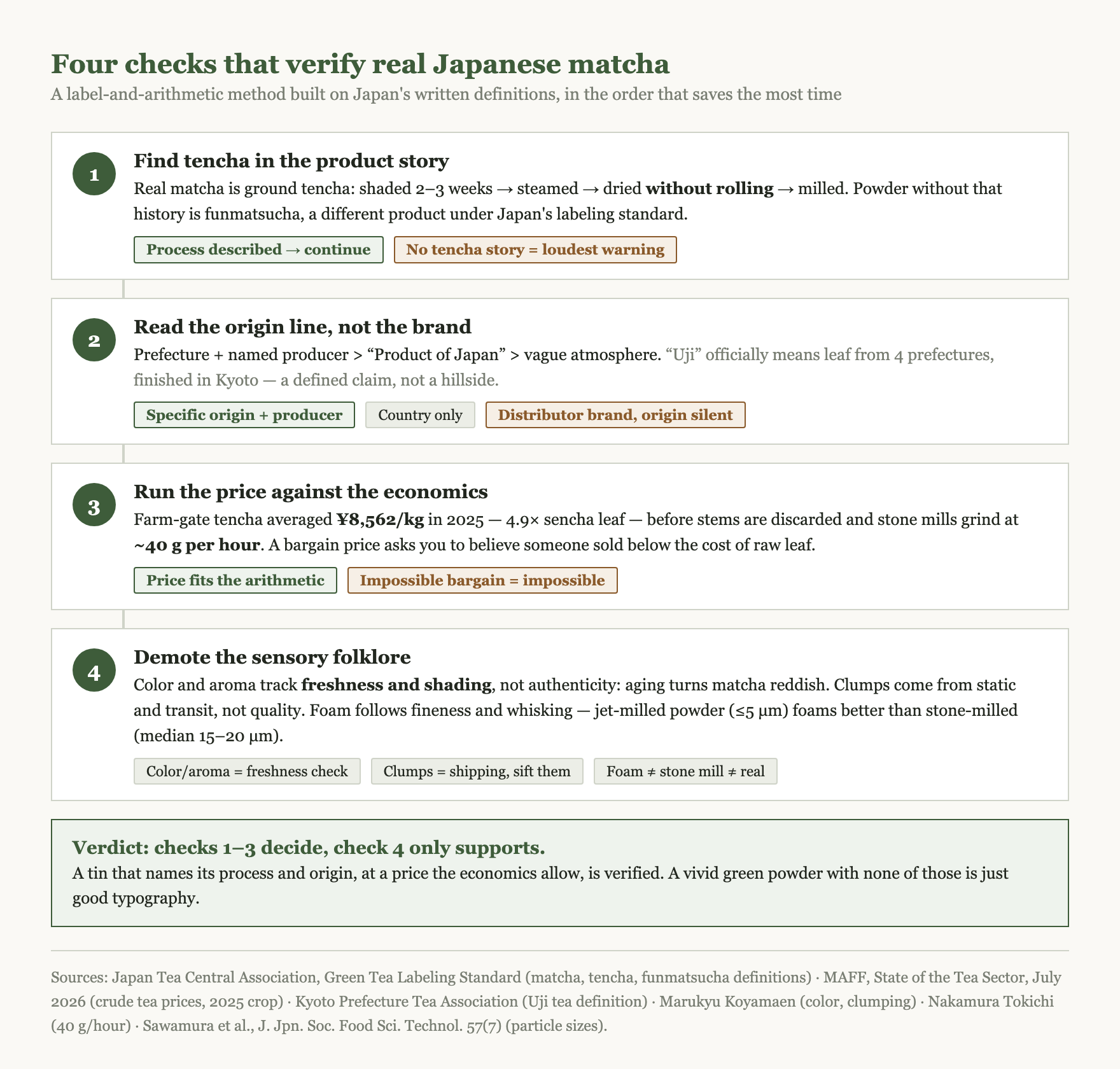
That single fact reorganizes the whole “real vs fake” question. You are not trying to judge a powder by eye. You are checking whether a product traces back to tencha. Four checks do most of the work:
- Look for tencha in the product story. Shade-grown, steamed, unrolled, milled. A seller of the real thing almost always says so, because the process is the cost.
- Read the origin line, not the brand. A Japanese-sounding name proves nothing. The origin declaration is the part regulators care about.
- Run the price against the economics. The raw material for matcha traded at 4.9 times the price of regular sencha leaf at the farm gate in 2025. Milling it is slower than you think. Very cheap “Japanese matcha” fails arithmetic before it fails a taste test.
- Treat color, foam, and clumping as weak signals. Each has a real basis and a failure mode. Measured data below.
The rest of this article gives you the actual wording, the label anatomy, and the numbers.
The definition, in writing
The Japan Tea Central Association publishes the green tea labeling standard used across the industry. Its table of tea names defines matcha in one sentence:
Matcha: tencha (tea leaves grown under cover and dried in a tencha furnace or similar, without rolling) manufactured into a fine powder with a tea mill or similar equipment.
An attached note pins down tencha itself: leaves picked from a “covered garden” shaded for about two to three weeks before harvest with reed screens, straw mats, or shading cloth, steamed, then dried without rolling. For scale, the same standard gives gyokuro about twenty days of shading and kabusecha about seven. Tencha sits at the long end of Japan’s shading spectrum, and what shading does to the leaf is a story of its own.
The same table defines the lookalike. Funmatsucha, powdered tea, is “tea made into powder by a grinder or similar.” Powdered sencha lands there. So does any green powder that never went through shading and unrolled drying. The standard also names a third category people confuse with both: konacha, the fine siftings from sencha finishing that sushi restaurants brew, which is not a powder you whisk at all.
Two details in the fine print are worth knowing, because they cut against popular assumptions.
A stone mill is not legally required. The note says the tea mill is the traditional stone mill, and then adds that equipment with equivalent function counts, regardless of grinding method. Stone milling is the craft benchmark, not the legal boundary. Keep that in mind for the particle-size myth below.
Cheap matcha can still be real matcha. The note recognizes tencha from autumn harvests and similar leaf, dried the tencha way, as food-processing tencha, the raw material for the matcha in your ice cream and lattes. Lower grade is not the same as fake. The line the standard draws is process, not price.
Since 2023 this definition has an international echo. ISO 20715, the standard that classifies tea types, gives matcha its own entry: tea made from shade-grown tender leaves, steamed, dried without rolling, and finely ground. A year earlier, ISO technical report 21380, prepared with Japan’s national agricultural research organization NARO leading, documented matcha’s definition and production for exactly this reason: powders sold abroad as “matcha” that no Japanese producer would recognize. A full ISO product standard, with chemical composition requirements, is in development.
One honest caveat. The Japanese standard is an industry standard for products sold in Japan. It does not police a tin packed in a third country and sold on a marketplace. That is precisely why the verification burden lands on you, and why the next section matters most.
Reading the label like a Japanese buyer
Tea sold in Japan carries a standardized label block, and the origin rules are strict in a way that transfers directly to your shopping abroad.
- Domestic tea finished in Japan declares its leaf origin: “green tea (Japan)” or a specific prefecture, like Kyoto or Kagoshima.
- Tea finished abroad and imported carries a country of origin line naming that country, with the importer listed.
- Blends list leaf origins in weight order. A regional name like “Uji” on the front requires at least 50 percent of the leaf from that region, and regional naming is reserved for domestic tea.
The working principle: the brand is decoration, the origin line is the claim. A company name and a Japanese aesthetic tell you who sells the tea. Only the origin declaration tells you where the leaf grew, and a seller who knows the answer will print it.
Applied to an overseas listing, the same principle becomes a ladder. A named prefecture and producer beats “Product of Japan.” “Product of Japan” beats “Japanese-style” or silence. If the only company named is a distributor and the origin is vague, you are holding a mystery powder with nice typography.
Two region-name traps deserve their own lines.
“Uji” does not mean grown in Uji. The Kyoto Prefecture Tea Association defines Uji tea as tea grown in Kyoto, Nara, Shiga, or Mie prefectures, finished within Kyoto by Kyoto businesses, with Kyoto-grown leaf given priority. That is the official definition, four prefectures wide. It reflects how the region’s blending tradition actually works, and it surprises almost everyone who assumed a single sacred hillside. I unpacked the terroir behind this in the Uji, Nishio, and Yame comparison, and the Uji name gets a full treatment, with the prefecture’s production numbers, in the Uji matcha guide.
Geographic protection can quietly disappear. “Nishio Matcha,” from Japan’s other historic matcha region, was registered under the national geographical indication system in 2017 and removed in 2020 at the producers’ own request, the first removal in the program’s history. The register currently has no Nishio matcha entry. A protected name on old packaging may no longer be protected. Labels have version histories, like software.
And one term you will not find in any Japanese standard: “ceremonial grade.” Japanese makers sort matcha by use, thin tea, thick tea, food processing. The ceremonial and culinary vocabulary was built for export marketing, a point several honest overseas sellers now concede in their own guides.
The myths, measured
English-language “spot fake matcha” guides lean on sensory tests. Japanese producers and food scientists have published enough measured data to sort the useful signals from the folklore.
The fineness myth. Overseas guides commonly claim high-quality matcha runs 1 to 10 microns and that stone milling is what achieves it. A study in the journal of the Japanese Society for Food Science and Technology, by researchers at Ito En and two universities, measured commercial grinding methods directly. Stone-milled matcha showed a median particle size of 15 to 20 microns, with the largest particles above 50. Jet-milled matcha came in under 5 microns. The finest powder in the study was not the stone-milled one. Fineness is a texture choice, not a fingerprint of tradition, and the labeling standard, remember, does not mandate the stone mill anyway. A powder can be silky and fake, or authentic and measurably coarser than the marketing number.
The foam myth. The same study found the ultra-fine jet-milled powder foamed better than coarser grinds. Foam quality also depends on your whisking, your water, and the amount of powder. A good crema-like head tells you the particles are fine and you whisked well. It does not tell you the leaf was tencha.
The clumping contradiction. One overseas seller argues clumping proves ultra-fine, high-grade powder. Another lists clumping as a sign of fake matcha. They cannot both be right, and neither is. Marukyu Koyamaen, a Kyoto producer milling matcha since 1688, states plainly that clumps form through static electricity and vibration in transit, that quality is unaffected, and that you should sift before whisking. Clumps mean the powder traveled. That is all.
The color half-truth. Color is the least useless of the sensory tests, and still not sufficient. The real version: shading raises chlorophyll, so fresh, well-shaded matcha is a vivid deep green, and top grades shaded under traditional straw-topped canopies are the most vivid of all. The same producer notes the failure mode: as matcha ages or degrades, the green shifts reddish and the shading aroma decays with it. So a dull, yellowish powder is telling you something, but it cannot distinguish “never was tencha” from “was excellent tencha, stored badly.” There is also a wrinkle almost nobody abroad mentions: in Japan’s baking-supply market, matcha blended with chlorella, an algae powder that slows color fading, is sold openly as a labeled product, ingredients declared. Vivid green in a finished sweet does not even prove the matcha was vivid. I searched for documented enforcement cases of undeclared coloring in matcha sold as pure and found none, so I will not repeat the horror stories as fact. The lesson stands anyway: color supports a verdict, it never delivers one.
The organic shortcut. JAS, USDA, and EU organic seals certify how the tea was farmed: no synthetic pesticides or fertilizers under the scheme’s rules, verified by a third party. Valuable, and orthogonal to authenticity. The organic rules say nothing about shading, unrolled drying, or tencha furnaces. Organic powdered sencha is a legal, certifiable, non-matcha product. Organic proves clean farming, not matcha.
The price floor
Marketing can imitate everything above. It cannot imitate cost structure.
Start at the farm gate. In Japan’s 2025 crop year, tencha averaged 8,562 yen per kilogram of crude tea, against 1,746 yen for sencha, a 4.9-times gap in the agriculture ministry’s own summary. That is the price of the raw, unfinished leaf, before stems and veins are sorted out, a step that discards part of what was bought, and before milling. Traditional stone mills grind about 40 grams per hour. Per mill. Uji’s Nakamura Tokichi, in business since 1854, publishes that number, which is why serious mills run by the hundreds, around the clock.
Then add the current squeeze. First-flush prices in the 2026 season traded at roughly double the prior year in Kagoshima and about 70 percent higher in Shizuoka. Demand is pulling hard from abroad: Japan’s green tea exports hit a record 72.1 billion yen in 2025, and 85 percent of the volume shipped to the United States was powdered tea.
Now the supply side nobody prints on a tin. China produced 89 percent of the world’s green tea in 2023; Japan produced 3.5 percent. A single Chinese city, Tongren in Guizhou, hosts a plant built in 2017 with invited Japanese expertise and a 4,000-ton annual matcha-style capacity, and the city’s official target for 2026 is more tencha-style leaf than 40 percent of Japan’s entire national tencha crop. None of this makes Chinese powder inherently bad tea. It means the arithmetic is unforgiving: most of the world’s green tea powder cannot be Japanese, and genuinely Japanese tencha keeps getting more expensive. A bargain-priced “Japanese matcha” large bag is asking you to believe someone bought leaf at record prices, discarded the stems, milled it at 40 grams an hour, shipped it across an ocean, and sold it below cost.
When a price looks impossible, it usually is exactly that.
What you can do today
The five-check routine, in the order that saves you the most time:
- Search the listing for “tencha,” or its process. Shade-grown, steamed, dried without rolling, then milled. No tencha story anywhere is the loudest single warning sign.
- Find the origin line. Prefecture named beats “Product of Japan,” which beats atmosphere. Weight the claim by who makes it: a named producer with an address outranks a distributor brand.
- Sanity-check the price per gram. Compare against the farm-gate reality above, not against other listings, which may share a supplier and a fiction.
- Demote the sensory folklore. Use color and aroma to judge freshness, not authenticity. Sift your clumps without reading meaning into them. Enjoy the foam you earned by whisking.
- Protect what you verified. Degradation mimics fakery. Ippodo, selling tea in Kyoto since 1717, recommends keeping an opened bag sealed at room temperature, away from light, strong smells, and humidity, and finishing it within about three weeks. Freeze only unopened packages, and bring them fully back to room temperature before opening so condensation does not ruin the powder. A tin that disappoints months after opening was not necessarily fake in January.
A closing thought on what “real” buys you. The definition you now know is not gatekeeping for its own sake. Every clause, the weeks of shade, the unrolled leaves, the dedicated furnace, exists because it changes what ends up in your bowl. Once you can verify those clauses from a label and a price tag, the arguing reviews stop mattering. You can read the tin yourself.
Related reading
- Why Is Matcha Sold Out? The shortage that makes these checks worth running, with Japan’s own supply numbers.
- Sencha vs Matcha What shading does to the leaf, the caffeine arithmetic, and the full price gap between the two teas.
- Uji vs Nishio vs Yame Matcha The terroir behind the region names on the tin, and who actually grows Japan’s tencha.
- Types of Japanese Green Tea Where tencha, matcha, and powdered tea sit among Japan’s 17 official tea names.
Sources
Definitions and public institutions:
- Japan Tea Central Association, Green Tea Labeling Standard (PDF): https://www.nihon-cha.or.jp/pdf/hyoujikijyun.pdf
- Japan Tea Central Association, tea names annex with the matcha and tencha note (PDF): https://www.nihon-cha.or.jp/pdf/meisyou180710.pdf
- ISO 20715:2023, Tea — Classification of tea types: https://www.iso.org/standard/75419.html
- Tea Media Corporation, commentary quoting the ISO 20715 matcha definition: https://www.teamedia.co.jp/blog_166/
- NARO press release, ISO/TR 21380:2022 Matcha tea — Definition and characteristics: https://www.naro.go.jp/publicity_report/press/laboratory/nifts/152224.html
- MAFF, “State of the Tea Sector,” July 2026 edition (crude tea prices, exports, HS powdered-tea split, PDF): https://www.maff.go.jp/j/seisan/tokusan/cha/attach/pdf/ocha-187.pdf
- House of Councillors research bureau, “Expanding Tea Exports: Matcha Supply” (world production shares, Tongren capacity, PDF): https://www.sangiin.go.jp/japanese/annai/chousa/rippou_chousa/backnumber/2025pdf/20251202087.pdf
- Kyoto Prefecture Tea Association, Uji tea definition (Q&A): https://ujicha.or.jp/knowledge/qa/
- MAFF, geographical indication register (no current Nishio matcha entry): https://www.maff.go.jp/j/shokusan/gi_act/register/index.html
Research:
- Sawamura et al. (Ito En / Seinan Jo Gakuin University / Yamaguchi Prefectural University), “Physical properties and morphology of matcha ground by different methods,” Journal of the Japanese Society for Food Science and Technology, Vol. 57 No. 7: https://www.jstage.jst.go.jp/article/nskkk/57/7/57_7_304/_article/-char/ja/
Producers and market:
- Marukyu Koyamaen, matcha knowledge page (color, shading aroma, clumping, storage): https://www.marukyu-koyamaen.co.jp/about-tea/know-matcha.html
- Nakamura Tokichi, stone milling vs machine grinding (40 g per hour): https://tokichi.jp/en/blogs/life-with-cha/matcha-processing-difference
- Ippodo support, recommended storage: https://support.ippodo-tea.co.jp/hc/ja/articles/360003061416
- Petitpas matcha powder with chlorella, baking-supply listing (labeled color-retention blend): https://seika.ocnk.net/product/1025