This article may contain affiliate links. If you buy through them, I may earn a small commission at no extra cost to you.
Uji Matcha: An Honest Guide to Japan's Most Famous Tea Name
Published 2026-08-05
Every premium matcha shelf has a tin that says Uji. The price is higher, the packaging is calmer, and the description mentions eight hundred years of history. You are left to guess what you are actually paying for: a place, a brand, or a mood.
Uji is a real place, and the name has a defined trade meaning, but almost nothing about it works the way the marketing implies. I live in Japan and work with the people who grow and sell Japanese tea. This guide walks through what the prefecture’s own statistics, the heritage records, and one remarkable soil study say about Japan’s most famous tea name, and what the current price surge is doing to it.
The short answer
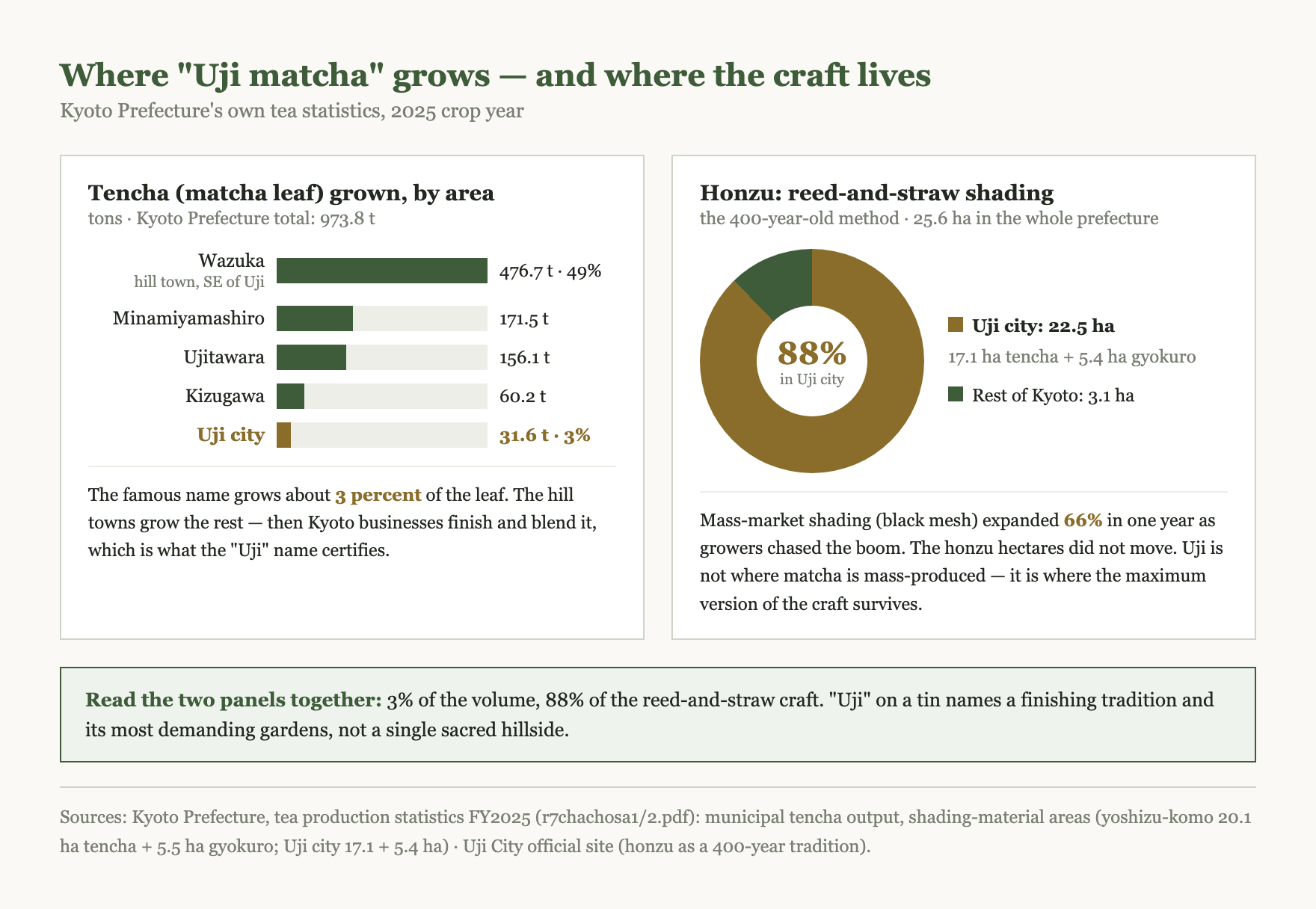
“Uji matcha” is not matcha grown in Uji city. Under the official definition, Uji tea is leaf grown in Kyoto, Nara, Shiga, or Mie prefectures, finished within Kyoto by Kyoto businesses. The leaf mostly grows in hill towns southeast of Uji. In the 2025 crop year, the town of Wazuka alone grew 49 percent of Kyoto Prefecture’s tencha, the leaf that becomes matcha. Uji city grew 3 percent.
So is the name hollow? No, and this is the part the skeptical take misses. Three things really do live in Uji and its region, and they are the substance behind the price:
- The craft was invented here. Shading tea, the step that makes matcha matcha, started in this area. A recent soil study dates it even earlier than the written record says.
- The rarest version of the craft survives here. Traditional reed-and-straw shading, called honzu, covers just 25.6 hectares in the entire prefecture. Uji city holds about 88 percent of it.
- The finishing is the product. Uji is where growers’ tencha becomes a house’s matcha, through a blending culture with its own name, its own masters, and its own national competition.
The rest of this guide gives you the history that checks out, the production map, the craft, and the numbers behind the current squeeze.
The history that actually checks out
Uji’s story is usually told in round numbers and legends. The record is better than the legends, and more interesting.
The founding legend, labeled as one. Japan’s Agency for Cultural Affairs certified this region’s tea story as one of the country’s first official Japan Heritage designations in 2015. Its telling is careful: in the 13th century, the monk Myoe is said to have taught Uji villagers to plant tea brought from China by the Zen master Eisai. That “said to” matters. The transmission story is tradition, not documented fact, and honest Japanese sources flag it.
The seven gardens, and the one survivor. In the Muromachi period, the shogun Ashikaga Yoshimitsu had seven famous tea gardens planted in Uji. Six are gone under streets and houses. One, Oku-no-Yama in the Zenpo district, still grows tea today, and its tea trees are listed among Uji’s hundred notable trees.
The soil that rewrote the date. The written record says shading cultivation began in the late 16th century, when growers covered fields with screens woven from reeds of the nearby Ogura pond, at the urging of tea masters like Sen no Rikyu. Then researchers from Kyoto Prefectural University and colleagues went digging, literally, in the surviving Oku-no-Yama garden. Radiocarbon dating and plant-silica analysis of the soil layers found traces of shading practice from roughly 1396 to 1440, about 150 years before the documents. The one garden that survived from the Middle Ages carried evidence that the craft is older than its own paper trail. Almost no English article has ever mentioned this study.
From matcha to everything else. The region kept inventing. In 1738 Nagatani Soen, a farmer in neighboring Ujitawara, worked out the hand-rolling method that became modern sencha. Combine his method with Uji’s shading and you get gyokuro. The Japan Heritage story’s summary is blunt: this one small region gave Japan matcha, sencha, and gyokuro. Tokugawa shoguns institutionalized the prestige, with annual processions carrying sealed jars of Uji tea to Edo. And through all of it, since 1160, the Tsuen teahouse has stood at the east end of the Uji bridge, run today by the 24th generation of the same family, in a building from 1672. It is a strong candidate for the oldest tea shop on earth.
Where Uji matcha actually grows
The Kyoto prefectural government publishes detailed tea statistics every year. English guides never quote them. Here is the 2025 crop year, from the prefecture’s own tables:
| Area | Tencha grown (tons) | Share of Kyoto |
|---|---|---|
| Wazuka town | 476.7 | 49% |
| Minamiyamashiro village | 171.5 | 18% |
| Ujitawara town | 156.1 | 16% |
| Kizugawa city | 60.2 | 6% |
| Uji city | 31.6 | 3% |
| Kyoto Prefecture total | 973.8 | 100% |
Wazuka, a fog-prone hill town of tea terraces an hour southeast of Uji, grows roughly half of Kyoto’s matcha leaf. Uji city itself, mostly urbanized, farms about 74 hectares of tea. What Uji city does grow is telling: mainly tencha and gyokuro, the two shaded luxury teas, and it ranks second in the prefecture for gyokuro despite its tiny area. The city’s own tea page says most of its gardens are still picked by hand.
Remember the definition from the verification guide: Uji tea may legally come from four prefectures, as long as Kyoto businesses finish it in Kyoto. The prefecture’s numbers show even the Kyoto-grown share is mostly not from Uji city. None of this is scandal. It is how a finishing-and-blending hub has worked for centuries, the same way Champagne houses press grapes from many villages. But it does mean “Uji” on a tin names a tradition and a supply chain, not a hillside, and a seller who implies otherwise is selling you the mood. Kyoto’s leaf does command a real premium, which the three-region comparison covers in detail.
The last honzu gardens
Shading is what turns tea leaf into matcha material. Modern gardens use black chemical-fiber mesh, either draped directly on the bushes or spread on frames. The original method, honzu, builds a full scaffold over the garden, lays woven reed screens across it, then scatters rice straw on top, adjusting the light leaf by leaf. Uji city’s official page calls it a tradition of more than 400 years and notes, plainly, that it survives only in places.
The prefecture’s statistics put a number on “only in places.” Reed-and-straw shading covered 25.6 hectares in all of Kyoto Prefecture in 2025: 20.1 for tencha, 5.5 for gyokuro. Of that, Uji city holds 22.5 hectares, about 88 percent. Read those two facts together. Uji city grows 3 percent of Kyoto’s matcha leaf, but nearly nine-tenths of the leaf raised the medieval way, under reeds and straw, much of it in the Shirakawa district the Japan Heritage listing singles out, and much of it hand-picked. The economics of the name suddenly make sense: Uji is not where matcha is mass-produced, it is where the maximum version of the craft is kept alive.
The same table shows the boom’s other face. Cheap direct-cover tencha area in the prefecture jumped 66 percent in a single year as growers rushed toward matcha demand. Mass tencha is expanding fast, elsewhere. The honzu hectares did not move at all.
Varieties, and the blender’s art
Two more layers of Uji’s substance are invisible on an English label.
The genetics are local. The backbone cultivars of high-grade matcha were selected from Uji’s native seedling population, called Uji zairai. Asahi, registered in 1954 from a selection by farmer Hirano Jinnojo, and Samidori, from a selection by Koyama Masajiro, remain the elite tencha cultivars, prized for competition-grade matcha. Gokou and Ujihikari came from the prefecture’s tea research institute the same year. When you drink good matcha from anywhere in Japan, there is a fair chance its cultivar’s family tree runs through Uji.
The blend is the finished art. In Uji’s trade, the tea master, chashi, combines tencha lots from different growers, districts, and cultivars into a house blend. The practice is called gougumi. A working Uji wholesaler explains it without romance: tea varies by cultivar, field, method, grower, and weather, so buying identical tea every year is impossible; blending is how a house keeps its signature taste, its ajisuji, stable anyway. The skill has its own national arena, an annual judging competition held since the 1950s where professionals identify cultivar, harvest period, and growing region by eye, nose, and palate, working toward ranks that top out at tenth dan. Western matcha marketing borrowed “single origin” from coffee and treats blends as a compromise. In Uji the hierarchy runs the other way: the blend is the finished product, and the single lot is an ingredient. Neither view is fake. They are different definitions of what a tea is supposed to be.
The boom, measured in Uji’s own market
You have probably read that matcha is scarce. Kyoto’s own auction table shows what that means at the source. The average first-flush tencha price in the prefecture ran 5,966 yen per kilogram in 2023 and 7,356 yen in 2024. In 2025 it hit 17,124 yen, two and a third times the prior year, blowing past the previous record of 10,795 yen set at the peak of the bubble economy in 1989.
The houses responded in public. Marukyu Koyamaen, one of Uji’s largest matcha makers, announced that demand had far exceeded its production capacity and limited customers to one matcha item per person at its directly run shops from March 2025. Ippodo in Kyoto city set purchase limits back in 2024 and has publicly warned about bulk-buying for resale. Meanwhile Uji city logged 6.19 million visitors in 2025, an all-time record. More demand, flat supply of the good stuff, and a finite number of honzu hectares: the price of real Uji matcha is not a mystery.
For you as a buyer, three practical consequences. Expect prices to keep moving. Treat purchase limits at famous houses as a sign of health, not failure. And be suspicious of abundant, cheap “Uji” powder in marketplaces while the source city rations tins, then run it through the verification checklist.
Visiting and buying
Uji is thirty minutes by train from Kyoto station, and it is one of the few places where you can watch the whole story in an afternoon. The houses below are the established names, with founding dates from their own records:
| House | Since | Where | Worth knowing |
|---|---|---|---|
| Tsuen | 1160 | Uji bridge, east end | 24th-generation teahouse, building from 1672 |
| Kanbayashi Shunsho | Eiroku era (1558–69) | Uji | Descendants of the shoguns’ tea officials, small museum |
| Marukyu Koyamaen | Genroku era (1688–1704) | Uji (Ogura) | Factory tours by reservation, English online shop that ships overseas |
| Ippodo | 1717 | Kyoto city, not Uji | Great tea, often mistaken for an Uji house |
| Itohkyuemon | 1832 | Uji | Matcha sweets empire, ships to over 100 countries via proxy |
| Nakamura Tokichi | 1854 | Uji | Tencha-grinding experience in a preserved merchant house |
Two notes from that table. The founding dates cluster in eras, not years, because that is how the houses themselves record them; treat any English site quoting a suspiciously exact year with care. And Ippodo, wonderful as it is, is a Kyoto-city house. “Bought in Kyoto” and “Uji house” are already two different claims, which is a small taste of how slippery the label gets by the time it reaches an export listing.
For the full ritual on a budget, the city runs its own tearoom, Taiho-an, behind the Byodo-in temple, where a bowl of properly whisked Uji matcha with a seasonal sweet costs less than a tourist-street parfait. The temple on the 10-yen coin, the 1160 teahouse, a working honzu district, and the tea are all within a fifteen-minute walk of each other.
Uji rewards the same habit as every other topic on this site: ignore the mood, read the definitions, and follow the numbers. The mood, for once, turns out to be backed by 25.6 very real hectares.
Related reading
- Why Is Matcha Sold Out? What the squeeze looks like nationally, and where it is already easing.
- How to Tell Real Japanese Matcha The verification method: definitions, labels, and the price arithmetic.
- Uji vs Nishio vs Yame Matcha How Japan’s three historic matcha regions actually differ, with the national production numbers.
- Types of Japanese Green Tea Where tencha, gyokuro, and matcha sit among Japan’s 17 official tea names.
Sources
Public institutions and statistics:
- Agency for Cultural Affairs, Japan Heritage story “800 Years of Japanese Tea History”: https://japan-heritage.bunka.go.jp/ja/stories/story009/
- Kyoto Prefecture, tea production and distribution statistics, FY2025 edition, part 1 (shading materials by area, PDF): https://www.pref.kyoto.jp/nosan/documents/r7chachosa1.pdf
- Kyoto Prefecture, tea statistics part 2 (municipal rankings, first-flush price series, PDF): https://www.pref.kyoto.jp/nosan/documents/r7chachosa2.pdf
- Uji City, tea production in Uji (tencha and gyokuro focus, honzu, hand-picking): https://www.city.uji.kyoto.jp/site/uji-cha/16203.html
- Uji City, the seven famous tea gardens of Uji: https://www.city.uji.kyoto.jp/site/uji-kankou/14231.html
- Uji City, tourism statistics: https://www.city.uji.kyoto.jp/soshiki/24/85921.html
- Inoue et al., “Estimating the onset of shaded tea cultivation from tea garden soil in Uji, Kyoto,” Japanese Journal of Soil Science and Plant Nutrition, Vol. 90 No. 6: https://www.jstage.jst.go.jp/article/dojo/90/6/90_900602/_article/-char/ja/
- Kyoto Prefecture Tea Association, Uji tea definition (Q&A): https://ujicha.or.jp/knowledge/qa/
- Kyoto Prefecture Tea Association, Uji cultivars (Asahi, Samidori, Gokou, Ujihikari): https://ujicha.or.jp/knowledge/flow/hinshu/
- Kyoto Tea Cooperative, national tea judging competition and Uji tea fair: https://kyocha.or.jp/pubinfo/
- Nihoncha Seikatsu, on the national judging competition and dan ranks: https://nihonchaseikatsu.com/introduce/touchakai/
- Ochano Kyoto (Japan Heritage site), Nagatani Soen’s birthplace and the 1738 method: https://ochanokyoto.jp/nihon-isan/cultural-property/detail.php?sid=749
Producers and local bodies:
- Hekisuien (Uji wholesaler), on gougumi blending and ajisuji: https://ujicha.co.jp/blend/
- Tsuen, official history (founded 1160): https://tsuentea.com/pages/history
- Marukyu Koyamaen, company history (Genroku founding): https://www.marukyu-koyamaen.co.jp/company.html
- Marukyu Koyamaen, matcha purchase limits from March 19, 2025: https://www.marukyu-koyamaen.co.jp/information/news-2956/
- Marukyu Koyamaen, international online shop FAQ: https://www.marukyu-koyamaen.co.jp/english/shop/faq
- Ippodo, purchase limits notice (October 2024): https://www.ippodo-tea.co.jp/blogs/news/matcha_restriction
- Ippodo, on continued shortages and resale concerns (August 2025): https://www.ippodo-tea.co.jp/blogs/news/20250801
- Ippodo, company history (founded 1717, Kyoto city): https://www.ippodo-tea.co.jp/pages/about
- Kanbayashi Shunsho, house history (Eiroku founding, tea officials): https://www.shunsho.co.jp/history/
- Itohkyuemon, company profile (founded 1832): https://www.itohkyuemon.co.jp/corporate/about/
- Nakamura Tokichi, company profile (founded 1854): https://tokichi.jp/pages/company-profile
- Uji City Tourism Association, Taiho-an municipal tearoom: https://www.kyoto-uji-kankou.or.jp/taihoan.html