This article may contain affiliate links. If you buy through them, I may earn a small commission at no extra cost to you.
Why Is Matcha Sold Out? Japan's Own Numbers, 2026
Published 2026-08-06
You went to reorder your usual tin. The button said sold out. Or the price had doubled, or the tin now holds fifteen grams where it held twenty. If you buy for a café, your supplier moved you to a substitute and would not promise a date.
I live in Japan and work with the people who grow and sell Japanese tea. Most English coverage of this shortage tells you the same three things: demand exploded, tea takes five years to grow, and relief is not coming until around 2030. Two of those are half true and the third has no source I can find. Japan publishes a great deal of data about its own tea, and not one of the thirteen English articles I checked cites any of it. This is what it says, as of August 2026.
The short answer
Four things are true at once, and English coverage usually gets only the first.
Demand outran supply, badly. Japan’s green tea exports hit 72.1 billion yen in 2025, up 98 percent in a single year. Powdered tea, which is mostly matcha, was 69 percent of the volume and 84 percent of the value.
Japanese supply did not fail. Tencha, the shaded leaf that gets ground into matcha, went from 1,969 tonnes in 2014 to 6,278 tonnes in the 2025 crop, a 3.2-fold rise. The English coverage I read treats Japanese supply as fixed. Japan tripled it, and demand still outran it.
The scarcity did not stay inside matcha. Growers switched to tencha because it pays about five times what sencha, ordinary leaf tea, pays. What they switched away from is now the scarcest thing on the shelf. It is bancha, the coarse everyday leaf picked later in the year, and hojicha, the roasted tea made from it.
And the squeeze is already easing in two measurable places, which I will come to at the end.
What is actually scarce
“Matcha” in English covers two markets that behave differently, and Japanese makers price them separately.
Real matcha is ground tencha: leaf shaded for two to three weeks, steamed, dried without rolling, then milled. Everything else ground green is funmatsucha, powdered tea, under the industry’s labeling standard. The verification method covers that line in detail. Within real matcha, makers sort by intended use, not by the “ceremonial” and “culinary” vocabulary invented for export.
Watch what one maker did in July 2026. Aoi Seicha in Nishio announced that food-processing matcha would rise roughly 1.3 to 1.5 times from September, and in the same notice held the price of its tea-ceremony matcha flat, organic grades excepted, calling it a thank-you to long-standing customers. One company, two grades, opposite decisions.
Aiya’s online shop, in the same month, published a four-tier limit list: ten brands with no purchase limit at all, two capped at five per order, three capped at one, and nine moved to make-to-order with a two-week wait. That is a market rationing its top end, not a market that has run dry.
Why supply cannot answer quickly
Here is where the English explanation stops at “tea takes five years.” The real constraints are more specific, and each one has a number.
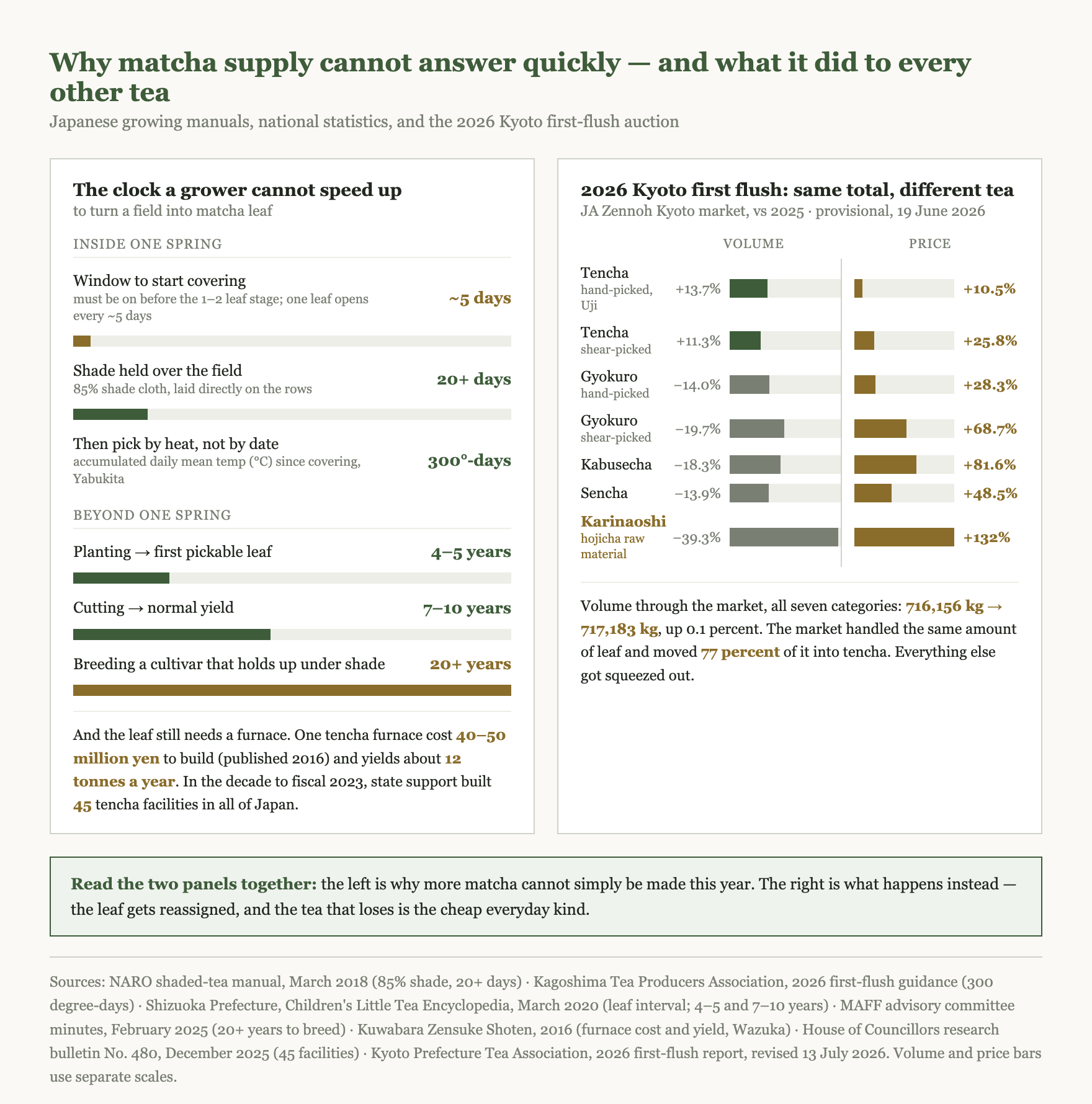
The decision window is about five days, once a year. To make tencha you must cover the field with 85 percent shade cloth before the new shoots reach the one-to-two-leaf stage, then hold it for at least twenty days. Shizuoka’s tea primer notes that the first leaf opens about two weeks after budding, and then roughly one new leaf every five days. Miss the window and you get kabusecha, briefly shaded leaf, or plain sencha. Harvest timing is not set by the calendar either. Kagoshima’s growers’ association tells farmers to pick when accumulated daily mean temperature since covering reaches about 300 degree-days, measured in Celsius, for the standard Yabukita cultivar.
Shading is the heaviest job on the farm and cannot be mechanized. Ministry field surveys put covering at 18 percent of field labor hours, tied for first with picking and pruning. The reason it stays manual is mundane: nobody has solved anchoring the material reliably. Japan’s target for practical labor-saving covering technology is 2030.
Shading costs the plant, and the bill arrives next year. The shading manual used by Japanese growers is blunt about it. Covering suppresses photosynthesis and growth, and repeated covering across seasons or across years can leave mature leaves unable to recover, hurting the following year’s crop. The manual includes a formal decision protocol for skipping next year’s shading, using starch content in the branches and canopy surface temperature as the tests. Matcha is not a switch a grower can hold down.
Old bushes cannot take it. Shade a thirty-year-old tea field and you lose both yield and quality, so converting means replanting. Of the tea gardens the agriculture ministry surveyed, about 39 percent are over thirty years old. Japan’s replanting support program has covered 7,272 hectares since 2011, roughly a fifth of the planted area, in fifteen years.
Replanting is slower than five years. Shizuoka’s primer gives the honest version: four to five years from planting to picking anything, and seven to ten years from the original cutting to a normal yield. Breeding a new cultivar takes over twenty years, according to a specialist speaking at the ministry’s advisory committee. Seimei, the cultivar developed to hold quality under shade, covered 130 hectares in 2023. That is 0.4 percent of Japan’s tea fields.
And then you need a furnace. Tencha needs a dedicated dryer, and it is not a machine you order like a mixer. A tea wholesaler’s survey of Wazuka, the Kyoto hill town that grows about half of the prefecture’s tencha, put the build cost of one furnace at 40 to 50 million yen when it was published in 2016, and calculated that one furnace yields roughly 12 tonnes of tencha a year. Whole lines cost more. Shizuoka’s grant records for fiscal 2024 list a tencha processing line at 117 million yen at one site and 373 million at another.
Two details make that worse. The line runs only during the picking season; one manufacturer states plainly that afterward the machines will not run again for months, and for hand-picked tencha, not until the following year. And in the decade to fiscal 2023, government support built 45 tencha processing facilities in all of Japan.
The chart below puts that clock next to what actually happened at Kyoto’s auction this spring. The next two sections take both apart.
The tea that got hit hardest is not matcha
This finding reorganizes the whole story, and it comes from a Kyoto tea house’s notice rather than any statistic.
Ippodo published a statement in February 2026 explaining the mechanism. Growing matcha from the first flush means shading the plant, which stresses it. So the second flush is often skipped, letting the bush recover for the following year’s matcha. The second flush is the raw material for bancha. Recent extreme summers make the work harder still.
Then Ippodo did the arithmetic in public. In the 2025 crop, average Kyoto first-flush prices ran 2.5 times the prior year and second-flush prices 2.9 times. Broken out by type, matcha rose 2.6 times while gyokuro, sencha, and bancha rose 1.3 to 1.8 times. Machine-picked Kyoto tencha averaged 14,141 yen per kilogram against 4,482 for sencha and 1,225 for bancha.
And then it discontinued six products from March 2026: premium hojicha, premium genmaicha, stem hojicha, a sencha, and two hojicha teabag sizes. One more was suspended with no restart date. The company’s stated worry for the future is not matcha. It is that bancha production falls sharply, and that even rising bancha prices will not pull production back, because matcha pays so much more.
The market data agrees. In Shizuoka, autumn-winter bancha, historically the cheapest leaf of the year, traded in the 2025 season at about seven times its five-year average. In Kagoshima it went further and passed the first flush: 431 yen per kilogram in 2024, and 3,403 yen on one day in October 2025, against 2,564 for first-flush leaf. Tea traders quoted by the local paper called it exceptional among exceptions.
Nakamura Tokichi, an Uji house, changed the origin of its stem hojicha in July 2025. Kyoto and Nara could no longer supply it reliably, the company said, because of erratic weather and because sencha fields there had converted to tencha. The blend now includes Kagoshima leaf.
The 2026 crop, and a correction worth knowing
Kyoto’s tea association published its first-flush auction results in June 2026, reporting Uji hand-picked tencha volume up 48.7 percent. Then it withdrew them. The association republished the report on 13 July 2026 with corrected prior-year baselines, and the real figure is up 13.7 percent. If you see 48.7 percent quoted anywhere, it comes from the superseded version.
The corrected table, as of 19 June 2026 and still provisional, tells a sharper story anyway. Volume is the left pair of columns, price the right.
| 2026 first flush, JA Zennoh Kyoto market | Volume vs 2025 | Price vs 2025 | Price (yen/kg) |
|---|---|---|---|
| Tencha, hand-picked (Uji) | +13.7% | +10.5% | 52,086 |
| Tencha, shear-picked | +11.3% | +25.8% | 17,797 |
| Gyokuro, hand-picked | −14.0% | +28.3% | 42,909 |
| Gyokuro, shear-picked | −19.7% | +68.7% | 14,249 |
| Kabusecha | −18.3% | +81.6% | 8,369 |
| Sencha | −13.9% | +48.5% | 6,657 |
| Karinaoshi (hojicha raw material) | −39.3% | +132% | 2,850 |
Volume through the market totaled 717,183 kg across those seven categories, against 716,156 kg the year before. The market did not handle more tea. It handled the same amount and moved 77 percent of it into tencha, by my calculation from the association’s figures. The prefecture’s own annual statistics show the same shift in land use for the 2025 crop year: tencha fields up 20.7 percent in one year, sencha fields down 35.4 percent, total tea area down. Kyoto’s unrefined tea output fell about a fifth while its value nearly doubled.
Hojicha raw material fell by 39 percent and more than doubled in price. That is the number explaining why your hojicha got expensive.
What you have probably read that is not right
“The first matcha shortage in history.” The Global Japanese Tea Association’s article says only that sales restrictions were “something unprecedented.” The stronger “first in history” line traces to a spoken remark in a news interview, not to the organization’s published analysis. Another English seller documents earlier Japanese matcha squeezes in 1996, when Häagen-Dazs Japan launched green tea ice cream, and again in 2001.
“Japan lost 53,000 tea farmers between 2000 and 2020.” The census figure 53,687 is the count of tea-growing operations in 2000, not the loss. The 2020 count was 12,325. The decline is about 41,400, and the ministry itself flags that the definition changed in 2020, so the two ends are not strictly comparable.
“Matcha is only 6 percent of Japan’s tea.” Tencha was 8.6 percent of Japan’s unrefined tea output in the 2025 crop, at 8,562 yen per kilogram against sencha’s 1,746. The 6 percent figure is several years stale.
“Full normalization around 2029 to 2030.” I looked for a Japanese primary source and did not find one. Not the agriculture ministry, not the House of Councillors research bulletin on matcha supply, not the Norinchukin Research Institute, not the Kyoto tea association, not any maker. The oldest English version I can trace states it as that site’s own forecast.
“Japan is cracking down on fake matcha.” Japan’s Consumer Affairs Agency has published no order against any tea product under the premiums and representations law in the six fiscal years through 2026. The agriculture ministry’s Kanto and Kinki regional bureaus list no tea labeling case either. Newspapers report that ground sencha is being sold as matcha, and I believe them, but no Japanese authority has published an enforcement action. The enforcement is happening in China, where two Uji makers filed jointly and a Suzhou regulator ordered five shops to take down signage and pay fines.
When does it ease
Nobody credible has named a year. The leading indicators are already turning in two places.
Buyers stopped buying at these prices. Japan’s green tea exports rose 83.5 percent in value in the first half of 2026, to 48.3 billion yen. Volume rose 7.4 percent. Almost the entire increase was price. Month by month it is starker: export volume fell 1.5 percent year on year in May and 14.0 percent in June. The exporters’ council summed up June by saying revenue rose because costs had been passed on, while orders collapsed, with some signs of recovery late in the month.
Sellers started lifting limits. Nakamura Tokichi removed its five-item cap entirely in January 2026, saying supply had stabilized. Ryuoen in Kyoto relaxed from one item per person to ten per month in May 2026. Aoi Seicha held its ceremony-grade prices in July. Marukyu Koyamaen is still the strict one, and maintains a public list of unauthorized resellers that it updated in August 2026.
Ippodo, in the English version of its February notice, put its view on record: it expects shortages to ease with time, and 2026 prices to stay near 2025 levels rather than climbing further. The same notice expects bancha to get worse. Those are not contradictory. The top of the market is finding its price, and the bottom of it is being abandoned.
One more thing worth holding onto. Prices began climbing with the 2024 crop and exploded in 2025, and Japanese tea farming still lost money along the way: income for tea operations went from a surplus of 30,607 yen per 1,000 square meters in 2023 to a deficit of 8,131 yen in 2024, as fuel, materials, and labor costs outran the gains. The number of tea processing businesses that closed or went under in 2025 was the highest on record, and the credit-research firm that counted them titled the report with the phrase “matcha popularity as a headwind.” The boom and the decline are happening to the same industry at the same time.
What to do about it
Buy by use, not by grade name. Japanese makers sort matcha by what it is for. For lattes and baking, processing grade is the category Japanese makers themselves point to, and it is where the price increases are landing hardest, so shop it on price. Save the drinking grades for drinking. The English “ceremonial” and “culinary” labels are export marketing and carry no standard.
Do not stockpile. Marukyu Koyamaen’s guidance says matcha discolors and degrades faster than any other green tea. Unopened and sealed with an oxygen absorber, it keeps well cold. Opened, it goes quickly. Both major Uji makers advise buying a size you will finish, and warn that a can taken straight from the freezer must come back to room temperature before opening, or condensation ruins it. A big tin bought in a panic becomes a small tin’s worth of good matcha and a lot of dull powder.
Widen your map. Kagoshima has grown the most tencha in Japan since 2020 and has been the country’s largest tea producer overall since the 2024 crop. At the 2026 opening auctions its first-flush leaf traded at roughly a third of Kyoto’s opening price. The three-region comparison covers what actually differs between growing areas.
Check the tin, not the story. If you are buying from a marketplace rather than a maker, Marukyu Koyamaen’s counterfeit notices give one test that costs nothing: on the fakes it has documented, the printed expiry date differs from the genuine format, and the ink wipes off.
Expect the label rules to keep moving. Japan’s only definition of matcha is an industry standard with no legal force, and it was revised on 10 July 2026. On the same day, “Japanese tea” was registered as a geographical indication covering all Japanese-grown, Japanese-processed green tea, the first such registration not tied to a specific region. The stated reason was Chinese-grown “Uji matcha” in circulation. Definition is moving faster than enforcement.
Related reading
- How to Tell Real Japanese Matcha The verification method: what the standard actually says, and which sensory tests do not work.
- Uji Matcha: An Honest Guide Where Uji matcha grows, and what the price surge is doing to the name.
- Hojicha Guide The roasted tea this shortage is quietly emptying off shelves.
- Types of Japanese Green Tea Where tencha, bancha, and matcha sit among Japan’s official tea names.
Sources
Government statistics and research:
- MAFF, “The State of the Tea Sector,” July 2026 edition (tencha output and price, export series, household consumption, garden age, replanting area, PDF): https://www.maff.go.jp/j/seisan/tokusan/cha/attach/pdf/ocha-187.pdf
- MAFF, 2025 agricultural export results, 3 February 2026 (green tea 72.09 billion yen, +98.2%, PDF): https://www.maff.go.jp/j/press/yusyutu_kokusai/kikaku/attach/pdf/260203-1.pdf
- MAFF, first-half 2026 export results, 4 August 2026 (green tea 48.25 billion yen, +83.5%, PDF): https://www.maff.go.jp/j/press/yusyutu_kokusai/kikaku/attach/pdf/260804-2.pdf
- MAFF, Basic Policy on the Promotion of the Tea Industry and Tea Culture, April 2025 (national policy to convert production to tencha, PDF): https://www.maff.go.jp/j/seisan/tokusan/cha/attach/pdf/230929-23.pdf
- MAFF, “Current State and Issues of the Tea Industry,” November 2024 (field labor share, household spending, PDF): https://www.maff.go.jp/j/seisan/tokusan/cha/attach/pdf/230929-4.pdf
- MAFF advisory committee minutes, second session, February 2025 (over twenty years to breed a cultivar, PDF): https://www.maff.go.jp/j/seisan/tokusan/cha/attach/pdf/230929-17.pdf
- MAFF, geographical indication registration No. 179, “Japanese tea,” 10 July 2026: https://www.maff.go.jp/j/press/yusyutu_kokusai/chizai/260710.html
- e-Stat, Crop Statistics, 2025 crop tea, planted area (confirmed figures, June 2026): https://www.e-stat.go.jp/stat-search/files/data?sinfid=000040469084&ext=xls
- e-Stat, Crop Statistics, 2025 crop tea, harvested area and output: https://www.e-stat.go.jp/stat-search/files/data?sinfid=000040469085&ext=xls
- House of Councillors Research Bureau, “Legislation and Research” No. 480, “Expanding tea exports: the state of matcha supply,” December 2025 (45 facilities, equipment costs, policy budgets, PDF): https://www.sangiin.go.jp/japanese/annai/chousa/rippou_chousa/backnumber/2025pdf/20251202087.pdf
- NARO consortium, Manual for Stable Production of Shaded Tea, March 2018 (shading periods, next-year avoidance protocol, PDF): https://www.naro.go.jp/publicity_report/publication/files/hihukucha-antei_man201803.pdf
- NARO, on the Seimei cultivar and why old bushes fail under shade, March 2025 (PDF): https://www.naro.go.jp/laboratory/brain/press/20250311_kobore_besshi_62.pdf
- Norinchukin Research Institute, “The Matcha Boom and Rising Sencha Prices,” 14 May 2026 (area and workforce series, tea farm income, autumn bancha prices, business closures, PDF): https://www.nochuri.co.jp/genba/pdf/otr20260514.pdf
- Shizuoka Prefecture, “Children’s Little Tea Encyclopedia,” March 2020 (leaf opening interval, four to five years to first pick, seven to ten to full yield, PDF): https://www.pref.shizuoka.jp/_res/projects/default_project/_page_/001/027/291/ochashoujiten.pdf
- Shizuoka Prefecture, fiscal 2024 production base grant projects (tencha line costs, PDF): https://www.pref.shizuoka.jp/_res/projects/default_project/_page_/001/026/990/r6_sanpajissitiku.pdf
- Kagoshima Tea Producers Association, 2026 first-flush production guidance (85 percent shade, 300 degree-days): https://kagoshima-cha.or.jp/skill/
- Kagoshima Tea Producers Association, on tencha output and the prefecture’s rank: https://kagoshima-cha.or.jp/knowledge/kagoshima-chagyo/
- Kyoto Prefecture Tea Association, 2026 Kyoto first-flush report, revised 13 July 2026 (PDF): https://ujicha.or.jp/wp-content/uploads/2026/07/【修正】2026年度茶価格の状況について.pdf
- Kyoto Prefecture, tea production and distribution statistics, FY2025 (garden area by type, output value, PDF): https://www.pref.kyoto.jp/nosan/documents/r7chachosa1.pdf
- Osaka Customs, special report on green tea exports, December 2025 (unit prices, why output cannot rise quickly, PDF): https://www.customs.go.jp/osaka/toukei/pdf/tokushu_202512.pdf
- Japan Tea Export Promotion Council, monthly export data (2026 volume turning negative): https://nihon-cha.or.jp/export/exporting
- Japan Tea Central Association, Green Tea Labeling Standard, revised 10 July 2026 (PDF): https://www.nihon-cha.or.jp/pdf/hyoujikijyun.pdf
- Consumer Affairs Agency, premiums and representations enforcement releases (searched FY2021 to FY2026, no tea cases): https://www.caa.go.jp/policies/policy/representation/fair_labeling/release/
Producers and trade press:
- Ippodo, “Industry supply shortages and upcoming bancha restrictions,” 1 February 2026: https://www.ippodo-tea.co.jp/blogs/news/20260201
- Ippodo, English version of the same notice: https://global.ippodo-tea.co.jp/blogs/news/202602019
- Ippodo, on shortages and resale, 1 August 2025: https://www.ippodo-tea.co.jp/blogs/news/20250801
- Nakamura Tokichi, lifting matcha order limits, 29 January 2026: https://tokichi.jp/blogs/news
- Nakamura Tokichi, changing the origin of its stem hojicha, 14 July 2025: https://tokichi.jp/blogs/news/202507-kukihoujicha-origin
- Aoi Seicha, price revision holding tea-ceremony grades flat, 6 July 2026: https://www.aoiseicha.co.jp/news/entry-256.html
- Saijoen (Aiya), tiered matcha purchase limits, 8 July 2026: https://www.shop-matcha.jp/view/news/20260708170313
- Ryuoen, relaxing matcha purchase limits, 19 May 2026: https://kyomono-sampo.jp/kyomono-ryuouen/
- Marukyu Koyamaen, matcha stock shortage and purchase limits, 25 October 2024: https://www.marukyu-koyamaen.co.jp/information/post-36738/
- Marukyu Koyamaen, notices index including the reseller list updated August 2026: https://www.marukyu-koyamaen.co.jp/information/
- Marukyu Koyamaen, on storing matcha: https://www.marukyu-koyamaen.co.jp/about-tea/know-matcha.html
- Marukyu Koyamaen, counterfeit notices including the wipe-off expiry print: https://www.marukyu-koyamaen.co.jp/information/news-3700/
- Marukyu Koyamaen and Yamamasa Koyamaen, joint enforcement action in Suzhou, May 2026: https://www.marukyu-koyamaen.co.jp/information/news-3556/
- Yamamasa Koyamaen, on resold product risks, 24 May 2025: https://www.yamamasa-koyamaen.co.jp/case/2025/post-32/
- Yamamasa Koyamaen, on handling and storage: https://www.yamamasa-koyamaen.co.jp/matcha/basic/handling.html
- Kuwabara Zensuke Shoten, on Wazuka’s tencha furnaces and their cost, published February 2016: https://www.zkuwabara.com/mattya2_2.html
- Yoshida (Kyoten), on tencha lines as seasonal equipment: https://www.yoshida-kyoto.co.jp/kyoten/line.html
- Kawasaki Kiko, tencha plant capacity: https://www.kawasaki-kiko.co.jp/tenchaline/all
- Minaminippon Shimbun, on autumn-winter bancha passing first-flush prices in Kagoshima, 8 November 2025: https://373news.com/news/local/detail/223642/
English-language sources referenced for the claims corrected above:
- Global Japanese Tea Association, “Unpacking the Matcha Shortage”: https://gjtea.org/unpacking-the-matcha-shortage-an-insightful-look/
- Ooika, on the 1996 and 2001 shortages: https://ooika.co/learn/5-matcha-shortage-facts