This article may contain affiliate links. If you buy through them, I may earn a small commission at no extra cost to you.
Hojicha Guide: Japan's Roasted Green Tea, Minus the Myths
Published 2026-08-04
Hojicha is the tea English-speaking shops sell as a bedtime story: roasted, toasty, and “nearly caffeine-free.” Look closer at those caffeine claims and the story falls apart. One popular retailer says a cup holds 7.7 mg. Another says 7 to 15. A third claims roasting removes 80 to 90 percent of the caffeine, a fourth says 20 to 50. They cannot all be right, and according to Japan’s official food composition tables, none of them is.
I live in Japan and work with the people who grow and sell Japanese tea, and hojicha deserves better than its marketing. It is one of Japan’s most loved everyday drinks, the reason tea shops smell the way they do, and the single best gateway tea for people who think they dislike green tea. This guide covers what hojicha actually is, what roasting does and does not change, measured by Japanese research institutes, and how to brew, buy, and even make it at home.
The short answer
Hojicha (ほうじ茶) is green tea that has been roasted. Japan’s green tea labeling standard defines it in one line: tea “made by roasting sencha, bancha, and the like over strong heat.” The brown color comes from the roast, not from fermentation; underneath, it is the same unoxidized green tea as everything else in the Japanese tea family.
Three things matter more than anything else about it:
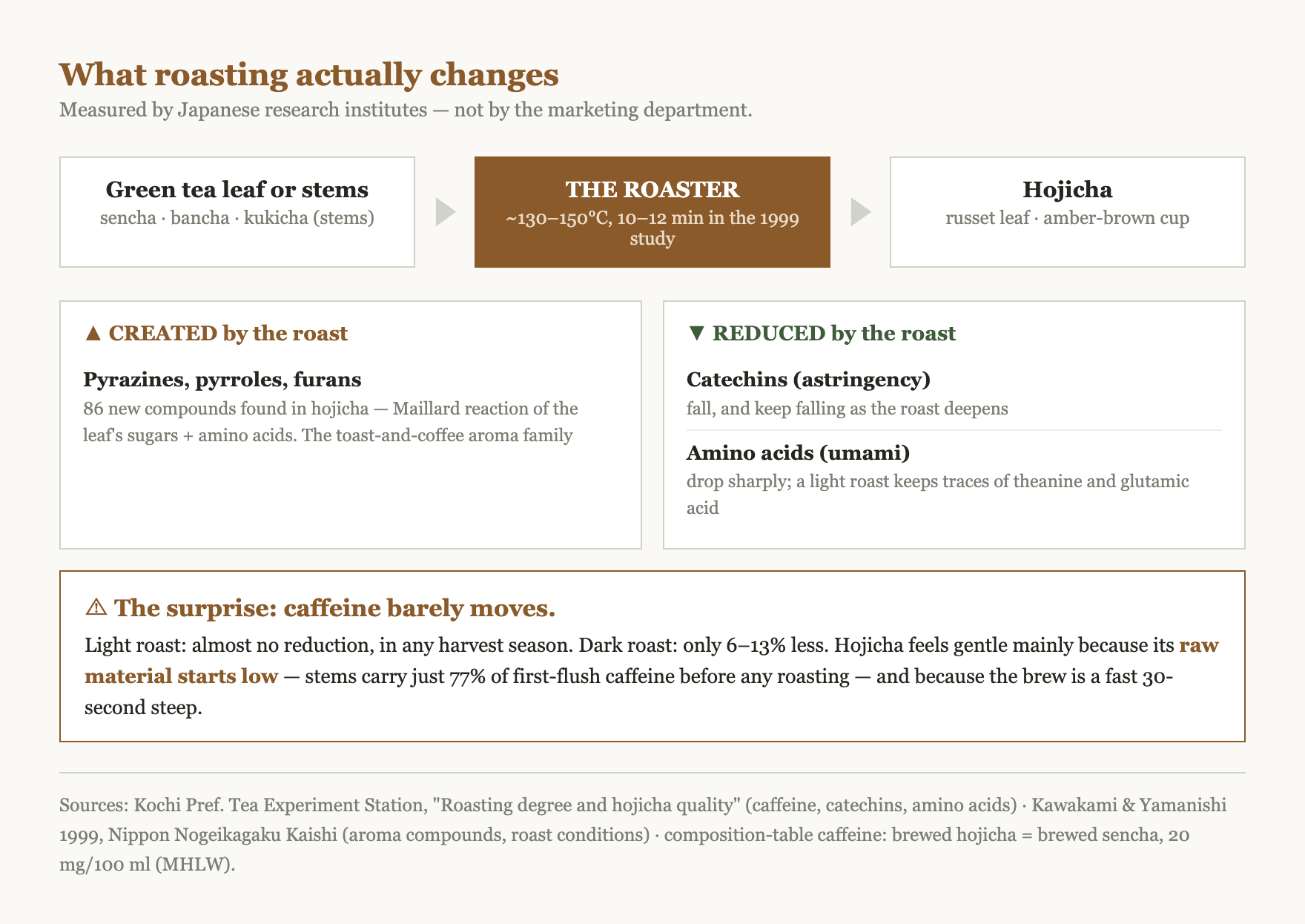
- The flavor is built in the roaster. Heat converts the leaf’s sugars and amino acids into pyrazines and related compounds, the same chemical family behind the aroma of roasted coffee and toasted bread.
- The caffeine story is mostly about the raw material, not the roast. Measured data shows light roasting removes almost no caffeine. Hojicha is gentle because it usually starts from leaves and stems that were low in caffeine to begin with.
- It is the easiest Japanese tea to brew. Boiling water, thirty seconds, no thermometer. The fussiness of sencha and gyokuro simply does not apply.
What gets roasted decides what you taste
English articles tend to flatten hojicha into “roasted bancha.” The standard’s own wording, “sencha, bancha, and the like,” hints at the real range. Three base materials dominate, and they taste different.
- Bancha base. Bancha is the official category for hardened, later-season leaf, and it makes the classic everyday hojicha: light, rustic, inexpensive, the tea of family restaurants and big teapots.
- Stem base (kuki hojicha, or bocha). Stems sorted out during finishing are roasted into a sweeter, rounder cup. Stems are naturally mild: Kochi Prefecture’s tea research station measured stem tea at 77 percent of the caffeine of first-flush leaf even before roasting. The famous example is Ishikawa’s kaga bocha, which has its own story below.
- Sencha base. Roasting proper sencha, sometimes even first-flush leaf, is the premium end. More amino acids in the leaf means more material for the roast’s flavor-building reactions, and the result is noticeably sweeter and more aromatic.
One label warning while you shop: kyobancha is not regular hojicha. Kyoto’s roasted bancha is made from large late-season leaves dried without rolling and then roasted, and it tastes intensely smoky, closer to a campfire than to toast. It is wonderful, and it is a shock if you expected a gentle latte base. The regional naming traps run deeper still: in parts of northern Japan, “bancha” itself means hojicha, a tangle I mapped in the types guide.
What roasting actually does, according to people who measured it
Two Japanese studies did the work English tea sites skip.
The aroma is created, not preserved. A study in the journal of the Japan Society for Bioscience, Biotechnology, and Agrochemistry analyzed what firing does to green tea and identified 86 new compounds in hojicha, dominated by pyrazines, pyrroles, and furans, products of the Maillard reaction between the leaf’s sugars and amino acids. That is the chemistry of toast and coffee happening inside a tea leaf. The same study even reports working roast conditions: around 150°C for 12 minutes when stems are included, a gentler 130°C for 10 minutes for leaf alone, and a finding that 100°C is simply not enough to build the roasted aroma.
The taste mellows because things are removed. Kochi Prefecture’s tea research station roasted the same teas to light, medium, and dark levels and measured the results. Total catechins, the astringent compounds, fell with roasting and kept falling as the roast deepened. Amino acids dropped sharply. What survives a light roast is a short list that includes theanine and glutamic acid, which is part of why good hojicha keeps a whisper of savory depth behind the toastiness.
So hojicha is not sencha with a smoky perfume. It is structurally rebuilt: astringency down, umami compounds down, and a new roast-built aroma layered on top. That is why it pairs with food so easily and why people who find sencha grassy or sharp often love it.
The caffeine numbers, from Japan’s official tables
Here is the section that contradicts most of what you have read.
Japan’s Standard Tables of Food Composition list caffeine for brewed tea under defined brewing methods. The health ministry’s own caffeine guidance reprints them. Per 100 ml of brewed tea:
| Tea | Caffeine | Official brew |
|---|---|---|
| Sencha | 20 mg | 10 g leaf, 90°C, 430 ml, 1 min |
| Hojicha | 20 mg | 15 g leaf, 90°C, 650 ml, 30 sec |
| Oolong, for reference | 20 mg | 15 g leaf, 90°C, 650 ml, 30 sec |
| Genmaicha | 10 mg | 15 g leaf, 90°C, 650 ml, 30 sec |
| Black tea | 30 mg | 5 g leaf, hot water, 360 ml |
| Coffee | 60 mg | 10 g grounds, hot water, 150 ml |
Brewed the official way, hojicha carries the same caffeine as sencha. Not 7.7 mg a cup, not 90 percent less. A 200 ml mug works out to roughly 40 mg, about two-thirds of the same volume of coffee’s per-100-ml figure. Lower than coffee, yes. Nearly caffeine-free, no.
What about the claim that roasting boils the caffeine away, since caffeine sublimes at around 178°C and roasters run hotter? The physics is real; the arithmetic is not. In the Kochi research station’s measurements, light roasting produced almost no caffeine reduction in any harvest season, and even dark roasting removed only 6 to 13 percent. The dramatic losses quoted by English retailers do not appear in measured Japanese data.
Why does hojicha still feel gentler than sencha, then? Mostly the starting material. The same Kochi data ranks raw-leaf caffeine from first flush at the top down through later harvests, with stems at 77 percent of first-flush levels; mature bancha leaf and stems, hojicha’s usual raw material, start low. Roasting then strips catechins, so the cup tastes softer than its caffeine number suggests. And everyday brewing, a quick 30-second steep in a big pot, extracts less than sencha’s slower steep. Material, chemistry, and habit, not evaporation.
If you genuinely need less caffeine, the tables point at genmaicha, where toasted rice halves the leaf per scoop, at 10 mg per 100 ml. The full cross-type comparison, including why gyokuro towers over everything at 160 mg, is in the types guide.
I want to be fair to the tradition here: Japanese tea culture does treat hojicha as the evening and children’s tea, and Japanese producers describe it as low-stimulation rather than caffeine-free. The culture is right about the experience. The English marketing just put the wrong mechanism, and the wrong numbers, behind it.
The emperor’s hojicha: how kaga bocha became famous
The best story in hojicha belongs to Ishikawa Prefecture. In 1983, Emperor Showa was due to visit for the National Tree Planting Festival. He was 82 and avoiding stimulating drinks, so his hotel asked the local roaster Maruhachi Seichajo, in business since 1863, for the finest hojicha it could produce.
The company’s answer broke the genre’s rules. Hojicha was scrap-grade tea by reputation, so Maruhachi went the other way: first-flush stems sourced from Kagoshima, and a new roasting method, shallow and even, using far-infrared heat to cook the stems from the core without scorching the surface. Standard hojicha of the day was roasted hard enough to char, which flattened every cup toward the same burnt note; the light roast kept the stems’ sweetness and produced a clear amber liquor instead of dark brown. The emperor liked it enough to take some back to Tokyo. It went on sale the following year as Kenjo Kaga Bocha, “presented-to-the-emperor Kaga stem tea,” and it remains the reference point for premium stem hojicha, proof that roasted tea can be a craft product rather than a way to use up leftovers.
How to brew it
Hojicha is the least demanding brew in Japanese tea, and the official guidance embraces that. Shizuoka Prefecture’s brewing guide files bancha, hojicha, and genmaicha together: 15 g of leaf for five people, about 130 ml of water per person, boiling water, about 30 seconds, drink at around 75°C. The agriculture ministry’s manual adds the vessel logic, an 800 ml dobin kettle and 200 ml mugs, and describes these as teas whose point is the roasted fragrance. Boiling water is not a compromise; it is what lifts the pyrazines out of the leaf.
Practical notes:
- Use more leaf than looks right. Roasted leaf is light and bulky, and the official 3 g per person is a bigger scoop than with sencha.
- Pour everything out. Second steeps extract almost instantly with hotter water, and the leaf is largely spent after two rounds. Shizuoka’s guide says exactly that: change the leaf after the second pour.
- Iced hojicha is excellent. The roast flavor survives chilling better than sencha’s greenness does.
- Hojicha latte: Ito En’s own recipe is a spoonful of hojicha powder dissolved in 30 ml of hot water, topped with 140 ml of milk warmed to just below boiling. Sweeten or not.
And you can make hojicha at home. This is the everyday trick Japanese households use on stale green tea, and Ito En’s customer FAQ endorses it: spread tired sencha in a pan lined with cooking paper, roast on low heat with slow stirring, and move the leaves off the pan the moment they turn mostly brown, because residual heat will scorch them. Two minutes of kitchen work turns a forgotten bag of sencha into fresh-smelling hojicha, which is as close to alchemy as tea gets.
Hojicha powder, and what it is not
The powder driving the global latte trend is simply hojicha milled fine. It is not matcha and not related to it: matcha is shaded, unrolled tencha ground on a mill, while hojicha powder is roasted ordinary tea, pulverized. The distinction matters at the register, since real matcha’s production costs are of a different order.
Buying advice fits in one sentence: read the ingredients line, and choose products where it says only tea, because the market is full of sweetened “hojicha latte mixes” whose first ingredient is sugar. Pure powder gives you the latte above, plus ice cream, cookies, and anything else cocoa powder can do.
The trend has legs beyond Japan, and not only in the West. JETRO, Japan’s trade organization, reports that in Southeast Asian markets the matcha boom is now widening into interest in other Japanese teas, hojicha among the first of them. Dedicated hojicha retailers already operate in English, and “hojicha powder” is a standard product category on international tea sites.
Who hojicha is for
- You find green tea bitter or grassy → hojicha is the gateway. The catechins that produce those edges are exactly what roasting removes.
- You want an evening tea and accept “lower,” not “zero” → hojicha at a light brew, or genmaicha if you want the measurably lowest caffeine cup in the family.
- You want tea that survives casual brewing → boiling water and thirty seconds. It is nearly impossible to ruin.
- You want a latte that is not coffee and not matcha → pure hojicha powder, hot milk, done.
- You want a splurge with a story → a tin of first-flush kaga bocha, brewed for someone who claims not to like tea.
Related reading
- Why Is Matcha Sold Out? Why hojicha got expensive: the raw material for it fell 39 percent in Kyoto this year.
- Types of Japanese Green Tea Where hojicha sits among the official 17 types, and the full caffeine table.
- Sencha vs Matcha The other side of the powder question, and how to compare caffeine fairly.
- How to Brew Sencha For the teas that do need a thermometer.
- What Is Fukamushi Sencha? Another route to a mellow cup, without the roaster.
Sources
Standards and public institutions:
- Japan Tea Central Association, Green Tea Labeling Standards, Table 1 (PDF): https://www.nihon-cha.or.jp/pdf/hyoujikijyun.pdf
- Ministry of Health, Labour and Welfare, Q&A on caffeine (composition-table values and brewing methods): https://www.mhlw.go.jp/stf/seisakunitsuite/bunya/0000170477.html
- MAFF, tea brewing manual (bancha and hojicha vessels and character, PDF): https://www.maff.go.jp/j/seisan/tokusan/cha/attach/pdf/ocha-1.pdf
- Shizuoka Prefecture, “How to Brew Delicious Tea” (bancha, hojicha, genmaicha section): https://www.pref.shizuoka.jp/kensei/introduction/soshiki/1002123/1041029/chanomiyako/1040637/1027281.html
- Ito En, Ocha Hyakka, caffeine in tea (gyokuro and cross-type values): https://www.ocha.tv/components_and_health/benefits_greentea/caffeine/
- JETRO, on the ASEAN Japanese-tea market after the matcha boom: https://www.jetro.go.jp/biz/areareports/2026/d7cf7db2e5a71454.html
Research:
- Kawakami and Yamanishi, “Formation of tea aroma by roasting and pan-firing,” Nippon Nogeikagaku Kaishi 73(9) (1999): https://www.jstage.jst.go.jp/article/nogeikagaku1924/73/9/73_9_893/_article/-char/ja/
- Kochi Prefecture Agricultural Research Center, Tea Experiment Station, “Roasting degree and hojicha quality” (PDF): https://www.nogyo.tosa.pref.kochi.lg.jp/download/?t=LD&id=7909&fid=58834
Producers:
- Maruhachi Seichajo, how Kaga Bocha became Kenjo Kaga Bocha: https://kagaboucha.com/cat2/4
- Maruhachi Seichajo, company history (1863 founding, 1983 episode): https://kagaboucha.com/cat4/1-6
- Maruhachi Seichajo, leaf hojicha and stem hojicha explained: https://kagaboucha.com/cat3/12
- Ito En, customer FAQ, reviving stale leaf by pan-roasting: https://www.itoen.jp/customer/faq/38999/
- Ito En, hojicha latte recipe: https://www.itoen.jp/recipe/39904/