This article may contain affiliate links. If you buy through them, I may earn a small commission at no extra cost to you.
Types of Japanese Green Tea: The Official 17, Explained
Published 2026-08-04
Search for the types of Japanese green tea and you get lists of five, eight, thirteen, sixteen. Every list is different, every list sounds confident, and none of them tells you where the list came from.
There is an actual answer. Japan’s green tea labeling standard, published by the Japan Tea Central Association, defines exactly seventeen named categories, with a legal-style definition for each. I have read the standard in the original, and as far as I can tell no English article has ever presented the full set. I live in Japan and work with the people who grow and sell Japanese tea. This guide is the map of the whole territory: the official seventeen, the three questions that explain them, and the numbers that show what Japan actually drinks.
The short answer
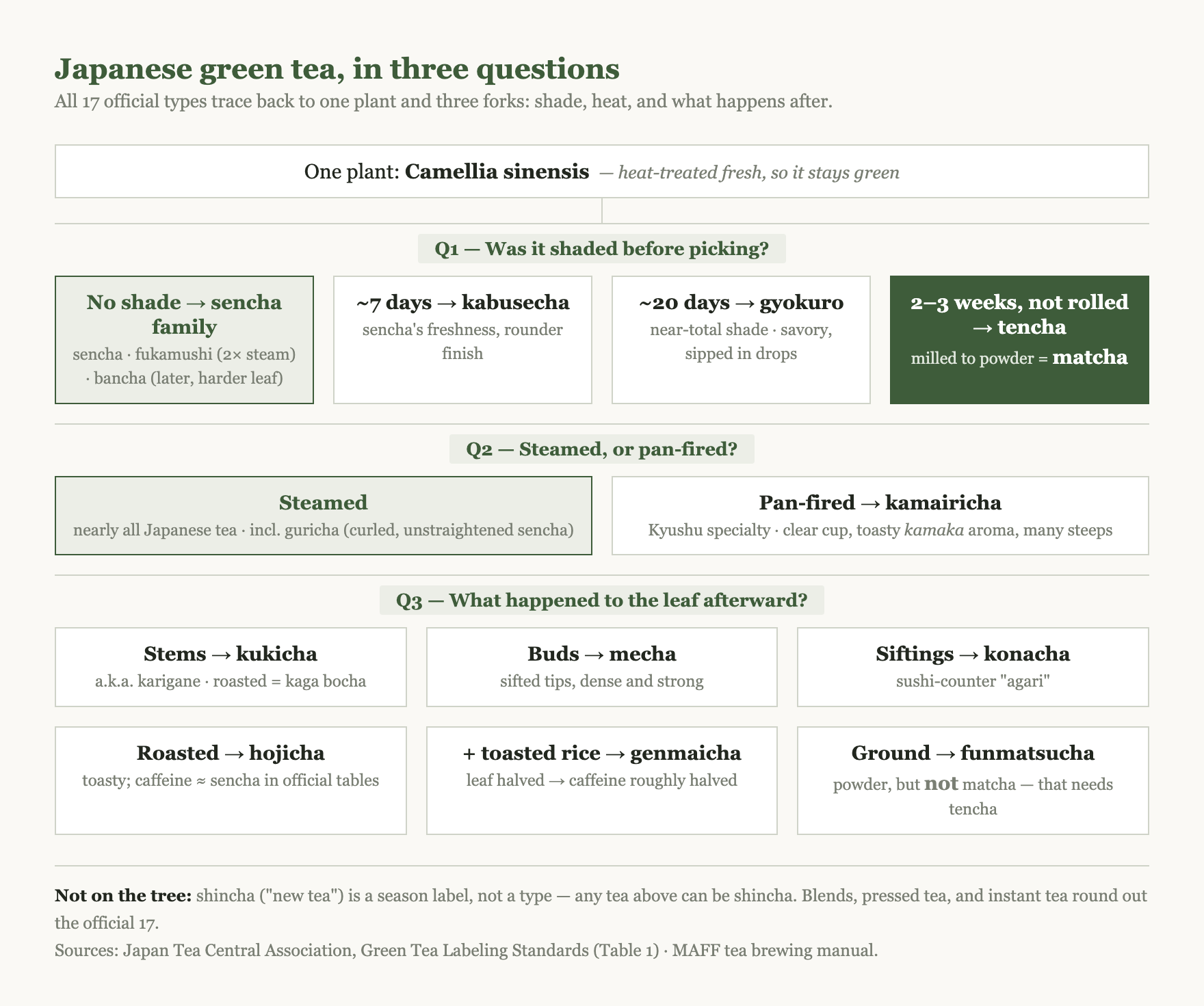
Every tea below comes from the same plant, and almost everything Japan grows is green tea, meaning the leaf is heat-treated right after picking so it never oxidizes. From there, three questions generate the entire catalog:
- Was the plant shaded before picking? Sun-grown leaf becomes the sencha and bancha families. Shaded leaf becomes kabusecha, gyokuro, or matcha, depending on how long the cover stayed on.
- Was the leaf steamed or pan-fired? Nearly all Japanese tea is steamed. One regional style fires the leaf in a hot pan instead.
- What happened to the leaf afterward? Stems, buds, and fine bits get sorted into their own teas. Roasting makes hojicha. Adding toasted rice makes genmaicha. Grinding makes powder, and which leaf you grind decides whether the powder is matcha or not.
Hold those three questions and no Japanese tea menu will ever confuse you again.
The official seventeen
This table is the labeling standard’s Table 1, translated and compressed. The definitions in quotes follow the original wording.
| # | Name | What the standard says it is |
|---|---|---|
| 1 | Sencha | Leaf that is steamed, rolled, and dried. The default Japanese tea |
| 2 | Fukamushi sencha | Sencha steamed “at least twice as long” |
| 3 | Gyokuro | Shaded about 20 days with near-total light blocking, then processed like sencha |
| 4 | Kabusecha | Shaded about 7 days before picking, then processed like sencha |
| 5 | Steamed tamaryokucha (guricha) | Sencha process minus the final straightening step, so the leaf stays curled |
| 6 | Pan-fired tamaryokucha (kamairicha) | Pan-fired instead of steamed, curled comma shapes |
| 7 | Bancha (or kawayanagi) | Made from hardened new growth, older leaves, and stems, or leaf picked between the main harvests |
| 8 | Matcha | Tencha, the shaded unrolled leaf, ground to a fine powder on a mill |
| 9 | Konacha | The powdery fraction sifted out during finishing |
| 10 | Mecha | The bud tips sifted out while finishing sencha or gyokuro |
| 11 | Kukicha (or bocha) | Stems and leafstalks separated out during finishing |
| 12 | Funmatsucha | Any tea run through a grinder into powder |
| 13 | Hojicha | Sencha or bancha roasted over strong heat |
| 14 | Genmaicha | Sencha or bancha with roasted rice added |
| 15 | Kongocha | A blend of different tea types |
| 16 | Kokeicha | Konacha bound with water into solid form |
| 17 | Instant tea | Extracted tea solids, concentrated and dried |
Numbers 15 through 17 are commercial categories you will rarely shop for by name. The first fourteen are the living menu, and the rest of this guide walks through them by family. The sencha family, numbers 1 and 2 plus the light-steamed style, has three dedicated guides on this site already: What Is Fukamushi Sencha?, Asamushi vs Fukamushi, and How to Brew Sencha. So here, sencha gets one line: it is the default, roughly half of everything Japan produces, and the reference point every other tea is defined against.
The shade family: kabusecha, gyokuro, and the road to matcha
Cover a tea plant and its chemistry changes: amino acids including theanine rise and catechins fall, so the taste slides from brisk toward savory-sweet. The details, with the research institute’s data, are in Sencha vs Matcha. What matters here is that Japan grades shading by the calendar.
Kabusecha, about 7 days of shade, is the halfway house: sencha’s freshness with a rounder, sweeter finish. The agriculture ministry lists Mie, Nara, Shizuoka, and Fukuoka as the main producing prefectures, and Mie alone accounts for 63 percent of national output.
Gyokuro, about 20 days under near-total shade, is the fully committed version, and everything about serving it is miniature. The ministry’s own brewing guide assumes a cup of just 10 ml, with 2 to 3 grams of leaf per person, water cooled to 50 to 60°C, and a 150-second steep. The reason is in the leaf’s chemistry: gyokuro is comparatively low in tannins but high in caffeine, so cool water pulls out the amino acids while leaving the bitter compounds behind. You sip it in drops, more like a sauce than a drink. It is also a statistical rarity, 1.0 percent of national production.
Here is a detail that surprises even tea-literate readers. Ask where gyokuro comes from and most write-ups say Kyoto’s Uji or Fukuoka’s Yame, the historically celebrated names. The ministry’s statistics say something else: Mie prefecture produces 74 percent of Japan’s gyokuro. The famous names carry the prestige and the auction records; the volume lives quietly next door. Both facts are true, and knowing the second one marks you as someone who reads past the marketing.
Tencha is shaded longest, two to three weeks, and dried without rolling. Ground on a mill it becomes matcha; that story, including why supermarket “green tea powder” is not matcha, continues below.
The pan-fired exception: tamaryokucha
Two teas share the name tamaryokucha, “curled green tea,” because both skip the final straightening step that gives sencha its needle shape. The steamed version, guricha, is otherwise sencha by another route. The pan-fired version, kamairicha, replaces steaming itself: the fresh leaf hits a hot pan, the way most Chinese greens are made. The ministry’s brewing manual describes the result precisely: the leaf structure stays intact, so the tea releases slowly and stands up to many steeps, the liquor is unusually clear, and the pan leaves a signature toasty aroma called kamaka, best drawn out with hotter water.
Both are deep regional specialties of Kyushu, Japan’s southwestern island: Saga and Nagasaki dominate the steamed style, and Miyazaki makes 72 percent of the pan-fired one. Combined they are about 2 percent of national production, which makes kamairicha one of the most distinctive teas a curious drinker can hunt down.
Bancha: the word that changes meaning as you travel
Bancha is officially the tea of hardened leaves, older pickings, and between-harvest harvests: the everyday, low-cost end of the leaf. Treat that as the textbook entry, then enjoy the chaos on the ground.
The word does not mean the same thing across Japan. In Tokyo, bancha is a green tea. In Hokkaido, Tohoku, and parts of Hokuriku, order bancha and you get roasted hojicha. Kyoto’s kyobancha is its own creature: large leaves cut late in the season, dried without rolling, then roasted, with a smoky flavor people either adore or flee. The Kaga roaster Maruhachi Seichajo puts the definition neatly: “bancha” names when the leaf was picked, not how it was finished, which is exactly why every region finished it differently. No English tea list I have seen mentions any of this, and it is the single most useful thing to know before buying a bag labeled bancha: read the fine print, because the word alone does not tell you what is inside.
The finishing teas: stems, buds, and siftings
Refining rough tea into finished sencha or gyokuro leaves behind stems, bud tips, and fine fragments. Japan sells each as its own tea, collectively nicknamed demono, and they are the best value hunting ground in Japanese tea.
Kukicha, the stem tea, is the famous one, also sold under the regional names karigane and shiraore. The Kaga roaster Maruhachi Seichajo explains the flavor logic: stems carry less catechin and caffeine and more amino acids than leaves, so the cup is light, faintly sweet, and hard to over-brew. In Ishikawa’s Kaga region the stems are roasted into kaga bocha, a celebrated stem hojicha. One warning for label readers, from the same maker: around Kaga, “bocha” usually means roasted stem tea, while in most of the country it means green stem tea. The regional-naming problem follows you everywhere in this family.
Mecha is the sifted bud tips, small, dense, and stronger-tasting than the parent tea. Konacha is the powdery fraction, and you have probably already drunk it: it is the tea traditionally poured at sushi counters, where it goes by the slang agari. Fragments this small release fast and thick, which is exactly what you want next to fish. Konacha is cheap, potent, and completely underrated outside Japan.
Roasted and blended: hojicha and genmaicha
Hojicha is sencha or bancha roasted over strong heat until the leaf turns russet and the flavor turns toasty. The roast builds new aroma compounds and softens the tea’s edge, and the ministry’s manual files it, along with bancha, under teas whose point is the roasty fragrance, brewed with plain hot water and no fuss. One caution before you accept the internet’s favorite fact about it: hojicha is routinely sold in English as nearly caffeine-free, and Japan’s official composition tables do not support that. The numbers are two sections down.
Genmaicha is tea plus roasted rice, half and half by the standard recipe. Two honest footnotes belong on the label. First, despite the name, “genmai” rice in commercial genmaicha is typically not brown rice: the composition table’s own product description is steamed roasted mochi rice plus roasted polished white rice, blended with sencha. Second, the rice is doing dilution work: with the leaf cut roughly in half per scoop, the brewed cup lands at about half the caffeine of sencha. That one is real, and it makes genmaicha the honest choice for an evening pot.
Powdered is not matcha: konacha vs funmatsucha vs matcha
Three Japanese teas come as small particles or powder, and English shopping sites blur them constantly. The differences are official.
- Konacha is sifted fragments of ordinary leaf. Not ground, not shaded. Sushi tea.
- Funmatsucha is any tea put through a grinder. Instant-adjacent, stirred into water, common in restaurant dispensers and cooking.
- Matcha is specifically tencha, leaf that was shaded two to three weeks and dried without rolling, milled to a powder measured in microns.
The Uji mill Yamamasa Koyamaen, which produces all three kinds of powder, states the price spread across powdered green teas at more than fiftyfold. That spread is the shading, the hand-work, and the milling. If a bargain “matcha” price looks too good, you are probably looking at funmatsucha with better marketing, and my Sencha vs Matcha guide shows how to read the label and what each is actually for.
What Japan actually grows: the numbers
Production statistics reset most assumptions about what “Japanese tea” means in practice. The latest agriculture ministry figures, for the 2025 crop:
- Sencha is 48.1 percent of aracha, unrefined tea, production. The default really is the default.
- Tencha, the matcha leaf, is 8.6 percent and climbing, and its farm-gate price, 8,562 yen per kilogram, runs about 4.9 times sencha’s 1,746 yen. The global matcha boom is visible in a farm ledger.
- Gyokuro is 1.0 percent. Rarity is not marketing talk here.
- Kabusecha and tamaryokucha are about 2 percent each. Everything else, roughly a third of production, is the bancha-grade leaf that becomes everyday tea, hojicha, and genmaicha.
- Kagoshima out-produced Shizuoka for the first time on record in the 2024 and 2025 crops, 30,000 tonnes to 24,100. Shizuoka remains the sencha heartland; Kagoshima leads in tencha, which tells you where the growth is.
Caffeine, by the official numbers
The composition tables behind Japanese nutrition labeling list caffeine for brewed tea, each with its standard brewing method. Per 100 ml:
| Tea | Caffeine | Official brew |
|---|---|---|
| Gyokuro | 160 mg | 10 g leaf, 60°C, 60 ml, 2.5 min |
| Sencha | 20 mg | 10 g leaf, 90°C, 430 ml, 1 min |
| Hojicha | 20 mg | 15 g leaf, 90°C, 650 ml, 30 sec |
| Genmaicha | 10 mg | 15 g leaf, 90°C, 650 ml, 30 sec |
| Black tea, for reference | 30 mg | 5 g leaf, hot water, 360 ml |
Two readings jump out. Gyokuro is the strongest caffeine hit in Japanese tea by an enormous margin, a product of shading, young leaf, and the concentrated brew. And hojicha ties sencha at 20 mg, which contradicts the “nearly caffeine-free” line that appears on English tea sites everywhere. Roasting does drive off some caffeine, but the brewed cup, measured the official way, is not the decaf the marketing implies. If low caffeine is the goal, the tables point to genmaicha, or to how you brew, since amounts and temperatures move these numbers. Matcha works differently because you swallow the leaf; the serving-size arithmetic is in Sencha vs Matcha.
One more label to decode: shincha
Shincha, “new tea,” appears every spring with festival energy and premium prices. It is not a tea type. The standard files it separately as a season label: the first tea produced that year, the same thing as ichibancha, the first flush. Ito En’s consumer guide notes first-flush leaf trends higher in amino acids, which is why the spring tea tastes sweeter and rounder. Any type on the seventeen list can exist as shincha. It is a vintage, not a variety.
How to actually start
If the seventeen feel like a lot, Japan’s oldest tea houses compress the decision beautifully. Ippodo, the 300-year-old Kyoto merchant, sells its sampler with this rhythm: sencha in the morning, gyokuro for the afternoon pause, hojicha at night. Energy, ceremony, wind-down.
A practical starting path, tuned to what this guide covered:
- Default cup: a mid-grade sencha, brewed by the numbers in the brewing guide.
- You want easy and forgiving: fukamushi sencha or a good bancha, thirty seconds and done.
- You want the savory deep end: kabusecha first; graduate to gyokuro when you are ready to treat tea like a tasting course.
- Evenings: genmaicha, on the caffeine math above, or hojicha for the aroma if caffeine is not your concern.
- You like oddities: kamairicha or a kaga bocha, both regional, both unlike anything else on the list.
- Cheap and excellent: konacha and kukicha, the finishing teas nobody abroad thinks to order.
The vessel sizes in the ministry’s manual are a shortcut to the whole culture: gyokuro is poured from a 90 ml pot into 40 ml cups, while bancha and hojicha come out of an 800 ml dobin kettle into 200 ml mugs. Small cup, contemplation. Big mug, daily life. Seventeen types, but really just those two moods, and every tea on this page belongs to one of them.
Related reading
- What Is Fukamushi Sencha? The deep-steamed member of the sencha family, in full.
- Asamushi vs Fukamushi How steaming time splits the sencha family, and which side fits you.
- How to Brew Sencha Temperatures, timing, and the water problem outside Japan.
- Sencha vs Matcha Leaf against powder: production, chemistry, cost, and caffeine arithmetic.
Sources
Standards and public institutions:
- Japan Tea Central Association, Green Tea Labeling Standards, Table 1 (PDF): https://www.nihon-cha.or.jp/pdf/hyoujikijyun.pdf
- Ministry of Agriculture, Forestry and Fisheries, “State of the Tea Sector” (July 2026 edition, PDF): https://www.maff.go.jp/j/seisan/tokusan/cha/attach/pdf/ocha-187.pdf
- MAFF, “Current State and Issues of the Tea Industry and Tea Culture” (PDF): https://www.maff.go.jp/j/seisan/tokusan/cha/attach/pdf/230929-4.pdf
- MAFF, tea brewing manual (PDF): https://www.maff.go.jp/j/seisan/tokusan/cha/attach/pdf/ocha-1.pdf
- MAFF, brewing manual, gyokuro section (PDF): https://www.maff.go.jp/j/seisan/tokusan/cha/attach/pdf/ocha-4.pdf
Composition data:
- Ito En, Ocha Hyakka, caffeine in tea (values from the Standard Tables of Food Composition in Japan): https://www.ocha.tv/components_and_health/benefits_greentea/caffeine/
- Eiyo to Ryori Plus, the composition tables’ tea entries explained (genmaicha composition): https://www.eiyotoryori-plus.com/webmagazine/food_composition_table/866/
Producers and merchants:
- Maruhachi Seichajo, on the word “bancha”: https://kagaboucha.com/cat3/161
- Maruhachi Seichajo, on stem tea and kaga bocha: https://kagaboucha.com/cat3/12
- Yamamasa Koyamaen, matcha vs konacha vs funmatsucha: https://www.yamamasa-koyamaen.co.jp/matcha/point/difference.html
- CHANOYU (Yamanen), regional meanings of bancha and kyobancha: https://www.e-cha.co.jp/contents/kyouban-cha/
- Ippodo, teabag sampler, morning-afternoon-evening guidance: https://www.ippodo-tea.co.jp/products/teabag651002
- Ito En, Ocha Hyakka, shincha and ichibancha: https://www.ocha.tv/varieties/nihoncha_varieties/shincha/
- Sugimoto Tea (USA), konacha as sushi-restaurant agari: https://www.sugimotousa.com/blog/what-kind-of-green-tea-is-served-at-japanese-restaurants