This article may contain affiliate links. If you buy through them, I may earn a small commission at no extra cost to you.
Uji vs Nishio vs Yame Matcha: An Honest Region Comparison
Published 2026-08-04
Pick up three tins of good matcha and you may find three place names: Uji, Nishio, Yame. English tea sites will tell you Uji is the Bordeaux of matcha, that Nishio grows anywhere from 20 to 60 percent of Japan’s supply depending on which article you read, and that Yame is the connoisseur’s secret. Some of that is true, some is out of date, and some is marketing that no Japanese source will back up.
I have a personal stake in this one. I live in Japan and work with the people who grow and sell Japanese tea, and I grew up in Aichi Prefecture, in the city next to Nishio’s tea fields. The granite for the stone mills that grind Nishio’s tencha is traditionally quarried in my hometown, a detail written into the region’s own production standards. So I will try to be fair to all three regions, and fairness here means numbers and definitions, not legends.
Who should NOT read this
- You just want a good everyday matcha for lattes. Region matters least at the culinary end. Buy from a reputable maker, check it is real matcha and not powdered sencha, and read Sencha vs Matcha for the label-reading rules.
- You want a verdict crowning one region. The most honest thing a Uji mill ever told its customers is quoted near the end of this article, and it will disappoint anyone shopping by place name alone.
- You are still deciding whether matcha is your tea at all. Start with the types guide to see where matcha sits in the family.
How I evaluated these
1. Official definitions and statistics over shop legends. The claims below rest on the Kyoto tea association’s written definition of Uji tea, Nishio’s city hall and trademark documents, the agriculture ministry’s tencha production tables, and the GI (geographical indication) registry. Where the regions’ own promotional numbers disagree with national statistics, I show both.
2. What the regions say about themselves, including the awkward parts. The most useful facts in this article, a Nishio maker’s sales breakdown, a Uji mill’s warning against its own brand halo, came from the producers themselves.
3. Disclosed bias, no fake tasting scores. I am an Aichi kid; I note it and move on. And I will not assign flavor points to regions, because blending practice, which you will read about below, makes region-level tasting claims shakier than they look.
The three at a glance
| Uji (Kyoto) | Nishio (Aichi) | Yame (Fukuoka) | |
|---|---|---|---|
| What the name legally covers | Tea from Kyoto, Nara, Shiga, or Mie, finished in Kyoto | Leaf grown in Nishio and Anjo, processed and milled there | Fukuoka’s tea brand; the GI protects its gyokuro, not matcha |
| Terroir | Mountain valleys, river fog, steep small plots | Flat river delta, sandy red soil, humid air off the Yahagi | Mountain fringe of the Chikugo plain, morning fog |
| Position in tencha statistics | Kyoto: 970 t, 23% share (2023) | Inside the 27% “other prefectures” slice | Inside “other”; Fukuoka grows ~2% of Japan’s tea overall |
| Identity | Tea-ceremony heritage, hand-picked top grades | Culinary matcha powerhouse | Gyokuro technique applied to matcha; sweet, small-batch |
| Signature varieties | Asahi, Samidori, Ujihikari | Samidori and Yabukita (yes, Samidori) | Yabukita and others; no official matcha-variety list |
| Best first purchase | A ceremony-grade tin from an established mill | Culinary grade for lattes and baking | A single-origin usucha for slow drinking |
What the names actually mean
“Uji” is bigger than Uji. The Kyoto tea association’s official definition, set in 2004, reads: Uji tea is tea from Kyoto, Nara, Shiga, and Mie, the four prefectures that developed Uji tea together, finished and processed by Kyoto businesses within Kyoto, with Kyoto-grown leaf given priority. Read that twice: leaf grown outside Kyoto Prefecture can lawfully wear the Uji name, so long as Kyoto hands finish it. That is not a scandal, it is how historic tea-trading regions actually work, but almost no English article mentions it, and it should reframe how much magic you attach to the word on the tin. How to weigh region names against the rest of a label is a big enough topic that I gave it its own verification guide.
Nishio wrote its standards down, then walked away from the seal. “Nishio Matcha” is a registered trademark: leaf grown in Nishio and neighboring Anjo, processed into tencha and stone-milled in the same area. In March 2017 it also became a national GI, with production conditions specified down to the mill stones, shelf-style shading, the Mikawa tencha drying furnace, and mills of granite quarried in Okazaki, turning at sixty revolutions a minute or less. Then, in early 2020, the producers’ association asked for the GI to be struck, the first deregistration in the system’s history; the paperwork suited a luxury product, and Nishio’s real business, as you will see, is somewhere else. The trademark remains; the GI chapter is closed. Today the national GI register lists no Nishio entry at all.
Yame’s crown is gyokuro, and matcha borrows it. “Yame tea” is Fukuoka’s brand, grown mainly in the hilly south of the prefecture. Its famous GI, the fifth product ever registered in Japan and the first tea, protects Yame Dentou Hongyokuro, the traditional shaded gyokuro. There is no Yame matcha GI. What Yame matcha offers instead is the same mountain fields and shading craft its gyokuro is built on; the prefecture’s own overview states plainly that gyokuro and tencha are grown mainly in Yame’s mountains. Fukuoka is a small grower overall, about 1,870 tonnes of unrefined tea a year, roughly 2 percent of Japan, which is exactly why Yame positions itself as a quality name rather than a volume one.
Terroir: three different answers to the same question
Shading is what makes matcha matcha; the chemistry is covered here. What the regions differ on is the land under the shade.
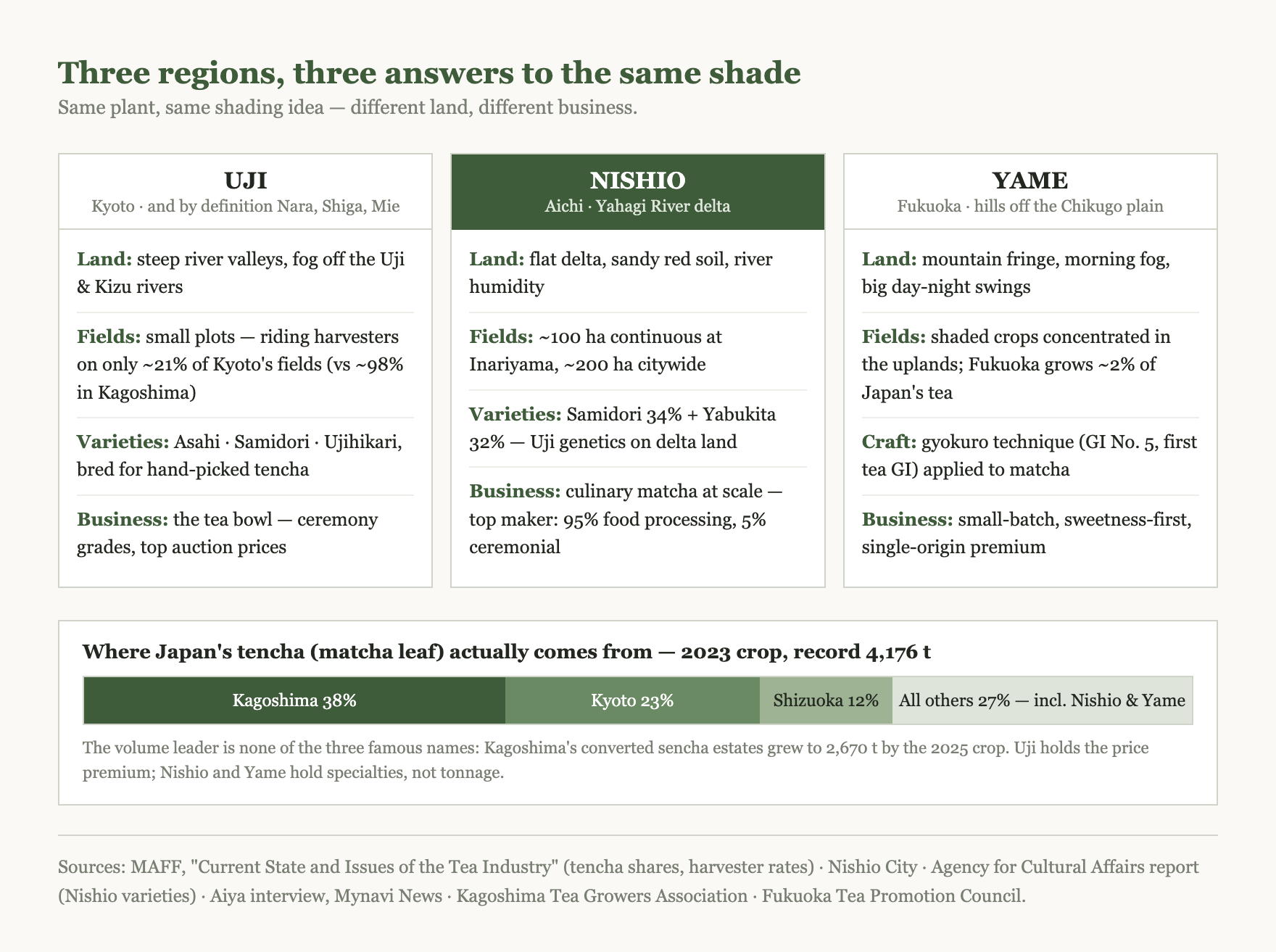
Uji: steep, misty, and stubbornly manual. The classic Uji tencha zones sit in river-valley terrain where fog off the Uji and Kizu rivers softens the light and plots are small and steep. The ministry’s own machinery statistics make the point better than poetry: riding-type harvesters cover about 98 percent of flat Kagoshima’s fields but only about 21 percent of Kyoto’s. Uji’s top grades are still hand-picked from varieties bred for exhibition tencha. That labor is a real cost, and it shows up later in this article as a real price.
Nishio: a flat delta built for tencha at scale. Nishio’s city hall describes the Inariyama tea zone on the left bank of the Yahagi River: about 100 hectares of continuous fields on well-draining sandy red soil, humidity held steady by the river, roughly 200 hectares citywide. Flat, uniform, fertile land is the opposite of Uji’s terrain, and it produces the opposite specialty: glossy, deep-green tencha in quantity, with shading nets cutting sunlight and the whole pipeline from field to granite mill contained in one small city.
Yame: gyokuro country lends its mornings to matcha. Yame’s tea sits where the Chikugo plain climbs into hills, with the big day-night temperature swings and morning fog that gyokuro growers prize. The prefecture concentrates its shaded production, gyokuro and tencha both, in these uplands. Star maker Hoshino Seichaen brands itself simply as being from “the village of Japan’s best gyokuro,” and its matcha leans on the same shading and hand-work tradition.
The production numbers nobody quotes in English
Japan measures matcha at the tencha stage, the shaded, unrolled leaf before milling, and the agriculture ministry’s tables rearrange the story you usually hear.
- Tencha production hit a record 4,176 tonnes in 2023, 2.9 times the level of 2008. The trade association’s count for 2024 is higher still at 5,336 tonnes. The boom is real and accelerating: tencha has climbed from 7.3 percent of national output to 8.6 percent in the 2025 crop, and its farm-gate price, 8,562 yen per kilogram, now runs about 4.9 times sencha’s.
- The biggest tencha grower is none of today’s three regions. It is Kagoshima, with 1,585 tonnes and a 38 percent share in 2023, rising to 2,670 tonnes by the 2025 crop, per the prefecture’s growers association. Kyoto is second at 970 tonnes and 23 percent, Shizuoka third at 12 percent. Kagoshima’s flat, machine-harvested estates converted from sencha to tencha as the matcha boom took off, and in 2024 the prefecture became Japan’s largest tea producer overall for the first time on record.
- Nishio and Yame live inside the remaining 27 percent. Nishio’s tourism board still says the region grows about 20 percent of Japan’s tencha; the current ministry tables, which put Kagoshima, Kyoto, and Shizuoka on the podium and everyone else in a shared “other” bucket, suggest that figure describes an earlier era, before Kagoshima’s surge diluted everyone’s share. Treat “20 percent” as history, not headline.
- The quality premium is real, and measurable at auction. At the 2026 new-tea auctions, leaf traded at 20,879 yen per kilogram in Kyoto against 9,019 yen in Shizuoka and 6,573 yen in Kagoshima, and a research-institute survey of Tokyo store shelves found Kyoto-linked matcha clustered in the top price band. Whatever you think of brand halos, the market prices Uji’s hand-picked, small-plot model at a multiple.
So the modern map reads: Kagoshima grows the volume, Uji holds the prestige and the price, Nishio owns a specialized industrial niche, and Yame sells refinement in small quantities.
Worth knowing how recent this map is. The research institute tracking the boom dates the takeoff to two products: Häagen-Dazs Japan’s green tea ice cream in 1996 and Starbucks Japan’s matcha tea latte in 2006, which normalized matcha as a flavor rather than a ceremony. Tencha production, around 2,200 tonnes in the early 1990s, has since roughly two and a half times over, and the growth landed unevenly: it made Nishio’s food-processing model enormous, then outgrew even that and pulled Kagoshima’s estates into the market. The regional hierarchy in this article is barely one generation old, which is a good reason to hold all of it lightly. Which brings us to the part the tins do not say.
The honest part: what each region is actually for
Nishio’s biggest maker put the number on the record. A director of Aiya, the dominant Nishio matcha house founded in 1888, said it outright in an interview: food processing, matcha for confectionery, ice cream, and bottled drinks, is 95 percent of sales; ceremonial-grade tea is about 5 percent. He added something even more useful: to meet food-industry specs, Aiya does not hesitate to source and blend matcha from Kyoto and other regions. Nishio is not embarrassed by this; it is the business model, executed brilliantly, and it is why the strict GI never paid for itself there. When your latte or matcha cookie tastes properly of matcha, there is a fair chance Nishio’s system is why.
Uji’s market is the tea bowl. The old Kyoto mills maintain grade ladders running from everyday thin tea up to family-endorsed ceremony blends, built on hand-picked crops of Asahi, Samidori, and Ujihikari from those steep valley plots. The auction premium above is the wholesale shadow of that market position.
Yame is the single-origin play. Small volume, gyokuro technique, and a sweetness-first profile have made Yame the name English-speaking specialty shops reach for when they want a premium alternative to Uji; dedicated Yame ceremonial tins are easy to find at overseas retailers now. It is the region to explore when you want to taste a place rather than buy an institution.
And one variety fact that undermines regional purism gently: Nishio’s most-planted tencha variety, at 34 percent of its fields, is Samidori, one of Uji’s flagship cultivars, ahead of the national workhorse Yabukita at 32 percent. The same genetics, raised on different land for different markets. Terroir and purpose, not secret bloodlines, are what separate these regions.
Recommendation by use case
- Ceremony, practice, or a serious gift → a Uji mill with real credentials. You are paying for hand-picked leaf and a graded house style, and at this end the premium buys something you can taste.
- Lattes, baking, matcha at breakfast volume → culinary grade, where Nishio’s specialty lies. Judge the maker, not the region line, and remember the maker may be blending regions on purpose.
- A drinking matcha with a sense of place → Yame single-origin usucha. Sweet-leaning, small-batch, increasingly available in English-speaking markets.
- Value without snobbery → do not fear Kagoshima. The region growing 38 percent of Japan’s tencha is not a compromise; it is simply younger as a brand than as a producer.
- The rule above all rules → buy by maker and grade, not by place name. Here is the quote I promised, from Yamamasa Koyamaen, a Uji mill: cultivation and processing in other regions have improved greatly, judging matcha by region alone is difficult, and Kyoto-made matcha is not necessarily delicious. When a Uji house says that about its own halo, believe it.
Reading a region label like a buyer
When a region name does appear on an English-market tin, here is what separates information from decoration. A meaningful label pairs the place with a maker and a harvest: Naoki’s Yame tin, for example, states origin Yame, Fukuoka, ceremonial grade, first harvest, which tells you who stands behind the leaf and when it was picked. A bare “Uji matcha” with no maker tells you only that a Kyoto business finished it, and, as you now know, not necessarily where it grew. And a listing that names no region at all is usually a blend, which is fine at culinary grade and worth questioning at ceremonial prices. Region last, maker and grade first: that order will not mislead you.
What would make me change this recommendation
Three things. If regional certification with teeth returns, a revived Nishio GI or a Yame matcha GI, place names would start guaranteeing process again, and this article’s “maker over region” rule would soften. If Kagoshima’s single-origin premium teas mature into named brands, the value recommendation becomes a quality recommendation. And if blend-disclosure becomes standard on matcha labels, the biggest uncertainty in region-based buying, what is actually in the tin, disappears, and comparisons like this one get much sharper.
Related reading
- Uji Matcha Guide The deep dive on the Uji name: where the leaf really grows, the last honzu gardens, and the blending culture.
- Sencha vs Matcha What shading does, what matcha legally is, and the caffeine arithmetic.
- Types of Japanese Green Tea Where tencha and matcha sit among the official 17 types, and why powdered tea is not always matcha.
- What Is Fukamushi Sencha? A different regional story: how flat-land Shizuoka invented deep steaming.
Sources
Definitions and public institutions:
- Kyoto Prefecture Tea Association, Uji tea definition (Q&A): https://ujicha.or.jp/knowledge/qa/
- Nishio City, on Nishio matcha, Inariyama fields, and the trademark: https://www.city.nishio.aichi.jp/sportskanko/kanko/1005620/1001475/1002604.html
- Nishio City PR bulletin, GI registration and production conditions (PDF): https://www.city.nishio.aichi.jp/_res/projects/default_project/_page_/001/003/366/a02-09spl.pdf
- MAFF, GI register (Yame Dentou Hongyokuro, No. 5; no current Nishio entry): https://www.maff.go.jp/j/shokusan/gi_act/register/index.html
- Fukuoka Prefecture Tea Promotion Council, production overview: https://fukuoka-yamecha.jp/gaiyo/
- MAFF, “Current State and Issues of the Tea Industry” (tencha tables, harvester statistics, PDF): https://www.maff.go.jp/j/seisan/tokusan/cha/attach/pdf/230929-4.pdf
- MAFF, “State of the Tea Sector,” July 2026 edition (tencha share and price, Kagoshima’s first overall No. 1, PDF): https://www.maff.go.jp/j/seisan/tokusan/cha/attach/pdf/ocha-187.pdf
- Kagoshima Tea Growers Association, tencha production: https://kagoshima-cha.or.jp/knowledge/kagoshima-chagyo/
- Kyoto Prefecture, Uji tea varieties (Asahi, Samidori, Ujihikari): https://www.pref.kyoto.jp/chaken/mame_ujihinnshu.html
- Agency for Cultural Affairs project report, Nishio tencha variety areas (PDF): https://www.bunka.go.jp/seisaku/bunkazai/joseishien/syokubunka_story/pdf/93910610_02.pdf
Research and industry:
- Norinchukin Research Institute, on the matcha boom, tencha volumes, and 2026 auction prices (PDF): https://www.nochuri.co.jp/genba/pdf/otr20260514.pdf
Producers and regional bodies:
- Mynavi News interview with Aiya director (sales breakdown, blending): https://news.mynavi.jp/techplus/article/newcentury-3/
- Yamamasa Koyamaen, on judging matcha beyond region: https://www.yamamasa-koyamaen.co.jp/matcha/point/difference.html
- Hoshino Seichaen (Yame), maker site: https://www.hoshitea.com/
- Nishio Tourism, tencha share claim: https://nishiokanko.com/course/model001/
- Naoki Matcha, Yame ceremonial tin (overseas availability example): https://naokimatcha.com/products/fragrant-yame-matcha