This article may contain affiliate links. If you buy through them, I may earn a small commission at no extra cost to you.
How to Choose a Japanese Teapot (Kyusu)
Published 2026-08-15
Search for a Japanese teapot and the results make no sense together. A glass pot for $21.50. A handmade one for $260. A cast iron pot that one site says you can put on the stove and another says you must never heat. The listings use words that are not explained: kyusu, tetsubin, dobin, hohin, sasame, obi-ami.
I live in Japan and work with the people who grow and sell Japanese tea. That gives me one advantage here, and it is a narrow one. I can read what the kilns, the trade associations, and the prefectural research labs actually publish in Japanese, and compare it against what English shopping guides say. On this subject the two do not match.
This guide is about picking one pot. In the recommendations below, the MUSUBI KILN product links are affiliate links (via Awin): if you buy through one, I earn a commission at no extra cost to you. No other links here are affiliate links, and no seller had any say in what this guide recommends.
Choose your next step
Buying your first kyusu? Compare the pots, then read the trade-offs in the individual recommendations. Start with the tea you brew, the strainer and your cup size.
Who should NOT read this
- You want the best teapot, full stop. There is no such pot. The strainer that makes deep-steamed sencha drinkable is the one that makes a large-leaf tea taste thin.
- You brew tea bags or grocery-store green tea. A basket infuser will serve you fine. Come back when you buy loose leaf you care about.
- You want a matcha bowl. Matcha is whisked, not steeped. A kyusu plays no part in it. Start at the types guide instead.
- You want an iron pot for the iron. Read the iron section below first. Most iron teapots sold for brewing are lined with enamel, and enamel does not release iron.
How I evaluated these
1. The strainer, before anything else. The clay gets all the attention in English guides. The strainer decides whether the tea you actually buy comes out clean or comes out full of leaf silt. Deep-steamed sencha, the most common style in Japanese supermarkets, breaks into fine particles that pass straight through a coarse strainer. Itoen, one of Japan’s largest tea companies, puts it plainly in its customer FAQ: because the leaf shape is fine, they recommend “網の目の細かい、深蒸し用急須” — a fine-mesh pot made for deep-steamed tea.
2. Whether the seller states its own limits. A page that lists origin, capacity, microwave and dishwasher status, and heat source is a page you can hold to account. A page that only says “authentic Japanese craftsmanship” is telling you nothing you can check. I weighted the first kind heavily.
3. Size measured against how you actually drink. Most buyers overshoot. The listed capacity is the brim-full volume, not the volume you brew, and Japanese and American sellers disagree about the gap by a wide margin. More on that below.
I did not weight region as a criterion. That decision needs explaining, and it takes up the middle of this article.
The iron pot problem
This is the error with real consequences, and English retail is full of it.
Two different objects are sold under the name tetsubin. One boils water. One brews tea. They look almost identical.
OIGEN, a cast iron foundry in Iwate that has been making Nambu ironware for generations, separates them in one line each. “鉄急須は、茶こしに茶葉を入れてお湯を注いでお茶を淹れる道具です” — the iron kyusu is a tool for putting leaf in a strainer and pouring hot water over it. “鉄瓶は火にかけてお湯を沸かす道具です” — the tetsubin is a tool for boiling water over a flame.
The reason you cannot swap them is inside the pot. An iron kyusu is lined with enamel to stop rust and to keep the iron away from the tea. Put it on a burner and, in OIGEN’s words, “火にかけると、ほうろうが割れてしまう可能性があります” — the enamel may crack. A tetsubin has no enamel. OIGEN describes its own tetsubin interiors as 素焼き, bare fired iron, which is exactly why they can take direct heat.
OIGEN also knocks down the shortcut most English articles reach for. “「鉄瓶は大きいもの、鉄急須は小さいもの」と、「サイズ感で見分ける」という説を耳にしますが、サイズで呼び方が変わるわけではありません” — the size rule is not a rule. Small tetsubin and large kyusu both exist.
Here is the part no English guide I found gets to. The clean split is not absolute either. Iwachu, the Morioka foundry, sells a product called 鉄瓶兼用急須, a dual-purpose pot. Its own spec line reads 内面ホーローなし, no interior enamel, and ガス・直火・IH等使用可, usable on gas, open flame and induction. It is 650 ml, priced at 12,100 yen on Iwachu’s Japanese site.
So the rule you can carry into a checkout page is not about the word on the label. It is about the lining. Enamel inside means brewing only. Bare iron inside means it can boil. If the listing does not say which, that is your answer about the seller.
The strainer, and a word that Japanese sources argue about
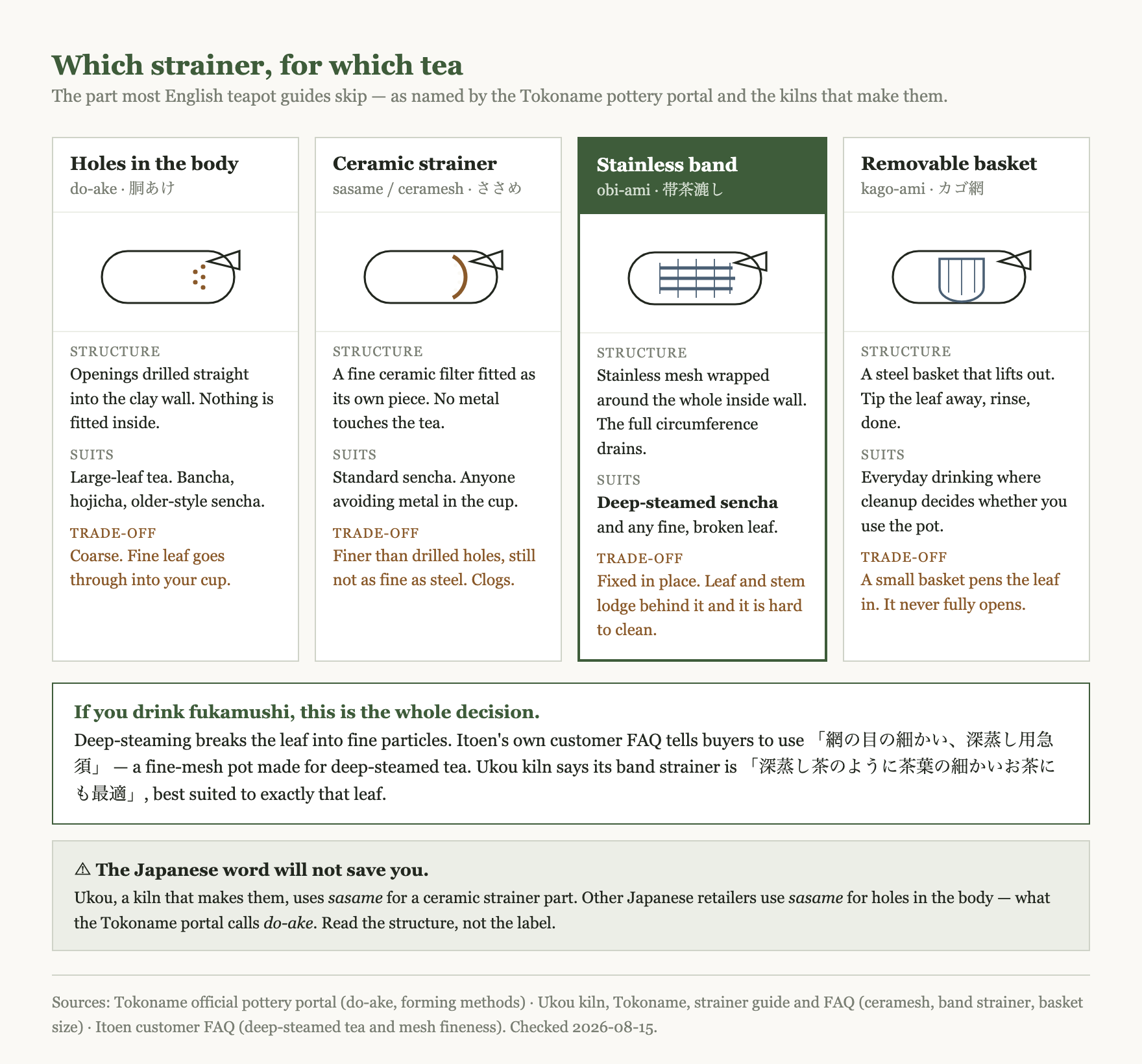
English guides usually offer two options: built-in strainer, or basket. Japanese sellers distinguish at least four, and the differences change what your tea tastes like.
The Tokoname official portal, run in the pottery town itself, names the simplest one: “「胴あけ」は急須胴体に直接穴をあけたタイプ” — holes drilled straight into the pot body. Nothing obstructs the leaf. Nothing fine gets filtered either.
Then there is the ceramic strainer fitted as a piece. Ukou kiln, a Tokoname maker that sells direct, describes its sasame or ceramesh strainer as “陶器製の細かい茶漉し” — a fine ceramic strainer. No metal touches the tea.
The third is the one worth knowing about. Ukou calls it 帯茶漉し網, the band strainer: a stainless mesh running around the inside wall of the pot, so the whole circumference becomes an exit for the water. Ukou’s own description of what it is for: “目の細かな網ですので、深蒸し茶のように茶葉の細かいお茶にも最適な茶漉しです” — the mesh is fine, so it suits teas with fine leaf such as deep-steamed sencha. If you drink fukamushi sencha, this is the structure to look for.
The fourth is the removable basket. Easy to empty, easy to wash, and the compromise is the leaf. Ukou notes that when the basket is small the leaf cannot open properly inside the pot.
One caution about the vocabulary itself. Japanese sources do not agree on what sasame means. Ukou, a kiln that makes them, treats sasame and ceramesh as a fine ceramic strainer part. Other Japanese tea retailers use sasame for holes in the body, the thing Tokoname’s portal calls do-ake. Chasing the Japanese word across listings will not get you a consistent answer. Read the structure instead: ceramic or steel, fixed or removable, coarse or fine.
What the red clay claim actually rests on
Nearly every English article about Tokoname teapots repeats a version of this: the iron in the red clay reacts with tannins in the tea and softens the bitterness, and science backs it up. I went looking for the science. There are three separate things underneath that sentence, and they are not equally strong.
The first is what the region and the kilns say. Tokoname’s official portal states it directly: “常滑急須は鉄分を多く含み、お茶の成分・タンニンと反応して、苦みが取れてまろやかになります.” Ukou kiln says the same thing in its FAQ, and its sentence ends differently: “急須の原料に含まれる酸化鉄と、お茶の成分であるタンニンが反応し、お茶の苦みがとれてまろやかで美味しい味わいになる。と言われています.” That last phrase, と言われています, means “it is said.” The kiln that makes the pots is hedging. English articles quoting this tradition drop the hedge.
The second is a conference abstract. A team at Nagoya Women’s University, led by Kazuko Yamazawa, presented “急須材質が緑茶浸出液の呈味成分に与える影響” — the effect of teapot material on the taste components of green tea — at the Japan Society of Cookery Science annual meeting in 2019. They measured polyphenols by the tartaric acid method and amino acids by ninhydrin colorimetry. Their conclusion is that green tea brewed in an iron-bearing Tokoname pot has weaker bitterness and astringency from reduced polyphenol content. Their own verb is 推察した, “inferred.” This is a meeting abstract, not a peer-reviewed paper.
The third is a prefectural research institute, and it is the interesting one. The Ceramics Research Division of the Mie Prefectural Industrial Research Institute published a study called 急須の材質による緑茶成分の変化について, on changes in green tea components by teapot material. They took five Banko pots fired five different ways: oxidation, neutral, 8 percent reduction, 11 percent reduction, and carbonization. They brewed 2 g of Mie-grown Yabukita in 200 ml of distilled water for five minutes, chilled the liquor on ice, and measured it two ways.
Their result splits. Measured by HPLC on one catechin, EGCg, “有意な差は得られませんでした” — no significant difference was obtained. Measured by the tartaric acid method, “還元焼成を行うと渋味強度が少なくなりました” — reduction firing lowered astringency. Amino acids barely moved at all.
Read that carefully, because it does not say what the marketing says. The variable that moved the numbers was the firing atmosphere, not the iron in the clay. And the same document defines the two clays by exactly that: shudei, the red clay of Tokoname, is fired in an electric kiln under oxidation; shidei, the purple clay of Banko, is gas-fired under reduction. In their tannin data the oxidation-fired sample sits near the top of the range and the reduction-fired sample near the bottom.
I want to be precise about the limits. That study tested Banko bodies under different firings. It did not put a Tokoname shudei pot next to a Banko shidei pot and compare them as products. So this is not proof that a Tokoname pot makes tea more bitter. What it does show is that the mechanism sold in English, iron meeting tannin, is not the mechanism Japan’s own public research measured. And within that research, two methods on the same samples disagreed.
My position: buy a Tokoname pot because the potters there have been making side-handled teapots for a very long time and are extremely good at the fit of lid to body and the pour. Do not buy one because a chemistry claim promised you a softer cup.
The listed size is not the size you brew
Every capacity number you see is the brim-full volume. Nobody brews to the brim.
How much to knock off is genuinely unsettled. Hakusan Porcelain, a Hasami maker, puts the working amount at about 70 percent of full. A note widely cited among Japanese tea drinkers puts it at 80 percent. Senbird, a US-facing Japanese tea seller, tells buyers to fill “about 90% full.” Nobody in this set is careless. They are answering different questions: how a maker measures a pot, versus how a shop tells you to pour.
Take the range seriously and a 300 ml pot gives you 210 to 270 ml of tea. That is two small Japanese cups, not three.
The other half of the mistake is buying big. Sellers converge here. Ujitawara Seichajo’s sizing runs 100 to 200 ml for one or two people, 200 to 340 ml for two or three, and 340 to 480 ml for three or four. Other shops set one person lower, around 100 to 150 ml, and Satoen sets it higher, at 200 to 250 ml. The spread comes from cup size assumptions, and 60 to 100 ml is the usual Japanese cup.
If you drink alone, a 200 ml pot is not small. It is correct. Brewing technique matters more than volume anyway, and that is covered in how to brew sencha.
The comparison
Every price, capacity and spec below was read off the seller’s own product page on 2026-08-15.
| Pot | Seller | Origin | Material | Strainer | Capacity | Price |
|---|---|---|---|---|---|---|
| ChaCha Kyusu Maru | Hario | Body Japan, strainer China | Borosilicate glass | Stainless | 300 / 450 / 700 ml | $21.50 |
| Glass Teapot 24 oz | Ippodo | KINTO Japan (made in China) | Glass | Not specified | 24.3 oz (720 ml) | $40 USD |
| Rusty Brown Mino Teapot | MUSUBI KILN | Mino, Gifu | Porcelain | Stainless, fixed | 470 ml (15.9 fl oz) | $62.00 USD |
| Kyusu Teapot Yozora | Senbird | Mino, Gifu | Glazed ceramic | Built-in side strainer | 235 ml and 250 ml both listed | $74.99 |
| IROIRO Teapot | MUSUBI KILN | Tokoname, Aichi | Unglazed stoneware | Fine ceramic mesh | 290 ml (9.8 fl oz) | $98.00–110.00 USD |
| Kyusu Teapot Kotori | Senbird | Aichi | Unglazed Tokoname clay | Built-in clay strainer | 280 cc/ml | $114.99 |
| Yakishime Kyusu (Banko) | Ippodo | Mie (Banko-yaki) | Ceramic, unglazed | Clay strainer | 8 oz (240 ml) | $260 USD |
A gap worth reporting: I could not verify a single enameled iron kyusu in stock at any of these three sellers. MUSUBI KILN’s Nambu ironware collection returned “This collection is empty,” and Senbird’s Tetsubin Gen was out of stock, as was every other pot in Senbird’s teapot collection on the day I checked. If you want cast iron, you are currently shopping elsewhere.
The individual pots
Hario ChaCha Kyusu Maru, $21.50. The cheapest honest entry point. Borosilicate glass body and lid made in Japan, stainless strainer made in China, and Hario says it is safe for hot water, microwave and dishwasher. That last line matters more than it sounds: almost nothing else here can go in a dishwasher. The complaint: glass tells you nothing about the tea and adds nothing to it. You see the leaf open, which is genuinely useful while you are learning, and that is the whole of it. Choose it if you are not yet sure you will keep drinking loose leaf.
Ippodo Glass Teapot, $40 USD. I include this one as an education, not a recommendation. Ippodo is a Kyoto tea house founded in 1717, and this is on its US store. The Origin field reads “KINTO Japan (made in China)”. A Japanese brand, sold by a Japanese tea house, manufactured in China, and disclosed openly. The complaint: at 720 ml it is a Western-sized pot and will not brew Japanese green tea well. Choose it if you want a big pot for herbal or roasted tea.
MUSUBI KILN Rusty Brown Mino Teapot, $62.00 USD. Mino porcelain with a fixed stainless strainer, 470 ml, listed as neither microwave nor dishwasher safe, with 8 units left when I checked. Porcelain is the practical pick for a one-pot household because it holds no aroma. The complaint: the handle requires separate installation by the customer, which is not what most buyers expect from a $62 teapot. Choose it if you switch between sencha, hojicha and herbal tea in the same pot.
Senbird Kyusu Teapot Yozora, $74.99 (regular $84.99). Glazed Mino ceramic with a built-in side strainer. Its own page lists the capacity twice and differently, 235 ml in one place and 250 ml in another. A buyer review says “Unfortunately, it is too small for my needs,” which is the standard reaction to a properly sized Japanese pot. The complaint: the capacity disagreement on a single product page is the kind of thing a careful seller catches. Choose it if you drink alone and want a glazed pot you can rinse and forget.
MUSUBI KILN IROIRO Teapot, $98.00–110.00 USD depending on color. Unglazed Tokoname stoneware, 290 ml, fine ceramic mesh strainer, no microwave and no dishwasher, three colors in stock when I re-checked on 2026-08-20. This is the one on the list that behaves like a traditional Japanese pot: it takes on the character of what you brew in it. The complaint: unglazed clay commits you. Brew one family of tea in it and stay there. Choose it if sencha is your daily tea and you want one pot dedicated to it.
Senbird Kyusu Teapot Kotori, $114.99. Unglazed Tokoname clay from Aichi with a built-in clay strainer, 280 ml. Senbird is unusually direct about the downside, telling you to “Avoid brewing strongly perfumed or flavored teas such as Jasmine, Chai, Earl Grey, Mint, Rose, etc, which may leave residual flavor in your Tokoname teapot,” and not to put it in the dishwasher. The complaint: it was out of stock in Senbird’s collection listing when I checked, along with everything else in that collection. Choose it if you find it in stock and want unglazed Tokoname with the warnings written down for you.
Ippodo Yakishime Kyusu (Banko-yaki), $260 USD. Mie-made, unglazed, 240 ml, described by Ippodo as “Completely handmade, one-by-one” and “one-of-a-kind,” with a clay strainer that Ippodo says pours fast and lets few leaves through. Banko is the Mie tradition that the prefectural research above was built on. The complaint: handmade means the pot you receive will not match the photograph, in shape, glaze or color. Ippodo says so on the page. Some buyers find that delightful and some feel misled. Choose it if you already know your brewing style and want one pot for a long time.
Recommendation by use case
- You drink deep-steamed sencha. Get a fine mesh, not holes. The IROIRO at $98–110 fits, or look for a band strainer, 帯茶漉し, if you buy from a Japanese kiln directly.
- You drink several kinds of tea from one pot. Glazed porcelain. The Rusty Brown Mino at $62.
- You are testing whether you will stick with loose leaf. The Hario at $21.50. Spend the difference on better tea.
- You want the pot to be part of the ritual. The Ippodo Yakishime at $260, accepting that it arrives unique and unrepeatable.
- You are left-handed. Standard side-handled pots are built for the right hand. Back-handled pots work either way. Left-handed side-handled pots do exist from Japanese makers, so ask before you settle.
- You want cast iron. Wait, or buy elsewhere. Confirm the interior lining before you pay, and read the iron section again.
What would make me change this recommendation
- Stock. Two of these sellers had thin or empty teaware shelves on the day I checked. Availability is the weakest part of this guide, and prices move with it.
- A direct comparison study. If a research group puts a Tokoname shudei pot beside a Banko shidei pot, brews the same leaf in both, and measures with more than one method, I will rewrite the red clay section around it. The Mie study varied firing, not region.
- A published production figure for Tokoname. English sellers say Tokoname makes about 90 percent of Japan’s teapots. Japanese sources repeat it too, and every one of them hedges with “it is said.” I have found no public statistic. If one exists, that number belongs in this article.
- Sellers fixing their own pages. One product page here lists two capacities. Another needs you to install the handle without saying so up front. These are small things that tell you how much checking the rest of the page has had.
Related reading
- What Is Fukamushi Sencha? — why the fine mesh matters
- How to Brew Sencha — water temperature and the last drop
- Types of Japanese Green Tea — where each tea sits
Sources
Kilns, foundries and regional bodies:
- OIGEN, on the difference between tetsubin and iron kyusu: https://oigen.jp/blogs/contents/column03
- Iwachu, dual-purpose iron teapot with no interior enamel: https://iwachu.co.jp/products/12822
- Iwachu, care instructions for iron teapots: https://iwachu.co.jp/pages/care-kyusu
- Tokoname official portal, on clay, handles, do-ake and forming methods: https://www.tokoname-kankou.net/tokonameyaki/miryoku/
- Ukou kiln, strainer types including the band strainer: https://www.ukou.jp/kyusu/chakoshi.html
- Ukou kiln FAQ, on red clay and tannins: https://www.ukou.jp/faq/kyusu/entry-234.html
- Hakusan Porcelain, on porcelain properties and working capacity: https://www.hakusan-shop-online.com/pages/instruction
Companies and public research:
- Itoen customer FAQ, on deep-steamed tea and fine-mesh pots: https://www.itoen.jp/customer/faq/ocha/4951/5020/page/2/
- Mie Prefectural Industrial Research Institute, Ceramics Research Division, “急須の材質による緑茶成分の変化について” (PDF): https://www.pref.mie.lg.jp/common/content/000172256.pdf
- Yamazawa Kazuko et al., “急須材質が緑茶浸出液の呈味成分に与える影響,” Japan Society of Cookery Science annual meeting abstracts 31(0), 128, 2019: https://cir.nii.ac.jp/crid/1390564238112084992
- Ujitawara Seichajo, teapot types and sizing: https://shop.chanoma.co.jp/special/detail/023
- Satoen, on choosing a kyusu for sencha: https://www.satoen.co.jp/blog/sencha-kyusu/
Product pages checked on 2026-08-15; MUSUBI KILN prices and availability re-checked on 2026-08-20:
- Hario ChaCha Kyusu Maru: https://www.hario-usa.com/products/maru-chacha-kyusu-tea-pot
- Ippodo Glass Teapot: https://ippodotea.com/products/glass-teapot
- Ippodo Yakishime Kyusu (Banko-yaki): https://ippodotea.com/products/yakishime-kyusu
- MUSUBI KILN Rusty Brown Mino Teapot: https://musubikiln.com/products/rusty-brown-mino-ware-japanese-teapot-15-9oz470ml
- MUSUBI KILN IROIRO Teapot: https://musubikiln.com/products/iroiro-japanese-teapot
- Senbird Kyusu Teapot Yozora: https://senbirdtea.com/products/kyusu-teapot-yozora
- Senbird Kyusu Teapot Kotori: https://senbirdtea.com/products/kyusu-teapot-kotori