This article may contain affiliate links. If you buy through them, I may earn a small commission at no extra cost to you.
How to Choose a Japanese Tea Set (and When Not to Buy One)
Published 2026-09-03
Type “Japanese tea set” into a search box and three different objects come back. A teapot with five small cups for $273. A bowl, a bamboo whisk and a scoop for $35.99. A box of three loose-leaf teas for $82.49. All three are labeled the same way, and the listings rarely say which one you are looking at.
I live in Japan and work with the people who grow and sell Japanese tea. What I can add here is narrow: I can read what Japanese tea merchants, kilns and the Ministry of Agriculture publish about what a tea set actually needs to contain, and I can do the arithmetic on real listings to see whether a set is cheaper than buying the pieces one at a time. On both counts, the English shopping guides I read while researching this were wrong more often than they were right.
This guide is about deciding whether you need a set at all, and if so, which kind. In the recommendations below, the MUSUBI KILN links are affiliate links (via Awin) and the Nio Teas links are referral links: if you buy through one, I earn a commission at no extra cost to you. No other links here are affiliate links, and no seller had any say in what this guide recommends.
Who should NOT read this
- You already own a teapot with a fine strainer and you are happy with it. You do not need a set. You need loose-leaf tea and, at most, smaller cups. Skip to the section on reading a tea gift box.
- You want to whisk matcha. That is a different set of tools and a different article. Matcha is whisked in a bowl, not steeped in a pot. Start with how to make matcha at home.
- You want a “tea ceremony set.” Most products sold under that name are a bowl, a whisk, a whisk holder and a scoop. That is a home matcha kit. It is not the equipment of a tea gathering, and no five-piece box is. Buy it if you want to whisk matcha at home, but not because it is “authentic.”
- You are buying for a household of one. Read the set math below first. A five-cup set can mean paying for three cups that will never leave the cupboard.
How I evaluated these
1. Which of the three things it actually is. Teaware for steeping leaf tea, tools for whisking matcha, or a box of tea. A set is only useful if it matches the tea you will drink. This sounds obvious. The listings make it hard.
2. Whether every piece in the set exists on its own. A cup will break. If the seller lists the same cup as a single item, the set has a future. If not, one chip turns a five-cup set into a four-cup set forever. I checked this for every set below by looking for the matching single item in the same store.
3. Price per piece against the single-item price. Where a store sells the same design as a set and as separate pieces, I added up the separate pieces and compared. This is the only honest way to know whether “set” means “discount” or “bundle of things you did not ask for.” It is possible for exactly one product family in this list, and the answer surprised me.
I did not weight region or kiln. That is covered in the kyusu guide, and it matters less for a set than whether the cups can be replaced.
Three different objects share one name
Japanese sellers keep these apart. The English market runs them together.
Teaware for leaf tea. In Japanese, 茶器 (chaki) or 煎茶器揃 (sencha-ki soroe): a kyusu teapot with cups, and sometimes a cooling pitcher. No tea included. JOC Goods, a US-facing store, describes its tea sets as a teapot with matching cups, which is the same definition.
Tools for matcha. A bowl (chawan), a bamboo whisk (chasen), a whisk stand, a scoop (chashaku) and often a sifter. Nio Teas puts the difference in one sentence on its sencha collection page: “Unlike matcha, sencha green tea only requires 1 piece of teaware and that is the kyusu teapot.” A matcha kit does nothing for sencha, and a kyusu does nothing for matcha.
A box of tea. Three or four loose-leaf teas in a gift box. Senbird Tea, for example, keeps “Tea Gift Sets” and “Teaware” as separate collections. A tea gift set from Senbird contains no teaware, and its Ceremonial Matcha Set contains a bowl and a whisk plus matcha. You have to read the contents line.
The mismatches cut both ways. More Than Matcha’s Matcha Essentials Set is four tools with the note “Set does not include matcha or teaspoon.” Jade Leaf’s Complete Matcha Ceremony Set is five tools with no powder. Nio’s Tosen Kyusu Teapot Set is a pot and two cups with no tea. None of these are hiding anything. The names just do not tell you.
What a sencha set actually needs
Strip it down and a sencha set is a kyusu and cups. Everything else is optional, and Japanese sources say so.
The cooling pitcher is optional. Sencha and gyokuro are brewed below boiling, so many sets include a yuzamashi, a small open pitcher for cooling the water. You do not need one. The Ministry of Agriculture’s brewing guide describes the alternative: pour the water from vessel to vessel, and “一回移すと5℃~10℃の湯冷ましができる” — each transfer cools it by 5 to 10°C. Its own example runs from boiling to about 90°C in the pot and about 80°C in the cup. Shunsho, a kyusu maker, says the same thing in its brewing instructions for both gyokuro and sencha: “湯冷ましがない場合は、湯呑で代用ができます” — if you have no yuzamashi, a teacup will do. Zojirushi, Fukujuen and Itoen all publish the same substitution. Four independent Japanese sources agree. A set that charges you for a pitcher is charging you for a convenience, not a requirement.
The cups are small on purpose. Japanese teacups run from about 40 ml to 130 ml. A Western mug holds 300 to 400 ml. This is not a quirk. The Ministry guide specifies for gyokuro “茶碗(40ml、極小振り茶碗)” — a 40 ml, extremely small cup — because gyokuro is brewed with very little water at 50 to 60°C and drunk in sips. The Seigaiha set reviewed below ships with 50 ml cups. If you have never held one, picture a double espresso cup. Sencha cups are larger but still small; the same sets from the same kiln run 120 ml. Anyone expecting mugs will be startled, and that is the single most common complaint in reviews of Japanese tea sets.
Five cups is the standard, and nobody is sure why. Japanese sets almost always come with five cups. Both MUSUBI KILN Seigaiha sets, in both sizes, ship with five. English guides usually explain this with “four sounds like death in Japanese.” I went looking for the source and found something more interesting. A reference librarian at Japan’s National Diet Library was asked this exact question and recorded four competing explanations: that tea-gathering ware came in fives; that odd numbers are auspicious in yin-yang thought; that ceramics were common wedding gifts and “『4』や『6』は『割り切れる』のでよくないとされた” — four and six were avoided because they are divisible, not because of death; and that gift merchants simply standardized on five. The librarian concluded, on the yin-yang theory, “陰陽五行説と関係があるのかはわからなかった” — they could not determine whether it was connected. So: five is real, the reason is not settled, and the death explanation is not what the library’s own record says.
One number that looks wrong and is not. The Ministry guide says to use 2 to 3 g of gyokuro per person, then “3 人の場合は少し多めの 10g” — for three people, a slightly generous 10 g. Three times three is nine, not ten. The next sentence explains: leaves absorb about four times their weight in water, so the first pour comes out short unless you add a little extra. It is a useful thing to know when a set’s brewing card gives you a number that does not multiply cleanly.
The set math, with real prices
Most guides say sets are good value. Almost none check. I found one product family where checking is possible: MUSUBI KILN sells the Seigaiha Blue Wave design from Midou Kiln in Hasami as a set and as separate pieces, same kiln, same glaze, same catalog. So the arithmetic is fair.
Seigaiha Blue Wave, 370 ml teapot with five 50 ml cups. Prices as listed on 2026-09-03.
| Piece | Price |
|---|---|
| Teapot, 370 ml, single item | $107.00 |
| Small teacup, 50 ml, single item | $42.00 |
| Five cups | $210.00 |
| Teapot + five cups bought separately | $317.00 |
| The set | $273.00 |
The set is $44.00 cheaper than the pieces, a 13.9% saving. So far, the guides are right.
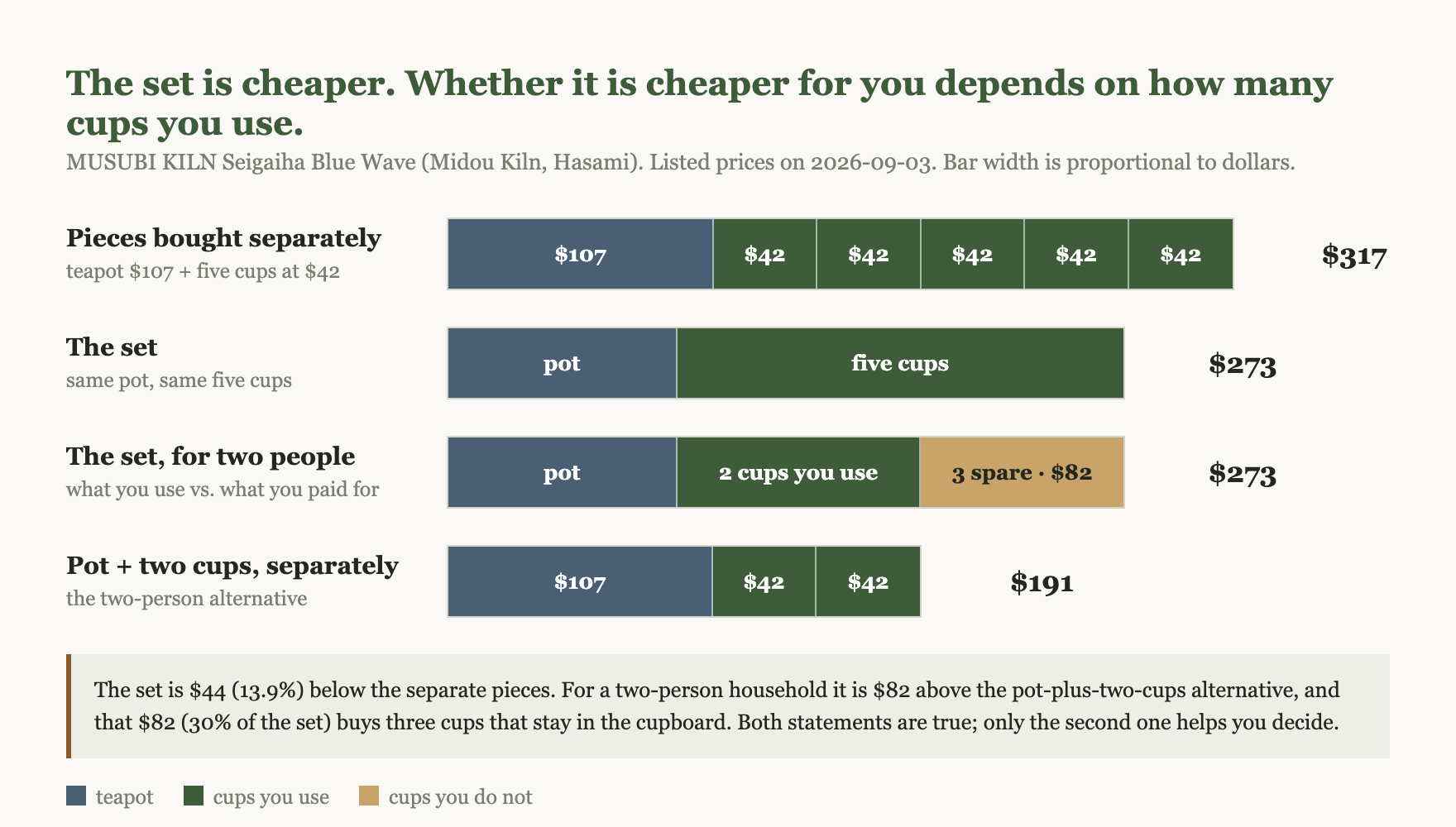
Now do it for two people. Teapot plus two cups is $107.00 + $84.00 = $191.00. The set costs $273.00. The $82.00 difference is the price of three cups you did not want. That is 30% of the set. The set is not “more expensive than buying separately.” It is cheaper per cup and more expensive per cup you will use. Both statements are true, and only the second one matters when you are choosing.
The replaceability check fails on the bigger set. The 700 ml Seigaiha set comes with five 120 ml cups. As far as I could find, MUSUBI KILN does not sell that 120 ml cup on its own; the Seigaiha singles in the catalog are the 50 ml cup and a lidded cup at $87.00. Break one and there is no matching replacement. The 370 ml set passes this check. The 700 ml set does not, and it costs $518.00.
Handmade sets cannot be checked at all. Nio’s Tosen Kyusu Teapot Set, $199.00, is a pot and two cups from a Tokoname studio. Nio does not sell the Tosen pot or those cups separately, so there is no single-item price to compare against and no replacement cup to buy. The same is true of most artisan sets. That is not a reason to avoid them. It is a reason to know what you are buying: an object, not a system you can extend.
Which store matters more than whether it is a set. Two home matcha kits with the same five-tool contents and no powder: Jade Leaf’s Complete Matcha Ceremony Set at $35.99 (marked “compared to $44.99” on the day I checked) and More Than Matcha’s Matcha Essentials Set at $89.00. Same job, 2.5 times the price. The set question is small next to the store question.
Reading a box of tea
If the “set” you want is a gift box of loose-leaf tea, the teaware questions go away and three others take their place.
Does the listing name the region, the cultivar and the harvest? This is the most practical quality signal there is, and it splits the market cleanly. Nio Teas and Senbird Tea state origin on their tea pages. Generic “assorted Japanese tea” listings on large marketplaces mostly do not. A box that says “green tea from Japan” and nothing else is a box you cannot evaluate.
What does it cost per 100 g, and where does that fall in Japan? Japanese tea merchants publish their own price bands, and they agree on the shape. Minorien lists sencha at “100g 300円~3,000円.” Shinryokuen describes everyday grades at a few hundred yen per 100 g, mid-grade around 1,000 yen, and premium sencha and gyokuro at 2,000 to 5,000 yen and up. Makinouen’s price list has a 200 g everyday sencha at ¥324 and a 100 g first-flush at ¥2,160. Three bands: everyday under about ¥1,000, mid-grade around ¥1,000, premium ¥2,000 to ¥5,000 per 100 g. Divide a gift box’s price by its total grams and see which band it lands in. A $82 box of 300 g is about $27 per 100 g, which puts it at the top of the Japanese mid-grade band before shipping and import, which is where a well-sourced but not rare tea should sit.
Is there any teaware in it? Usually not, and that is fine, as long as the recipient owns a kyusu. Senbird’s Green Tea Gift Set is three teas and nothing else. If the person you are buying for has only a French press, pair the box with a kyusu or accept that the tea will be brewed badly. A Western pot with a coarse basket lets fine sencha leaf through; the strainer question is the whole of the kyusu guide.
The comparison
All prices as listed on 2026-09-03. Shipping from the seller’s published policy the same day.
| Set | Type | Contents | Price | Ships to US | Replaceable cups? |
|---|---|---|---|---|---|
| MUSUBI KILN Seigaiha Blue Wave Tea Set, 370 ml | Teaware | Teapot 370 ml + five 50 ml cups, Hasami porcelain | $273.00 | Yes, DDP, free over $199 | Yes (single cup $42.00) |
| MUSUBI KILN Seigaiha Blue Wave Tea Set, 700 ml | Teaware | Teapot 700 ml + five 120 ml cups | $518.00 | Yes, DDP, free over $199 | Not found |
| MUSUBI KILN Renzan Kutani Tea Set | Teaware | Teapot 400 ml + two cups (170 ml, 150 ml) + steel strainer | $174.00 | Yes, DDP, free over $199 | Unknown |
| Nio Teas Tosen Kyusu Teapot Set | Teaware | Handmade Tokoname pot, up to 250 ml + two tasting cups. No tea | $199.00 | Yes, US warehouse, free over $54.99 | No |
| Senbird Tea Green Tea Gift Set | Tea only | Sencha, hojicha, genmaicha | $82.49 | Yes | n/a |
| Senbird Tea Ceremonial Matcha Set | Matcha tools + tea | Matcha 30 g, bowl, whisk, scoop, sifter, whisk stand | $119.99 | Yes | n/a |
| Jade Leaf Complete Matcha Ceremony Set | Matcha tools | Bowl, whisk, whisk holder, scoop, strainer. No matcha | $35.99 | Yes, free over $60 | n/a |
| More Than Matcha Matcha Essentials Set | Matcha tools | Bowl with spout, whisk holder, whisk, sifter. No matcha | $89.00 | Yes, free over $50 | n/a |
| Nio Teas Tea Advent Calendar 2026 | Tea only | 24 single-serve sachets, six tea types, nine farms | $109.00 | Yes, US warehouse | n/a |
DDP means duties are included in the checkout price; MUSUBI KILN states this for US orders. Nio ships US orders from a US warehouse with no customs charge. Senbird, Jade Leaf and More Than Matcha are US-based sellers.
The individual sets
MUSUBI KILN Seigaiha Blue Wave Tea Set, 370 ml, $273.00. Hasami porcelain from Midou Kiln, a 370 ml pot with a built-in strainer and five 50 ml cups. This is the set I can vouch for on the numbers: every piece is sold separately, the set is 13.9% below the pieces, and a broken cup costs $42.00 to replace. The product page lists it as not microwave safe and not dishwasher safe, which matters because “porcelain is dishwasher safe” is a rule you will read elsewhere and it does not hold here. The complaint: 50 ml cups. They are correct for gyokuro and small pours of sencha and they will look like toys to anyone who drinks tea by the mug. Choose it if you want one good set for two to four people and you want to be able to replace what breaks.
MUSUBI KILN Seigaiha Blue Wave Tea Set, 700 ml, $518.00. Same kiln and pattern, scaled up: a 700 ml pot and five 120 ml lidless cups. The cups are a sensible size for sencha and for guests. The complaint: I could not find the 120 ml cup sold on its own, so this is the set where one chip is permanent. At $518.00 that is a real risk. Choose it if you host, you want the larger pour, and you accept the replacement problem.
MUSUBI KILN Renzan Kutani Tea Set, $174.00. Kutani stoneware from Ishikawa: a 400 ml pot, two cups and a stainless strainer. It is built as a pair set rather than a five-cup set, which fixes the “three cups you do not need” problem before it starts. Not microwave or dishwasher safe. The complaint: the two cups are different sizes, 170 ml and 150 ml. That is a deliberate his-and-hers convention in Japanese ware (meoto yunomi), but if you wanted a matched pair, this is not one. Choose it if there are two of you and you would rather have a pot and two good cups than a pot and five.
Nio Teas Tosen Kyusu Teapot Set, $199.00. A black handmade kyusu from Tosen, a studio in Tokoname, with two small tasting cups. The pot is unglazed, fired by the yakishime method, and Nio’s care note is blunt: “You shouldn’t use dish soap or sponges to clean the teapot.” That is standard for unglazed Tokoname clay, which absorbs whatever you wash it with. The complaint: there is no single-item version of the pot or the cups, so nothing in this set can be replaced, and Nio says colors vary piece to piece because they are handmade. Choose it if you want one artisan object for sencha and you are buying for the object, not for a system.
Senbird Tea Green Tea Gift Set, $82.49. Three teas, no teaware: sencha, hojicha and genmaicha. Senbird names its origins, which puts it on the right side of the first question above. The complaint: it assumes the recipient already has a kyusu. If they do not, the sencha will be brewed in whatever they own, and a coarse Western infuser lets fine leaf through. Choose it if the recipient already brews loose leaf.
Senbird Tea Ceremonial Matcha Set, $119.99. The one set on this list that includes both the tools and the tea: 30 g of matcha with a bowl, whisk, scoop, sifter and whisk stand. That completeness is the point. The complaint: it is matcha only. None of it is any use for sencha, and the price is three times Jade Leaf’s toolkit before you count the 30 g of powder. Choose it if you want someone to be able to whisk their first bowl the day the box arrives.
Jade Leaf Complete Matcha Ceremony Set, $35.99. Bowl, whisk, whisk holder, scoop and a strainer, no matcha. On price per tool nothing else comes close. The complaint: the reviews on Jade Leaf’s own page include a broken whisk holder on arrival and unanswered support emails. One reads, “It came with a broken whisk holder, i took a photo and emailed it with my order # requesting a new one. I still have not heard back.” Read those before you buy. Choose it if you want the cheapest way to try whisking matcha and you can absorb a support problem.
More Than Matcha Matcha Essentials Set, $89.00. A handmade ceramic bowl with a pour spout, a whisk holder, a bamboo whisk and a stainless sifter. The spouted bowl is the reason to consider it: it is made for pouring into a latte cup. The complaint: “Set does not include matcha or teaspoon,” so the real price with the store’s own 30 g tin is $134.00, and it had no reviews when I checked. Choose it if you make matcha lattes rather than straight bowls and the spout matters to you.
Nio Teas Tea Advent Calendar 2026, $109.00. Twenty-four single-serve sachets across six tea types from nine farms in six regions, with brewing cards. As a “tea set” for someone who does not know what they like, it beats any three-tea box: it is a sampler with a calendar attached. Nio says the 2025 run sold out in under three weeks, and it is sold by reservation. The complaint: one reviewer on the page describes the packaging as “a bunch if envelopes thrown together in a box” rather than a traditional advent calendar. Choose it if the recipient is a beginner and the gift is for December.
Recommendation by use case
- Two people, one good set, replaceable pieces: the Seigaiha 370 ml set, or buy the Seigaiha pot and two cups separately for $191.00 and skip the three spare cups.
- Two people who want matched-but-different cups: the Renzan Kutani pair set.
- You host four or more: the Seigaiha 700 ml set, knowing the cups cannot be replaced.
- One artisan piece, not a system: the Nio Tosen set.
- The recipient already owns a kyusu: Senbird’s Green Tea Gift Set, or Nio’s advent calendar if they are still finding out what they like.
- Someone wants to whisk matcha: Senbird’s Ceremonial Matcha Set if the tea must be in the box, Jade Leaf’s if the budget is under $40 and you have read the reviews.
- You already own a teapot with a fine strainer: buy tea, not a set.
What would make me change this recommendation
- If MUSUBI KILN lists the 120 ml Seigaiha cup as a single item. That would move the 700 ml set to the top of the hosting recommendation.
- If a second store publishes both set and single-piece prices for the same design. One product family is enough to do the math once. It is not enough to call it a rule. I would rerun the numbers and report them, whichever way they go.
- If prices move. Everything above is dated 2026-09-03. Jade Leaf’s price was a sale price on that day. The Nio calendar is a reservation item.
- If a Japanese merchant publishes a clear statement that pairing a kyusu with non-Japanese cups is fine. I believe it is, and JOC Goods says as much to US buyers, but I could not find a Japanese tea merchant saying it in so many words, so I have not claimed it above.
Related reading
- How to Choose a Japanese Teapot (Kyusu) — the strainer question, and why it decides whether a Western pot will do.
- How to Brew Sencha — the temperatures and times the cups above are sized for.
- Types of Japanese Green Tea — which tea goes in which pot.
- How to Make Matcha at Home — if the set you want is the whisk-and-bowl kind.
Sources
Government and public institutions:
- Ministry of Agriculture, Forestry and Fisheries, brewing guide (PDF), on gyokuro cup size, water temperature, cooling by transfer, and leaf quantity: https://www.maff.go.jp/j/seisan/tokusan/cha/attach/pdf/ocha-4.pdf
- National Diet Library, Collaborative Reference Database, on why Japanese tea sets come in fives: https://crd.ndl.go.jp/reference/entry/index.php?id=1000294820&page=ref_view
Japanese tea merchants and makers:
- Shunsho (kyusu maker), brewing instructions, on substituting a teacup for a yuzamashi (PDF): https://www.shunsho.co.jp/kyusucampaign6/pdf/cha_3.pdf
- Zojirushi, on brewing without a yuzamashi: https://www.zojirushi.co.jp/kakushiaji/article/001443/
- Fukujuen, brewing instructions, on cooling water by transfer: https://shop.fukujuen.com/n/instruction/
- Itoen, brewing video page, on cooling water in the cup: https://www.itoen.jp/movie/oi/
- Minorien, on sencha price ranges: https://minorien.jp/chishiki/nedan.html
- Shinryokuen, on tea price bands: https://shinryokuen.co.jp/?mode=f731
- Makinouen, price list: https://www.makinouen.co.jp/teika.html
- Tokoname Enkel, on care for Tokoname kyusu: http://tokonameenkel.com/kyusu-5/
Product and policy pages checked on 2026-09-03:
- MUSUBI KILN Seigaiha Blue Wave Tea Set 370 ml: https://musubikiln.com/products/midou-kiln-seigaiha-blue-wave-hasami-japanese-teapot-set-12-5-oz-370-ml
- MUSUBI KILN Seigaiha Blue Wave Teapot 370 ml (single): https://musubikiln.com/products/midou-kiln-seigaiha-blue-wave-hasami-japanese-teapot-370ml-12-5oz
- MUSUBI KILN Seigaiha Blue Wave Small Teacup (single): https://musubikiln.com/products/midou-kiln-seigaiha-blue-wave-hasami-japanese-small-teacup
- MUSUBI KILN Seigaiha Blue Wave Tea Set 700 ml: https://musubikiln.com/products/midou-kiln-seigaiha-blue-wave-hasami-japanese-teapot-set-23-7-oz-700-ml
- MUSUBI KILN Renzan Kutani Tea Set: https://musubikiln.com/products/renzan-kutani-japanese-teapot-set
- MUSUBI KILN shipping policy (DDP for US): https://musubikiln.com/policies/shipping-policy
- Nio Teas Tosen Kyusu Teapot Set: https://nioteas.com/products/tosen-kyusu-teapot-set
- Nio Teas Tea Advent Calendar 2026: https://nioteas.com/products/tea-advent-calendar
- Nio Teas sencha collection, on sencha needing only a kyusu: https://nioteas.com/collections/sencha-tea
- Nio Teas shipping policy: https://nioteas.com/policies/shipping-policy
- Senbird Tea Green Tea Gift Set: https://senbirdtea.com/products/green-tea-gift-set
- Senbird Tea Ceremonial Matcha Set: https://senbirdtea.com/products/ceremonial-matcha-set
- Jade Leaf Matcha Complete Matcha Ceremony Set: https://www.jadeleafmatcha.com/products/matcha-ceremony-set
- More Than Matcha Matcha Essentials Set: https://morethanmatcha.co/products/full-matcha-set
- JOC Goods tea sets collection, on set definition: https://www.jocgoods.com/collections/tea-sets