This article may contain affiliate links. If you buy through them, I may earn a small commission at no extra cost to you.
How to Make Matcha at Home: What Japan Actually Specifies
Published 2026-08-08
You bought the powder. You bought the bamboo whisk. You found a guide that said 80°C, two grams, sixty milliliters, whisk in a W motion for fifteen seconds. Then you found a second guide that said seventy milliliters and thirty seconds, and a third that said 1.5 grams, and now you are standing in your kitchen holding a thermometer and wondering which one is the traditional method.
None of them is. I live in Japan and work with the people who grow and sell Japanese tea, and here is what I found when I went to the source: Japan’s oldest tea school specifies two things, and neither of them is a temperature.
The short answer
There is no single correct recipe, and the disagreement is not sloppiness. It runs through the Japanese sources themselves.
Urasenke is one of Japan’s three main tea schools, tracing to Sen no Rikyū in the sixteenth century. Its public instruction page states an amount and a verb for each of the two drinks. That is the whole specification. No water temperature. No whisking time. No description of how to move the whisk.
Every number you have read in English — the 80°C, the two grams, the fifteen seconds, the W motion — comes from Japanese tea companies writing beginner guides. Those companies are worth reading. They also contradict each other, and the contradictions are the most useful thing on this page.
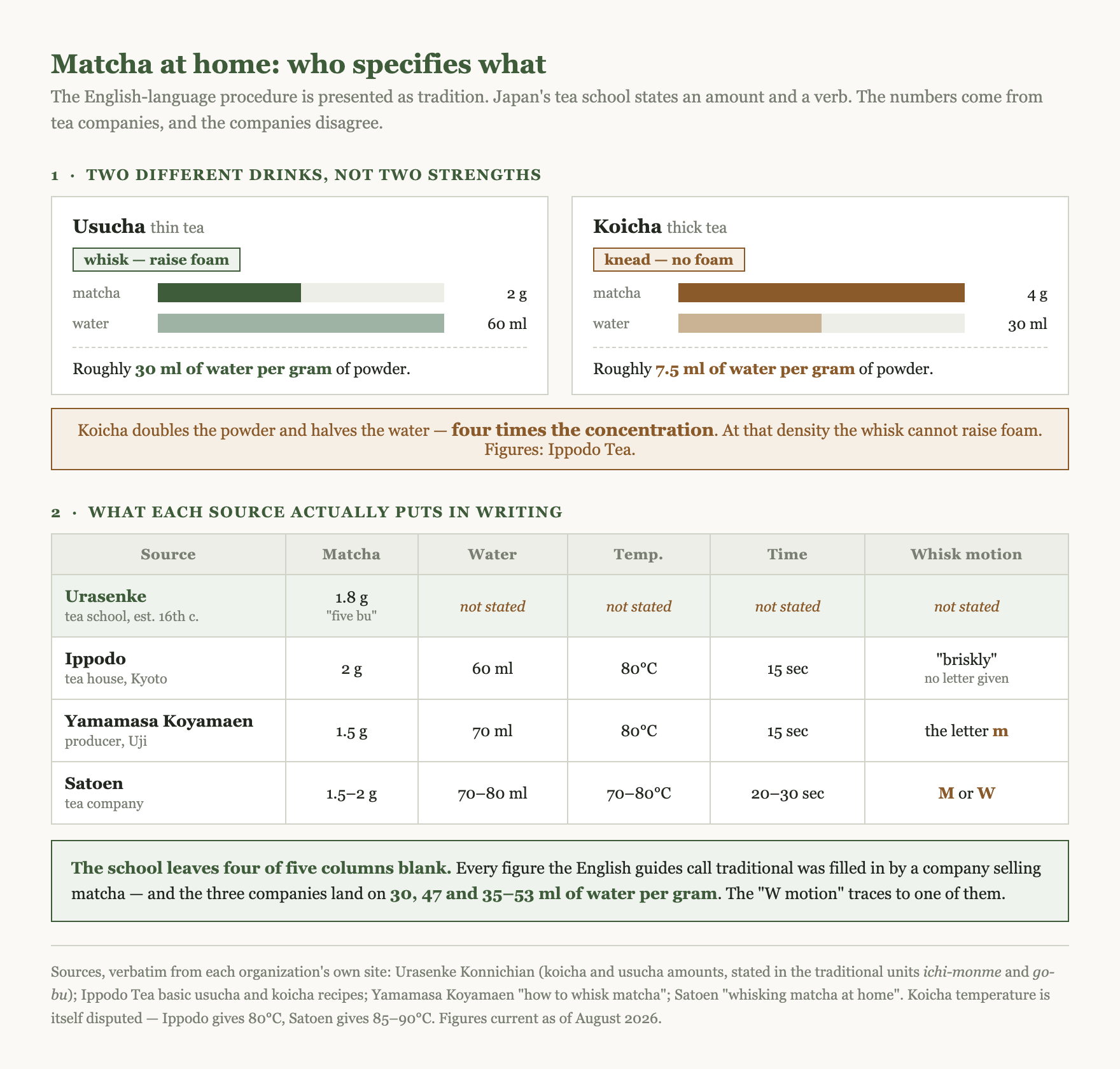
Usucha and koicha are two different drinks
Start here, because most English guides skip it and it changes everything downstream.
Japanese practice splits matcha into usucha (thin tea) and koicha (thick tea). Same powder, same mill, different drink. The Japanese language marks the split in the verb: you whisk usucha and you knead koicha.
Urasenke states it directly:
濃茶は一人当たり一匁(もんめ)(約3.75g)ほどの抹茶と適量適温の湯を入れ、茶筅(ちゃせん)で練り、飲みやすい濃さにします。
For koicha, put in about one monme (roughly 3.75 g) of matcha per person with a suitable amount of water at a suitable temperature, and knead it with the chasen to a drinkable thickness.
薄茶は茶碗に五分(ぶ)(約1.8g)ほどの抹茶と湯を入れ、茶筅でほどよく泡を立て大きな泡が残らないようにします。
For usucha, put about five bu (roughly 1.8 g) of matcha and water in the bowl, and raise a moderate foam with the chasen so that no large bubbles remain.
Ippodo, a Kyoto tea house, publishes both recipes with modern units:
| Usucha | Koicha | |
|---|---|---|
| Matcha | 2 g | 4 g |
| Water | 60 ml | 30 ml |
| Temperature | 80°C | 80°C |
| Time | 15 seconds | 15 seconds |
| Instruction | 手早く点てる (whisk briskly) | ゆっくり練る (knead slowly) |
Look at the ratio. Koicha doubles the powder and halves the water. That is four times the concentration, and at that density you cannot raise foam even if you try. The whisk does not beat. It folds.
You will almost certainly make usucha. Koicha needs expensive matcha, and the rest of this guide assumes the thin bowl.
What the tea school does not tell you
Read the Urasenke page again and notice the absences.
Water temperature: the page says 適温, “a suitable temperature.” No number.
Whisking time: not stated.
How to move the whisk: not stated.
The school specifies weight in traditional units — one monme, five bu — and it specifies the verb. Everything else is left to the person holding the bowl.
That absence is the finding. English-language matcha content presents a precise procedure as ancient practice. The precision is real, and it is recent, and it comes from companies selling you tea.
Where the numbers actually come from
Three Japanese tea companies publish beginner guides. All three are legitimate primary sources. All three disagree.
| Source | Matcha | Water | Temperature | Time | Whisk motion |
|---|---|---|---|---|---|
| Ippodo (Kyoto) | 2 g | 60 ml | 80°C | 15 sec | ”whisk briskly” — no shape given |
| Yamamasa Koyamaen (Uji) | 1.5 g | 70 ml | 80°C | 15 sec | ”draw the letter m” |
| Satoen | 1.5–2 g | 70–80 ml | 70–80°C | 20–30 sec | ”draw an M or a W” |
Three sellers, three ratios. Ippodo pours 60 ml over 2 grams. Yamamasa Koyamaen pours 70 ml over 1.5 grams. That is a 30 ml/g spread against a 47 ml/g spread — the same drink at meaningfully different strengths.
The gap widens on koicha. Ippodo keeps koicha at 80°C, the same as its usucha. Satoen calls for 85–90°C, hotter than its own usucha range of 70–80°C. One says thick tea takes the same heat; the other says it takes more. Both are producers. Neither is wrong in a way I can adjudicate, and the honest move is to tell you the disagreement exists.
Then there is the scoop. Every English guide translates chashaku — the bamboo scoop — as if one scoop were a fixed unit. Run the arithmetic on the Japanese sources:
- Ippodo: 1.5 scoops = 2 g, so one scoop ≈ 1.33 g
- Yamamasa Koyamaen: 1.5 scoops = 1.5 g, so one scoop ≈ 1.0 g
- Satoen: 2–3 scoops = 1.5–2 g, so one scoop ≈ 0.5–1.0 g
One scoop is somewhere between half a gram and one and a third grams, depending on whose scoop and whose wrist. I could not find a Japanese source, maker or school, that fixes a value. If you want repeatable results, weigh the powder.
The W motion, traced to its source
English matcha content is close to unanimous on this: whisk in a W or an M, never in a circle. It is stated as the traditional technique.
I went looking for it in Japanese. Here is what is there.
Satoen, a Japanese tea company, writes it as plainly as any English blog:
「M」または「W」を描くように茶筅を素早く動かし、20〜30秒で細かな泡を立てる
Move the chasen quickly as if drawing an “M” or a “W,” raising a fine foam in 20 to 30 seconds.
Yamamasa Koyamaen uses the lowercase letter:
茶筅でmの字を描くように、素早く上下に15秒ほどかき混ぜます。
Stir quickly up and down for about 15 seconds with the chasen, as if drawing the letter m.
So the letters are Japanese in origin. The English guides did not invent them.
What the letters are not is a teaching of the tea ceremony. Ippodo publishes a recipe for the same drink and gives no letter at all. It says 手早く点てる, whisk briskly, and stops. Urasenke gives no shape either.
The letter metaphor lives in one specific place: beginner guides written by companies that sell matcha. It solves a real beginner problem, which is that people instinctively stir in circles, and circles do not aerate. It is good advice. It is not liturgy, and no one in English says where it came from.
If you have seen a claim that the W motion is how tea has been made for four hundred years, that claim has no source I can find. The oldest instruction I can point to says to raise a moderate foam and leave no large bubbles, and leaves your hand to you.
What actually goes wrong
Three failures account for most bad bowls.
Clumps. English guides blame moisture, which leads people to store matcha wrong and sift at the wrong moment. Marukyu Koyamaen, a Kyoto producer milling matcha since 1688, states that clumps form through static electricity and vibration in transit, and that quality is unaffected. Clumping means the tin traveled. The fix is a sieve, every time, right before you whisk. Ippodo’s recipe builds it into step one: 抹茶2gを濾す, sift 2 g of matcha. The verification guide covers why clumping tells you nothing about grade.
Powder that will not “dissolve.” It never will. Matcha is ground leaf, not an extract — the whole point of the drink is that you swallow the leaf. What you are making is a suspension: solid particles held in water by agitation. Left alone, it settles. That is physics, not failure. Drink it while it is up, and swirl the bowl if it separates.
Bitterness. Two causes. Water too hot, and powder that was never meant for a bowl. Every Japanese source I read agrees on the first: pour boiling water into another vessel first and let it drop. Yamamasa Koyamaen offers a rule of thumb — each transfer between vessels sheds roughly 8–10°C. Two transfers from a boil lands you near 80°C without a thermometer.
There is also a step the English guides skip. Yamamasa Koyamaen recommends adding a little water first, working it into a paste, then pouring the rest:
最初に少量のお湯を入れ、茶筅で軽く練ってから、お湯を注いで点てるとダマになりにくい。
Add a small amount of hot water first and knead lightly with the chasen, then pour in the rest and whisk — this makes clumps less likely.
They give this for the general case, not only for koicha. If your matcha keeps clumping after sifting, this is the next thing to try.
A starting point you can defend
You need somewhere to begin. Here is a defensible one, with the reasoning attached so you can move off it.
2 g matcha, 70 ml water, 80°C. The powder weight follows Ippodo, the water follows Yamamasa Koyamaen and Satoen, and 80°C is the one number all three agree on. Sift the powder. Add a splash of the water and work it smooth. Add the rest. Whisk fast for fifteen to twenty seconds — in an M, or a W, or straight back and forth from the wrist, all of which are attested — until a fine foam covers the surface. Lift the whisk through the center as you finish.
Then change one variable at a time.
- Too strong or too bitter: drop to 1.5 g before you touch the temperature.
- Thin and watery: hold the powder, cut the water to 60 ml.
- Still harsh at 60 ml: your water may be too hot. Add a transfer.
- Grassy and flat rather than sweet: the powder may be old, or it may be a culinary blend.
Weigh the powder for the first week. Once your hand knows what two grams feels like on your own scoop, put the scale away.
What Japanese makers actually restrict
English-language matcha marketing sorts powder into “ceremonial” and “culinary” grades. Those terms do not exist in Japan. Japanese makers sort by use, and the restriction they publish runs the other direction from what you would expect.
Yamamasa Koyamaen states it on its own site:
濃茶を点てる場合は濃く練りますので、苦味や渋味が強くなりがちな並級品以下の抹茶は濃茶用としては適しません。
Because koicha is kneaded thick, matcha of standard grade or below — which tends toward bitterness and astringency — is not suited for koicha.
The company names its own threshold: Senjin no Mukashi and above are recommended for koicha.
Read what that means. The constraint is on koicha, not on usucha. A mid-grade matcha makes a fine thin bowl and a punishing thick one, because kneading four grams into thirty milliliters concentrates every flaw. Nothing in the Japanese framing says a cheaper powder is unfit for the drink you are actually making.
The whisk is a consumable
One thing about the tool, because Western kitchens get this wrong.
A chasen is not a kitchen whisk. It is a single piece of bamboo split into dozens of tines, and the tines break. It wears out and gets replaced, the way a pencil does.
Over 90% of Japan’s chasen come from one place: the Takayama district of Ikoma, Nara Prefecture, which the prefecture notes is designated a national traditional craft. When you buy a cheap bamboo whisk of unstated origin, you are not buying a lesser version of the same object. You are buying a different object.
I could not find a manufacturer or trade body publishing a replacement interval. Secondary sources range from two months to two years, which is wide enough that I would not repeat any of it as fact. Watch the tines instead. When several have snapped, or the whisk stops raising foam it used to raise, it is done.
What I would tell a friend
Sift. Use water off the boil, not from it. Weigh the powder until your hand learns it. Whisk fast enough that it feels like effort, and stop reading guides that tell you there is one right number.
The tea school specifies an amount and a verb. Four hundred years on, that is still most of what anyone can honestly tell you.
Choosing the tools
Before buying a matcha set, check whether it includes the bowl, whisk, sifter and tea. You may already own some of what you need. The Japanese tea gift guide compares tools and sets, including what each leaves out. It contains affiliate links; purchases may earn me a commission at no extra cost to you.
Related reading
- How to Tell Real Japanese Matcha The official definition, label rules, and why clumping and color prove nothing.
- Sencha vs Matcha Why one is brewed and discarded and the other is swallowed whole.
- Why Is Matcha Sold Out? What the shortage is doing to prices and purchase limits.
- Uji Matcha Guide What the Uji name covers, and what it does not.
- Types of Japanese Green Tea Where matcha sits among the seventeen official categories.
Sources
Tea school (primary):
- Urasenke Konnichian, “How matcha is made” (koicha and usucha amounts and verbs): https://www.urasenke.or.jp/textb/shiru/beginer/dekiru.html
Producers and tea houses (primary):
- Ippodo Tea, basic usucha recipe (2 g / 60 ml / 80°C / 15 sec / sifting): https://www.ippodo-tea.co.jp/blogs/tea-recipe/%E5%9F%BA%E6%9C%AC%E3%81%AE%E8%96%84%E8%8C%B6-%E6%8A%B9%E8%8C%B6
- Ippodo Tea, basic koicha recipe (4 g / 30 ml / 80°C / knead slowly): https://www.ippodo-tea.co.jp/blogs/tea-recipe/%E5%9F%BA%E6%9C%AC%E3%81%AE%E6%BF%83%E8%8C%B6-%E6%8A%B9%E8%8C%B6
- Yamamasa Koyamaen, how to whisk matcha (1.5 g / 70 ml / 80°C / “letter m” / paste-first method / heat loss per transfer): https://yamamasa-koyamaen.com/blogs/%E6%8A%B9%E8%8C%B6%E3%81%AB%E3%81%A4%E3%81%84%E3%81%A6/%E6%8A%B9%E8%8C%B6%E3%81%AE%E7%82%B9%E3%81%A6%E6%96%B9
- Yamamasa Koyamaen, matcha naming and grade guidance (why standard grade is unsuited to koicha): https://www.yamamasa-koyamaen.co.jp/matcha/point/name.html
- Satoen, whisking matcha at home (“M” or “W”, usucha and koicha figures): https://www.satoen.co.jp/blog/matcha-tatekata-jitaku/
- Marukyu Koyamaen, matcha knowledge page (clumping from static electricity and transit): https://www.marukyu-koyamaen.co.jp/about-tea/know-matcha.html
Public institutions:
- Nara Prefecture, Takayama chasen (over 90% national share, national traditional craft designation): https://www.pref.nara.lg.jp/kougei-taiken/1043.html