This article may contain affiliate links. If you buy through them, I may earn a small commission at no extra cost to you.
Japanese Gift Ideas for Tea Drinkers (That Actually Get Drunk)
Published 2026-09-03
The most common failure with a Japanese tea gift is not that the recipient dislikes it. It is that they never drink it. A tin of matcha with no whisk. A bag of gyokuro brewed with boiling water. A 200 g bag of sencha opened in January and still half full in June, tasting of cardboard. The gift was fine. It did not come with what it needed to work.
I live in Japan and work with the people who grow and sell Japanese tea. What I can bring to a gift guide is limited but useful: I can read what Japanese tea merchants say, in Japanese, about how long an opened bag lasts and how it should be stored, and I can read what US Customs and Japan Post have published about shipping since the rules changed in 2025. Both turn out to matter more than which brand you pick.
This is a guide to choosing a tea gift that gets used. In the recommendations below, the MUSUBI KILN links are affiliate links (via Awin) and the Nio Teas links are referral links: if you buy through one, I earn a commission at no extra cost to you. No other links are affiliate links, and no seller had any say in what is recommended here.
Start with the person, then the gift
Choose by recipient or compare the gifts. Check what is included before you buy: tea, tools and a bowl are not always sold together. Product details below are dated checks; confirm current prices, stock and delivery with the seller.
Who should NOT read this
- You are buying for someone who already brews Japanese tea daily. Skip to the “already a tea person” recommendation. They do not need a starter kit, and a generic one will sit in a drawer next to the one they already own.
- You want the cheapest matcha set on the internet. There are $20 sets in the table below, with what their own reviews say goes wrong.
- You are shipping to Japan, not from it. This is written for a US recipient.
- You want to give a tea ceremony. A five-piece box is a home matcha kit, not a ceremony. It is a good gift under its real name.
How I evaluated these
1. Can they drink it the day it arrives? Matcha needs a whisk and a bowl. Loose leaf needs a pot with a fine strainer, and gyokuro needs cool water. If the gift assumes equipment the recipient does not own, it is a gift of homework. Every set below is marked for what it lacks.
2. Will it still be good when they get to it? A Japanese tea bag carries a best-before date for the unopened bag. What matters is how long it lasts after opening, and Japanese merchants publish that number: two to four weeks. Quantity is therefore a freshness decision, not a generosity decision.
3. Will it arrive, and at the price on the screen? The $800 duty-free allowance for small packages into the US was suspended on August 29, 2025, and it has not come back. For a gift shipped from Japan, that can mean a customs bill on the doorstep. Two sellers handle this well. Most do not mention it.
I did not weight “authenticity.” Everything here is made in Japan or from Japanese tea. What separates them is whether the person opening the box can use it.
The failure nobody warns you about
Every source I checked, Japanese and English, lands on the same first problem: the recipient cannot make the tea.
The evidence is on the sellers’ own pages. Jade Leaf’s Traditional Matcha Starter Set description reads, “All you need is some matcha, a small bowl, and some hot water and you’re ready to go!” The set is a whisk, a scoop, a sifter and a booklet: no matcha, no bowl. A good $24.99 kit for someone who has both, and three tools and a promise for someone who does not. On the same company’s Complete Matcha Ceremony Set page, a reviewer writes: “It came with a broken whisk holder, i took a photo and emailed it with my order # requesting a new one. I still have not heard back.” That is the second failure: bamboo and ceramic travel badly.
The third is quieter. Nio Teas’ sencha page says, “Unlike matcha, sencha green tea only requires 1 piece of teaware and that is the kyusu teapot.” True, and the kyusu is the piece most Americans do not own. A Western pot with a coarse basket lets fine Japanese leaf straight through. Give loose leaf to someone with a French press and you have given them silt.
So the first question is not “which tea.” It is “what do they own.” The six kinds of gift below are sorted by what each assumes.
The six kinds of Japanese tea gift
1. A box of loose-leaf tea. Two to four teas, no equipment. Assumes a kyusu. Senbird’s Green Tea Gift Set is the clean example: sencha, hojicha and genmaicha, $82.49, nothing else. Right for someone who already brews; wrong for a beginner.
2. A sampler or calendar. Many teas in single-serve portions. Assumes a kyusu but forgives inexperience, because each portion is pre-measured and carded. Nio’s Tea Advent Calendar is 24 sachets from nine farms, $109.00, sold by reservation. The best gift for a beginner who has a pot and does not know what they like.
3. A matcha kit. Bowl, whisk, scoop, often a sifter. Assumes nothing, if the matcha is in the box. Check. Senbird’s Ceremonial Matcha Set ($119.99) includes 30 g. Jade Leaf’s Complete Matcha Ceremony Set ($44.99) and More Than Matcha’s Matcha Essentials Set ($89.00) do not, and both say so. Buyers are not always reading.
4. Teaware alone. A kyusu, a matcha bowl, a tea canister. Assumes the recipient has tea. Teaware is harder to duplicate than you think: serious drinkers keep separate pots for separate teas because unglazed clay absorbs aroma, so a second kyusu is welcome where a second starter kit is not. The cast-iron kettle is the exception; see the $299 rule below.
5. Tea bags. I could not find a Japanese merchant that positions tea bags as a gift line. Skip unless the recipient specifically wants bags.
6. A gift card or subscription. Assumes nothing and delivers no moment of opening. Nio sells gift cards from $35.00 to $100.00, and a $59.00 monthly club that ships a kyusu with the first box, the one subscription that solves the equipment problem instead of ignoring it.
How long it stays good, in the merchants’ own words
The date printed on a Japanese tea bag is for the unopened bag. Tokichi, the Uji merchant, puts it in one line on its English storage page: “The expiration date of all products is limited to unopened products.” Once opened, the guidance shortens fast, and it comes from the merchants themselves:
- Ippodo (Kyoto): keep the opened bag sealed at room temperature and drink it within “3週間ほど” — about three weeks.
- Nakamura Tokichi (Uji): about two weeks in summer, about a month in winter.
- Suetsugien: “開封後は2週間前後” — around two weeks after opening.
- Hankyu Food, on shincha: two to three weeks, a month at most.
- Senbird (US, in English): “Once opened, consume within 3–4 weeks for optimal freshness. Unopened packages stay fresh for 6–12 months when stored properly.”
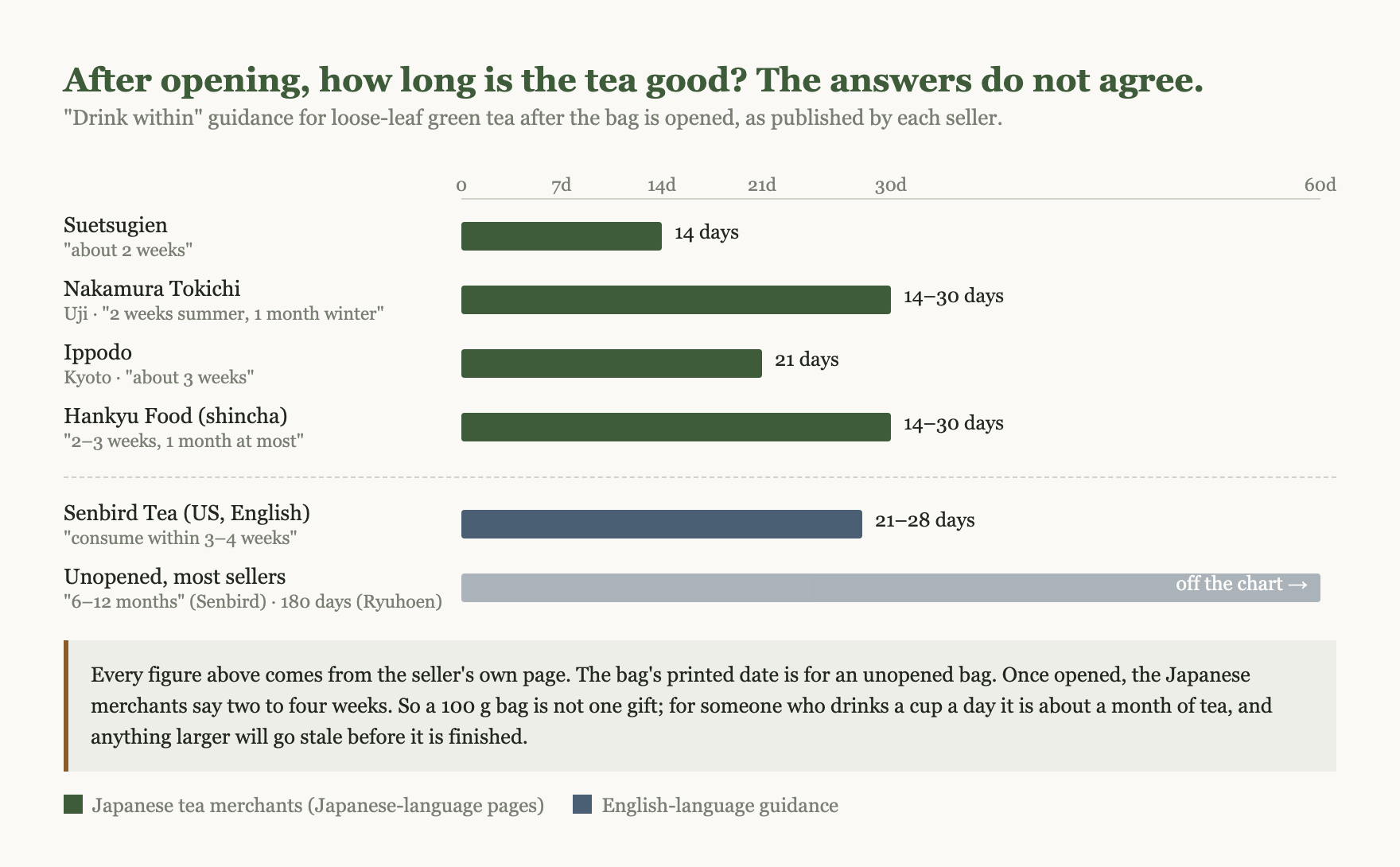
Two things follow. A 100 g bag is about a month of daily cups, so it is the right gift size; 200 g is a gift with a deadline the recipient will miss. And matcha is worse: Ippodo lists the enemies of tea as “酸素・強い香り・光・高温多湿” — oxygen, strong smells, light, heat and humidity — and a powder has the most surface exposed to all four.
The refrigerator mistake. The instinct to keep tea cold is right and the execution is usually wrong. Yamamasa Koyamaen, a Uji matcha maker, is explicit: “低温のまま開封すると、温度差で空気中の水分を吸って結露し、急速に品質が劣化します” — open it while cold and it draws moisture from the air, condenses, and degrades fast. Ippodo’s storage guidance is the same: freeze it unopened, and “常温に戻してから開封してください” — bring it back to room temperature before opening. If you are stockpiling gifts in the freezer, tell the recipient this, or the care you took will be what ruins it.
Caffeine, as numbers only. Japan’s food composition tables give, per 100 ml of brewed tea: gyokuro 160 mg, sencha 20 mg, hojicha 20 mg, genmaicha 10 mg. The gyokuro figure is high because the standard brew uses 10 g of leaf in only 60 ml of water; it is a concentration, not a warning. Hojicha is the same as sencha, which surprises people who were told roasting removes caffeine; the tables say it does not. Matcha is 3.2 g per 100 g of powder, so a 1.5 g bowl is 48 mg and a 2 g bowl is 64 mg. If the recipient avoids caffeine after noon, genmaicha and hojicha are the safer gifts by the numbers, and gyokuro is the wrong one.
Shipping, and the customs bill that did not exist before
Until August 2025, a package worth under $800 entered the US duty-free. That allowance, de minimis, was suspended for all countries on August 29, 2025, and in June 2026 US Customs and Border Protection issued rules suspending it indefinitely. The CBP fact sheet: “Effective Aug 29, 2025, imported goods from all countries that are valued at or below $800 will no longer be eligible for de minimis treatment and will be subject to all applicable duties, taxes, and fees.” It has not been restored.
Japan Post suspended most US-bound parcels from August 27, 2025, and only resumed full acceptance on April 14, 2026, with duty prepayment required on goods over $100. That is why some gifts ordered from Japan last winter never arrived on time.
For a gift, this splits the stores into three groups.
Ships from inside the US. No customs. Senbird, Jade Leaf, Cuzen, More Than Matcha and Tezumi are US-based. Nio Teas states that orders ship “from our warehouses in the United States, the European Union, or Japan, depending on your delivery location,” and that US-warehouse orders “are not subject to customs charges or import duties.” Free US shipping over $54.99.
Ships from Japan with duties included. MUSUBI KILN ships from Japan by FedEx or DHL, quotes 2 to 5 business days, and states on its shipping policy: “Customs duties and import taxes are already included in the price shown at checkout. No additional fees are charged upon delivery.” Shipping is $29, free over $199. This is the only seller I found that has taken the customs problem off the recipient entirely, and it is the reason a Japanese-shipped teapot can still be a safe December gift.
Ships from Japan, duties not addressed. JOC Goods ships from Japan within 1 to 2 business days, flat $25 to the US, free over $199. I could not find a statement about who pays import duties. Assume the recipient might.
Christmas cutoffs. USPS’s 2025 send-by dates for December 25 delivery in the contiguous US: Ground Advantage and First-Class Mail December 17, Priority Mail December 18, Priority Mail Express December 20. UPS and FedEx dates circulate in the press, but I could not confirm them on the carriers’ own pages, so they are not here. USPS usually publishes the new dates in mid-September.
What Japan does with tea as a gift
English guides leave this out, and it changes what you say when you hand the box over.
Green tea is a standard gift in Japan in two seasons: ochugen in summer and oseibo in December. Japan Post’s gift service describes oseibo as the gift for the whole year’s thanks, sent roughly December 10 to 20, and weighted more heavily than the summer one. A December box of Japanese tea is not a novelty in Japan. It is the default.
Tea is also the standard return gift after a funeral. Japan Post’s guide to koden-gaeshi, the gift sent to those who attended, explains the rule: families choose “消えもの” — things that are consumed and gone — “食べ飲みして無くなるようにと” — so that, like the item, the sorrow does not linger. Tea, sweets and soap are the classic choices. Meat and fish are avoided, as are celebratory items like kombu and sake. There is also a folk explanation you will see repeated, that tea bushes once marked land boundaries and so tea marks the boundary between this world and the next. It is offered as one theory, and I would leave it there.
None of this makes tea an unlucky gift. The same Japan Post page calls tea “相手を選ばず安心して贈ることができるもの” — something you can give anyone with confidence — and practical even if not to the recipient’s taste. In the US the funeral association is unknown. In a Japanese context, tea carries both meanings, and the box and the words around it tell the recipient which.
The box does the work. High-grade tea in Japan travels in a paulownia box, a kiribako, because the wood swells in humid air and seals. MUSUBI KILN’s Sakura Shiboridashi set ships in one, a “bespoke paulownia box with a small card that shares the spirit behind the set.” For everything else, MUSUBI KILN and JOC Goods wrap every order in furoshiki at no charge (“All orders from MUSUBI KILN are wrapped for free using furoshiki”), and MUSUBI KILN leaves the invoice out of the box. JOC Goods adds a message card up to 250 characters. Neither offers noshi, the paper wrapper standard in Japan; no US-facing seller I found does, so furoshiki is the closest you will get.
The comparison
All prices as listed on 2026-09-03. Shipping from the seller’s published policy the same day.
| Gift | Kind | What it assumes | Price | Ships from | Wrapping |
|---|---|---|---|---|---|
| Nio Teas Genmaicha with Roasted Rice | Loose leaf | A kyusu | $14.50 (small) | US warehouse | Not stated |
| Jade Leaf Traditional Matcha Starter Set | Matcha tools | Matcha and a bowl | $24.99 (sale $19.99) | US | Not stated |
| Jade Leaf Complete Matcha Ceremony Set | Matcha tools | Matcha | $44.99 (sale $35.99) | US | Not stated |
| JOC Goods Zen Celadon Matcha Bowl | Teaware | Matcha and a whisk | $55.00 | Japan, $25 flat | Furoshiki + card |
| Nio Teas Monthly Tea Club with Kyusu | Subscription | Nothing (kyusu included) | $59.00/month | US warehouse | Not stated |
| Senbird Tea Green Tea Gift Set | Loose leaf | A kyusu | $82.49 | US | Gift box |
| MUSUBI KILN IROIRO Tea Canister 8.1 fl oz | Teaware | Tea to put in it | $84.00–88.00 | Japan, DDP | Furoshiki |
| More Than Matcha Matcha Essentials Set | Matcha tools | Matcha | $89.00 | US | Not stated |
| Nio Teas Tea Advent Calendar 2026 | Sampler | A kyusu | $109.00 | US warehouse | Sleeve + box |
| Senbird Tea Ceremonial Matcha Set | Matcha kit + tea | Nothing | $119.99 | US | Gift box |
| MUSUBI KILN Renzan Kutani Tea Set | Teaware | Tea | $174.00 | Japan, DDP | Furoshiki |
| Nio Teas Tosen Kyusu Teapot Set | Teaware | Tea | $199.00 | US warehouse | Not stated |
| Cuzen Matcha Maker Starter Kit | Appliance | Nothing, then refills | $299.00 | US | Not stated |
| MUSUBI KILN Sakura Shiboridashi Tea Set | Teaware | Gyokuro, and patience | $299.00 | Japan, DDP | Paulownia box + furoshiki |
DDP means duties are included at checkout. “Not stated” means the seller’s page says nothing about wrapping, which for a gift is itself information. The JOC bowl and the Cuzen mill are in the table for range; the JOC bowl ships with an unanswered duties question, and the Cuzen mill takes only Cuzen’s own leaf refills.
The individual gifts
Nio Teas Genmaicha, from $14.50. Green tea with roasted rice, the tea most likely to convert a coffee drinker: toasty, 10 mg of caffeine per 100 ml by the tables, and forgiving of hot water. The complaint: it is a bag of tea, and it assumes a kyusu. Choose it if you need a $15 gift for a coffee person who owns a pot.
Jade Leaf Traditional Matcha Starter Set, $24.99, on sale at $19.99. Whisk, scoop, sifter, handbook; you still need “some matcha, a small bowl, and some hot water.” The complaint: a review on the page reports matcha from the same store arriving “with a small cut in it. It leaked matcha everywhere in the box.” Choose it if the recipient already owns a bowl and matcha.
Jade Leaf Complete Matcha Ceremony Set, $44.99, on sale at $35.99. Bowl, whisk, whisk holder, scoop, strainer, no matcha. On price per piece nothing beats it. The complaint: the broken whisk holder review above, and another about a discount code never applied and no reply. Choose it if you accept a support risk for the lowest price on a complete tool set.
Nio Teas Monthly Tea Club with Free Kyusu, $59.00 a month. The one subscription that ships the equipment. First box comes with a red clay kyusu, then tea monthly. The complaint: a subscription is a gift the recipient has to manage, and there is no moment of opening after the first box. Choose it if you want the equipment problem solved and you will cover a few months.
Senbird Tea Green Tea Gift Set, $82.49. Sencha, hojicha and genmaicha, in a box that reviewers describe as gift-worthy. Origins are named on the page. The complaint: no teaware, so it assumes a kyusu. Choose it if the recipient brews loose leaf already and you want three good teas rather than one.
MUSUBI KILN IROIRO Tea Canister, $84.00 to $88.00 by color. A ceramic tea canister, shipped duties-paid in furoshiki. Given what the merchants say about opened tea, a sealed canister is the gift that protects the other gift. The complaint: it is empty, and a canister only matters to someone who buys loose leaf in bags. Choose it if you are pairing it with a bag of tea, or the recipient is the kind who keeps three teas open at once.
More Than Matcha Matcha Essentials Set, $89.00. Spouted bowl, whisk holder, whisk, sifter; the spout is for pouring into a latte. The complaint: “Set does not include matcha or teaspoon,” so the working price with the store’s 30 g tin is $134.00, and the page had no reviews. Choose it if the recipient drinks matcha lattes, not straight bowls.
Nio Teas Tea Advent Calendar 2026, $109.00. Twenty-four single-serve sachets, six tea types, nine farms, brewing cards, a storage box. For a beginner with a pot, it answers “what do they like” by asking 24 times. Sold by reservation. The complaint: one reviewer calls it “a bunch if envelopes thrown together in a box” rather than a traditional calendar. It is a sampler in a sleeve, not a cardboard house. Choose it if the recipient has a kyusu and the gift is for December.
Senbird Tea Ceremonial Matcha Set, $119.99. The complete answer: 30 g of matcha, bowl, whisk, whisk stand, scoop, sifter. Nothing assumed. The complaint: matcha only, and three times the Jade Leaf toolkit before the matcha is counted. Choose it if the recipient has nothing and you want them whisking a bowl the day it arrives.
MUSUBI KILN Renzan Kutani Tea Set, $174.00. A 400 ml Kutani teapot with two cups and a strainer, duties-paid, in furoshiki. The complaint: the cups are different sizes (170 ml and 150 ml), a his-and-hers convention in Japanese ware that reads as a mismatch if nobody explains it. Not dishwasher safe. Choose it if the gift is for a couple and you want it to arrive with no customs surprise.
Nio Teas Tosen Kyusu Teapot Set, $199.00. A handmade Tokoname kyusu with two tasting cups, from a US warehouse. The complaint: Nio’s care note is “You shouldn’t use dish soap or sponges to clean the teapot,” and the recipient will not know unless you tell them. Choose it if the recipient is serious about sencha and you will pass on the care note.
MUSUBI KILN Sakura Shiboridashi Tea Set, $299.00. A 60 ml handleless shiboridashi with two 40 ml cups from Gyokko Kiln in Tokoname, in a paulownia box with a card. The gift that looks like a Japanese gift. The complaint: 60 ml is a gyokuro vessel, not a teapot. Give it to a beginner and it will be admired and never used. Choose it if the recipient already drinks gyokuro or high-grade sencha and the gesture matters as much as the tea.
The $299 rule. At this price, check what the object is for. The cast-iron tetsubin sells at $488 and up and is often listed as a “teapot.” Tezumi’s own page for one says it is “designed for boiling water on the stove, not for brewing tea.” A kettle given as a teapot is the most expensive way to give a gift that cannot be used. The difference is in the kyusu guide.
Recommendation by recipient
- Already a tea person: teaware, not tea. The Renzan set, the IROIRO canister, or the Sakura Shiboridashi if they drink gyokuro. A second kyusu is welcome; a second starter kit is not.
- Beginner who owns a pot: the Nio advent calendar in December, the Senbird Green Tea Gift Set the rest of the year.
- Beginner who owns nothing: Senbird’s Ceremonial Matcha Set for matcha, or the Nio monthly club for leaf tea, because both put the equipment in the box.
- Coffee drinker: genmaicha or hojicha. Both take hot water without complaint, and by the tables neither is a caffeine gift.
- Office, boss, client: something sealed and self-explanatory. The Senbird gift box or the Nio calendar. Not a kit that needs a lesson.
- Host gift, opened at the door: a sampler or the genmaicha. Small, sealed, and sharable that evening.
- Someone in a Japanese context: know the two meanings above. Furoshiki wrapping from MUSUBI KILN or JOC Goods signals the seasonal gift, not the funeral one.
What would make me change this recommendation
- If the de minimis suspension is lifted. Then shipping from Japan stops being a customs question and JOC Goods moves up the list. As of this writing, CBP has not lifted it.
- If JOC Goods states a duties policy. Its furoshiki and message card are the best wrapping of any store here. It is held back only by the unanswered customs question.
- If Jade Leaf’s reviews change. The complaints are about packaging and support, not the tools. A clean season would move the Complete Ceremony Set to the top of the budget tier.
- If 2026 carrier cutoffs are published. The USPS dates above are 2025’s.
Related reading
- How to Choose a Japanese Teapot (Kyusu) — the strainer question, and the kettle that is not a teapot.
- How to Make Matcha at Home — what to tell the person you gave the kit to.
- Hojicha Guide — why roasting does not remove caffeine.
- Types of Japanese Green Tea — which tea suits which recipient.
Sources
Government and public institutions:
- US Customs and Border Protection, fact sheet on the suspension of duty-free de minimis treatment (PDF): https://www.cbp.gov/sites/default/files/2025-08/factsheet_suspension_of_duty-free_de_minimis_treatment.pdf
- US Customs and Border Protection, e-commerce FAQs, on the June 2026 interim final rules: https://www.cbp.gov/trade/basic-import-export/e-commerce/faqs
- Japan Post, resumption of US-bound mail acceptance from April 14, 2026: https://www.post.japanpost.jp/service/send/oversea/information/2026/0413_01.html
- USPS, 2025 recommended holiday mailing and shipping dates: https://about.usps.com/newsroom/national-releases/2025/0917-usps-recommends-2025-holiday-mailing-and-shipping-dates.htm
- Ocha.tv, caffeine by tea type from the Standard Tables of Food Composition in Japan: https://www.ocha.tv/components_and_health/benefits_greentea/caffeine/
Japanese tea merchants and makers:
- Ippodo, recommended storage: https://support.ippodo-tea.co.jp/hc/ja/articles/360003061416
- Nakamura Tokichi, how to store (English): https://tokichi.jp/en/pages/how-to-store
- Suetsugien, storage guidance: https://www.suezakien.net/html/page1.html
- Hankyu Food, on shincha and best-before dates: https://web.hh-online.jp/hankyu-food/blog/lifestyle/detail/002165.html
- Yamamasa Koyamaen, matcha handling and condensation: https://www.yamamasa-koyamaen.co.jp/matcha/basic/handling.html
- Chamart, caffeine by tea type and brewing conditions: https://chamart.jp/archives/learn_article/caffeine/
Japanese gift customs:
- Japan Post gift service, on koden-gaeshi and “kiemono”: https://www.shop.post.japanpost.jp/shop/pages/gift_contents_152.aspx
- Japan Post gift service, on items to avoid for koden-gaeshi: https://www.shop.post.japanpost.jp/shop/pages/gift_contents_87.aspx
- Japan Post gift service, on oseibo: https://www.shop.post.japanpost.jp/shop/pages/oseibo_wiki.aspx
- Japan Post gift service, on the difference between ochugen and oseibo: https://www.shop.post.japanpost.jp/column/ochugen/ochugen_oseibochigai.html
- MUSUBI KILN journal, on furoshiki wrapping for every order: https://musubikiln.com/blogs/journal/japanese-style-gift-wrapping
Product and policy pages checked on 2026-09-03:
- Nio Teas shipping policy: https://nioteas.com/policies/shipping-policy
- Nio Teas sencha collection: https://nioteas.com/collections/sencha-tea
- Nio Teas Genmaicha: https://nioteas.com/products/genmaicha-green-tea-with-roasted-rice
- Nio Teas Monthly Tea Club with Free Kyusu: https://nioteas.com/products/monthly-tea-club-with-free-red-kyusu
- Nio Teas Tea Advent Calendar 2026: https://nioteas.com/products/tea-advent-calendar
- Nio Teas Tosen Kyusu Teapot Set: https://nioteas.com/products/tosen-kyusu-teapot-set
- Nio Teas Gift Card: https://nioteas.com/products/nio-teas-gift-card
- MUSUBI KILN shipping policy (DDP): https://musubikiln.com/policies/shipping-policy
- MUSUBI KILN IROIRO Tea Canister: https://musubikiln.com/products/iroiro-tea-canister-8-1-fl-oz
- MUSUBI KILN Renzan Kutani Tea Set: https://musubikiln.com/products/renzan-kutani-japanese-teapot-set
- MUSUBI KILN Sakura Shiboridashi Tea Set: https://musubikiln.com/products/sakura-shiboridashi-japanese-tea-set
- Senbird Tea Green Tea Gift Set: https://senbirdtea.com/products/green-tea-gift-set
- Senbird Tea Ceremonial Matcha Set: https://senbirdtea.com/products/ceremonial-matcha-set
- Jade Leaf Traditional Matcha Starter Set: https://www.jadeleafmatcha.com/products/traditional-matcha-starter-set
- Jade Leaf Complete Matcha Ceremony Set: https://www.jadeleafmatcha.com/products/matcha-ceremony-set
- JOC Goods Zen Celadon Matcha Bowl: https://www.jocgoods.com/products/zen-celadon-matcha-bowl
- More Than Matcha Matcha Essentials Set: https://morethanmatcha.co/products/full-matcha-set
- Cuzen Matcha Maker Starter Kit: https://cuzenmatcha.com/products/matcha-maker-starter-kit
- Tezumi, cast iron tetsubin (boiling only): https://www.tezumi.com/products/japanese-tetsubin-kunzan-kobo-round-cast-iron-kettle