This article may contain affiliate links. If you buy through them, I may earn a small commission at no extra cost to you.
Unique Japanese Tea Gifts (Beyond the Matcha Kit)
Published 2026-09-03
Search “unique tea gifts” and the results are a loch ness monster infuser, a mug with a disappearing Van Gogh, and cloud-shaped tea bags. Search “unique Japanese tea gifts” and you get the same matcha kit, over and over, with the word “unique” in front of it. In the eight English gift guides checked for this article, a matcha starter kit appeared in seven and a sencha assortment in six. A Japanese black tea, a pan-fired tea, or a fermented tea appeared in zero.
I live in Japan and work with the people who grow and sell Japanese tea. That gives me one narrow advantage: I can read the Ministry of Agriculture’s own production statistics and the tea associations’ pages in Japanese, which is where “rare” stops being a marketing word and becomes a number. The teas below are rare by those numbers, and every one of them ships to a US address.
This guide is about giving something a tea drinker has not already been given. In the recommendations below, the Nio Teas links are referral links and the MUSUBI KILN links are affiliate links (via Awin): if you buy through one, I earn a commission at no extra cost to you. No other links are affiliate links, and no seller had any say in what is recommended here.
Who should NOT read this
- The recipient is new to Japanese tea. Start with the gift guide for tea drinkers. Rare teas reward people who already know what sencha tastes like.
- You want a novelty object. Everything here is a real tea or a real tool. Nothing is shaped like a duck.
- You need it to be “the best.” These are the interesting ones, not the highest-graded ones. A prize-winning gyokuro is a better tea than a lacto-fermented bancha. It is also the gift they may already own.
How I evaluated these
1. Rare by a published number, not by adjective. Pan-fired tea is under 1% of Japanese tea. Awabancha is made by a handful of villages and holds a national cultural designation. A cultivar other than Yabukita is a minority nationally but, as it turns out, the majority in Japan’s largest tea prefecture. Each item below carries its number.
2. Buyable from a US address, in dollars, this month. I dropped the teas I could only find shipping from Japan. Two of the most interesting teas in this category failed that test and appear only in the “do not gift” section.
3. Interesting to a tea drinker, not only to me. A sour fermented tea is fascinating. It is also the gift most likely to be tried once. I say so where it applies.
Why “rare” has a number now
The Ministry of Agriculture publishes an annual tea report, and the July 2026 edition changed a fact that every English guide still repeats. Yabukita, the cultivar behind “Japanese green tea” as most people know it, covers 64% of national acreage in the FY2025 survey. In Shizuoka it is 86%. In Kagoshima it is 28%, behind a mix of Yutakamidori (26%), Saemidori (16%) and others. The same report records that in the 2024 and 2025 crop years, “鹿児島県が統計開始以来、初の日本一” — Kagoshima became Japan’s top producer of crude tea for the first time since the statistics began.
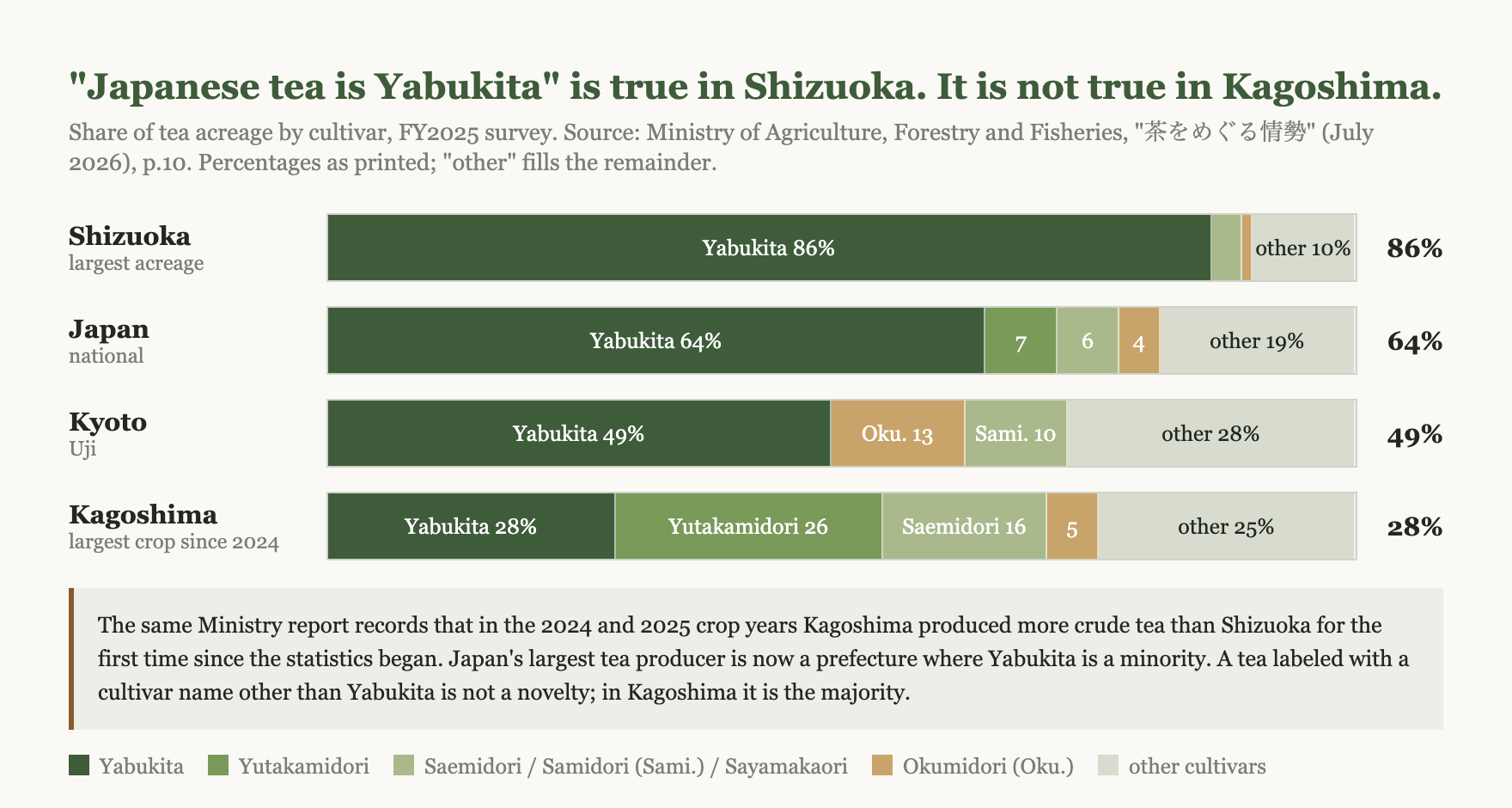
So a tea sold under a cultivar name other than Yabukita is not a curiosity. In the prefecture that now grows the most tea, it is the norm. The teas below lean on that.
The teas: rare by the numbers
Kamairicha (pan-fired green tea). Almost all Japanese green tea is steamed to stop oxidation. Kamairicha is fired in a pan instead, the way Chinese greens are made, and the Tokyo Tea Association puts its share at “日本茶全体の割合から見て1%以下” — 1% or less of Japanese tea. The Ministry report names Miyazaki as the top producer. It tastes nutty and rounder than sencha, with none of the seaweed edge, which makes it the rare tea most likely to please someone who finds sencha too green.
Two are worth knowing about, and they contradict each other on purpose. Nio’s Pan Fired Kamairicha from Miyazaki Sabou, $29.90 for 100 g, is the textbook version: grown in Gokase in the Miyazaki mountains, organic-certified, brewed at 160°F for one minute. Nio’s Chanoka Kamairicha, $33.93, is the exception: made in Uji, Kyoto, by a single farmer, Takada Masahiro, at 400 m with no shading, from the Suruguwase cultivar, a variety identified in 1957 that few people grow. “Pan-fired tea is from Kyushu” is true of the category and false of this bag. For someone who thinks they know Uji, this is the one.
Wakoucha (Japanese black tea). Same plant as green tea, fully oxidized. Igarashien, a producer, states the point plainly: “緑茶も中国茶も紅茶も、原料となる茶葉はすべて同じです” — green, Chinese and black teas all start from the same leaf. The standard cultivar is Benifuuki, registered in 1993 by Japan’s agricultural research agency. Wakoucha is so small a category that the Ministry’s tea statistics have no line for it; the secondary sources that do estimate it put it around 200 tonnes a year against roughly 75,000 tonnes of green tea. It tastes gentler than Indian black tea, with less tannin, and it takes hot water, which makes it the one rare Japanese tea you can give to someone who owns nothing but a kettle and a mug.
Senbird’s Wakoucha Honoka, $29.99 for a 60 g tin, is Shizuoka Benifuuki, brewed at 203°F for one to two minutes. Tezumi’s Takachiho Minamisayaka Wakoucha, $28.00, is from Miyazaki and named for its cultivar, Minamisayaka, which is the kind of label that did not exist on Japanese tea a decade ago.
Awabancha (lacto-fermented tea). The strangest tea Japan makes, and now a designated cultural property. The leaves are heat-treated, then packed into wooden barrels to ferment with lactic acid bacteria, then sun-dried. The town of Naka in Tokushima describes the result as “甘酸っぱく爽やかな香り” — a sweet-and-sour, fresh aroma — with little bitterness. The Agency for Cultural Affairs listed the production technique of Awabancha as an Important Intangible Folk Cultural Property on March 11, 2021, three years after selecting the fermented teas of the Shikoku mountains for documentation, and in March 2026 the related Goishicha of Otoyo was added, according to reports in the Nikkei and Yomiuri.
For a US recipient, the only version I could find in stock stateside is Tea and Whisk’s Awabancha, shipped from Las Vegas: $21.00 for 1 oz, $40.00 for 2 oz, $59.00 for 3 oz, from Tokushima. Brew it hot and long; Naka’s own instruction is about five minutes, until it turns gold. It is sour. Read the “do not gift” section before you send it.
Kukicha and karigane (stem tea). Not a cultivar or a process but a sorting: the stems separated from the leaf during finishing, sold on their own. Karigane is the same cut from gyokuro or high-grade sencha, sweeter and lighter than the leaf it came from. Nio’s Gyokuro Karigane starts at $29.99; the plainer Osada Kukicha from $16.00. The gift-giving problem is cosmetic: a bag of stems looks like the cheap tea, and it is often the better one.
A koji-fermented tea. Not the barrel tea above: Nio’s Nadeshiko Rose, $44.85 for 100 g, is made in Uji from Benifuuki leaf “using the same method of koji fermentation used to make soy sauce, sake and miso,” and brewed at a low 60°C. It ships from Nio’s US warehouse, which no lacto-fermented tea I found does. It is the safer of the two fermented gifts, and the more expensive.
Beyond the leaf
A tea incense heater (chakōro). A small ceramic stand that holds a tealight under a dish of tea leaves. The heat toasts the leaves slowly and the room smells of hojicha for an hour. Tezumi sells one, the Chakōro from Sekiryū Kiln in Tokoname, for $72.00, with a candle and a wooden trivet; “any tea can be used, but senchas and other green teas are most common.” None of the eight guides mentioned this object exists. Give it with a bag of tea that has gone a little stale: that is what it is for.
A tea canister that is not a tin. Japan’s famous canister maker, Kaikado of Kyoto, has been at it since 1875 and ships from Japan at prices in the ¥25,000 range through resellers. The duties-included alternative is MUSUBI KILN: the IROIRO ceramic canister at $84.00 to $88.00, or the cherry-bark canister from Akita at $209.00, made in the kabazaiku technique that wraps wild cherry bark over a wooden core. Both arrive in furoshiki with duties paid.
A kintsugi kit. The gold-seam repair of broken ceramics, as a thing to do rather than a thing to own. MUSUBI KILN’s Kintsugi MUSUBI Craft Kit is $267.00. It is the right gift for exactly one person: the tea drinker who has a chipped cup they refuse to throw away.
A whisk that is the real thing. Almost every matcha whisk in an English kit is unattributed. The Japanese ones come from one place: Takayama, in Nara, whose prefectural government states that Takayama chasen hold “全国シェアの90%以上” — over 90% of the national share — and carry national traditional-craft designation. Tezumi and MUSUBI KILN both sell attributed whisks in the $88 to $124 range. It is a small gift that a matcha drinker will notice.
A subscription with the pot included. If the recipient has no kyusu, none of the leaf teas above will work. Nio’s Monthly Tea Club, $59.00 a month, ships a clay kyusu with the first box. It is the only subscription I found that solves the equipment problem instead of assuming it away.
The comparison
All prices as listed on 2026-09-03.
| Gift | What it is | Why it is rare | Price | Ships from |
|---|---|---|---|---|
| Nio Pan Fired Kamairicha, Miyazaki Sabou | Pan-fired green tea, Gokase | Under 1% of Japanese tea; Miyazaki is the top producer | $29.90 / 100 g | US warehouse |
| Nio Chanoka Kamairicha | Pan-fired green tea, Uji | Single farmer, Suruguwase cultivar, made outside Kyushu | $33.93 | US warehouse |
| Senbird Wakoucha Honoka | Japanese black tea, Shizuoka Benifuuki | No line in national statistics; ~200 t/yr by secondary estimates | $29.99 / 60 g | US |
| Tezumi Takachiho Minamisayaka Wakoucha | Japanese black tea, Miyazaki | Sold under a cultivar name | $28.00 | US |
| Tea and Whisk Awabancha | Lacto-fermented bancha, Tokushima | Important Intangible Folk Cultural Property (2021) | $21.00 / 1 oz | US (Nevada) |
| Nio Gyokuro Karigane | Stems of gyokuro | A sorting, not a grade; sweeter than the leaf | from $29.99 | US warehouse |
| Nio Nadeshiko Rose | Koji-fermented Benifuuki, Uji | Fermented with sake and miso koji | $44.85 / 100 g | US warehouse |
| Tezumi Chakōro | Tea-leaf incense heater, Tokoname | Uses tea without drinking it | $72.00 | US |
| MUSUBI KILN IROIRO Tea Canister | Ceramic canister | Craft canister, duties paid | $84.00–88.00 | Japan, DDP |
| MUSUBI KILN Cherry-Bark Tea Canister | Kabazaiku canister, Akita | Wild cherry bark over wood | $209.00 | Japan, DDP |
| MUSUBI KILN Kintsugi Craft Kit | Gold-seam repair kit | A gift you do, not own | $267.00 | Japan, DDP |
| Nio Monthly Tea Club with Kyusu | Subscription + teapot | The one that includes the pot | $59.00/mo | US warehouse |
DDP means duties are included at checkout; MUSUBI KILN states this for US orders, ships by FedEx or DHL in 2 to 5 business days, and wraps every order in furoshiki.
The individual gifts
Nio Pan Fired Kamairicha, Miyazaki Sabou, $29.90. Organic, from a mountain farm in Gokase, brewed at 160°F with 5 g per 150 to 200 ml. Nutty and clean. The complaint: someone expecting the grassy hit of sencha will find it mild, and the 100 g bag is the whole gift, no box. Choose it if the recipient likes Chinese greens and has never had a Japanese one that tastes like them.
Nio Chanoka Kamairicha, $33.93. Uji, one farmer, one cultivar, 400 m, unshaded. The most specific origin story on this list. The complaint: it is brewed at 70°C, and a kettle poured straight from the boil will flatten it; the recipient needs to know that or own a thermometer. Choose it if they think Uji means matcha and nothing else.
Senbird Wakoucha Honoka, $29.99. Shizuoka black tea in a 60 g tin, brewed with boiling water for one to two minutes. The forgiving one. The complaint: 60 g at $29.99 is dear per gram, and it sits under Senbird’s $99 free-shipping line on its own. Choose it if the recipient drinks black tea and has never met a Japanese one.
Tezumi Takachiho Minamisayaka Wakoucha, $28.00. From Miyazaki, sold by cultivar. The complaint: Tezumi’s page gives less detail on this tea than Nio gives on its kamairicha, so you are trusting the shop more than the label. Choose it if you are already buying the chakōro from Tezumi and want tea in the same box.
Tea and Whisk Awabancha, $21.00 to $59.00. Tokushima, wild-grown, barrel-fermented, shipped from Nevada. The only US-stocked lacto-fermented Japanese tea I found. The complaint: it is sour, and one reviewer on the page “would prefer single use bags.” This is a gift for the curious, not the comfortable. Choose it if the recipient already drinks pu-erh or kombucha and wants to know what Japan did with the same idea.
Nio Gyokuro Karigane, from $29.99. Gyokuro stems: sweet, light, low in fuss. The complaint: it looks like twigs. Tell them what it is. Choose it if the recipient likes gyokuro and you cannot afford to give them gyokuro.
Nio Nadeshiko Rose, $44.85. Koji-fermented, Uji, Benifuuki, brewed at 60°C. The complaint: Nio says not to cold-brew it and that it needs a pot, not a strainer, to open properly; it is also the priciest tea here per gram. Choose it if you want a fermented tea that is unusual without being sour.
Tezumi Chakōro, $72.00. A candle, a dish, a room that smells of roasting tea. The complaint: it is an open flame on a table, and it needs tea to burn; give it with a bag or it is an empty stand. Choose it if the recipient already has more tea than they can drink.
MUSUBI KILN IROIRO Tea Canister, $84.00 to $88.00. Ceramic, duties paid. The complaint: it is below MUSUBI KILN’s $199 free-shipping threshold, so $29 shipping applies unless you add something. Choose it if they keep tea in the bag it came in.
MUSUBI KILN Cherry-Bark Tea Canister, $209.00. Akita kabazaiku. The complaint: it is a $209 container. Choose it if the recipient is the kind who owns a good pen.
MUSUBI KILN Kintsugi Craft Kit, $267.00. The complaint: it is a craft project, with the time and mess a craft project involves, and it does nothing for someone whose cups are all intact. Choose it if they have a broken favorite.
Nio Monthly Tea Club with Kyusu, $59.00 a month. The complaint: it is a subscription, which means the recipient will eventually have to cancel it. Choose it if they own no pot and you want the rare teas above to be brewable.
Rare, and not a gift
Goishicha. The two-stage fermented tea of Otoyo in Kochi, mold first and then lactic acid, which the Ministry’s traditional-foods register describes as having “甘酸っぱい風味と香り” — a sweet-and-sour flavor and aroma. It is the most interesting tea in Japan and I could not find it shipping to the US from anyone. If that changes, it goes to the top of this list.
A Kaikado canister. The Kyoto maker’s own page notes that brass is used for Buddhist altar fittings and recommends copper for celebratory gifts, which is the kind of detail that makes it a perfect gift, and it ships from Japan without duties handled and must not be washed with water. Not a gift for someone who runs everything through the sink.
Kuradashi, the aged autumn tea. Real: the Tokyo Tea Association describes the first tea of the year opened in autumn as “封切り茶” or “蔵出し茶.” Not buyable from the US that I could find.
A cast-iron tetsubin sold as a teapot. Tezumi’s $488.00 Nanbu ironware kettle is a beautiful object, and its own page says it is “designed for boiling water on the stove, not for brewing tea, and as such does not have a filter or infuser basket.” It is a kettle. Do not give it as a pot. The distinction is in the kyusu guide.
Anything that needs 60°C water, to someone without a thermometer. The Chanoka kamairicha, Nadeshiko Rose, and every gyokuro. Pair them with a note, or give the wakoucha instead.
What to tell them when you hand it over
| Tea | Water | Time | Leaf per cup | Source |
|---|---|---|---|---|
| Kamairicha (Nio, Miyazaki) | 160°F / 70°C | 1 min, then 20 s per re-steep | 5 g / 150–200 ml | Nio product page |
| Kamairicha (Nio, Uji) | 160°F / 70°C | 1 min, then 20 s | 5 g / 150 ml | Nio product page |
| Wakoucha (Senbird) | 203°F / 95°C | 1–2 min, up to 3 steeps | 3 g / 8 oz | Senbird product page |
| Awabancha | boiling | about 5 min, “until gold” | producers differ: about 5 g per 500 ml is the common figure | Naka town shop; Hanazen |
| Nadeshiko Rose | 140°F / 60°C | 1 min, then 20 s | 5 g / 150 ml | Nio product page |
Spellings you will see: wakoucha, wakocha, or simply “Japanese black tea”; kamairicha or “pan-fired green tea”; awabancha or “Awa bancha”; goishicha; kukicha and karigane; chakōro or “tea incense burner.” None of these has a settled English name yet, which is part of why they are rare gifts.
Recommendation by recipient
- Drinks sencha daily: the Miyazaki kamairicha, then the Uji one when they ask for more.
- Drinks black tea, owns a kettle and a mug: Senbird’s wakoucha. No equipment, no temperature.
- Drinks pu-erh, kombucha, natural wine: the Awabancha, with a warning.
- Has everything: the chakōro, and a bag of their own stale tea.
- Has a broken favorite cup: the kintsugi kit.
- Has no teapot: the Monthly Tea Club, then any of the above next year.
What would make me change this recommendation
- If Goishicha ships to the US. It replaces the Awabancha at the top of the fermented category.
- If the Ministry’s next report moves the cultivar numbers. The 64% figure is from the FY2025 survey in the July 2026 edition; the report comes out yearly.
- If a second US seller stocks a lacto-fermented Japanese tea. One source is a fact; two would be a recommendation.
- If prices move. Everything above is dated 2026-09-03.
Related reading
- Japanese Gift Ideas for Tea Drinkers — for the recipient who is not yet a tea person.
- How to Choose a Japanese Teapot (Kyusu) — the kettle that is not a teapot.
- Hojicha Guide — what the chakōro is quietly making.
- Types of Japanese Green Tea — where kamairicha and kukicha sit in the official classification.
Sources
Government and public institutions:
- Ministry of Agriculture, Forestry and Fisheries, “茶をめぐる情勢” July 2026 (PDF), cultivar shares by prefecture (p.10, FY2025 survey), Kagoshima’s first-place crop, Miyazaki as top kamairicha producer: https://www.maff.go.jp/j/seisan/tokusan/cha/attach/pdf/ocha-187.pdf
- Ministry of Agriculture, Forestry and Fisheries, traditional foods register, Goishicha: https://www.maff.go.jp/j/keikaku/syokubunka/traditional-foods/menu/goisitya.html
- Agency for Cultural Affairs, Cultural Heritage Online, Awabancha production technique (Important Intangible Folk Cultural Property, designated 2021-03-11): https://online.bunka.go.jp/heritages/detail/541631
- Agency for Cultural Affairs, Cultural Heritage Online, fermented tea techniques of the Shikoku mountains (selected 2018): https://online.bunka.go.jp/heritages/detail/392215
- Nara Prefecture, on Takayama chasen: https://www.pref.nara.lg.jp/kougei-taiken/1043.html
- NARO (National Agriculture and Food Research Organization), on the Benifuuki cultivar (PDF): https://www.naro.go.jp/publicity_report/press/files/vegetea051209-1-7.pdf
- Town of Naka, Tokushima, official shop page on Awabancha: https://nakatown.shop/pages/awabancha
Tea associations and producers:
- Tokyo Tea Association, on kamairicha’s share of Japanese tea: https://tokyo-cha.or.jp/article/kamairi-cha.html
- Tokyo Tea Association, on kuradashi tea: https://www.tokyo-cha.or.jp/entry2013/20131115_1604.html
- Igarashien, on wakoucha and the shared tea plant: https://igarashien.jp/products/和紅茶
- Hanazen, Awabancha brewing: https://awabancha-hanazen.co.jp/pages/awabancha-of-hanazen
- Kaikado, on copper for celebratory gifts and care: https://www.kaikado.jp/2019/08/09/銅-平型200g/
Product and policy pages checked on 2026-09-03:
- Nio Teas Pan Fired Kamairicha Miyazaki Sabou: https://nioteas.com/products/kamairicha-miyazaki-sabou-100g
- Nio Teas Chanoka Kamairicha: https://nioteas.com/products/chanoka-kamairicha-loose-leaf-green-tea
- Nio Teas Gyokuro Karigane: https://nioteas.com/products/gyokuro-karigane-sakamoto-sakamoto-green-tea
- Nio Teas Osada Kukicha: https://nioteas.com/products/kukicha-osada-ff
- Nio Teas Nadeshiko Rose Japanese Fermented Tea: https://nioteas.com/products/nadeshiko-rose-japanese-fermented-tea
- Nio Teas Monthly Tea Club with Free Kyusu: https://nioteas.com/products/monthly-tea-club-with-free-red-kyusu
- Nio Teas shipping policy: https://nioteas.com/policies/shipping-policy
- Senbird Tea Wakoucha Honoka: https://senbirdtea.com/products/wakoucha-honoka-black-tea
- Tezumi Takachiho Minamisayaka Wakoucha: https://www.tezumi.com/products/takachiho-minamisayaka-wakoucha
- Tezumi Chakōro Tea Leaf Incense Heater: https://www.tezumi.com/products/chakoro-sekiryu-kiln-tea-leaf-incense-heater
- Tezumi Round Arare Cast Iron Tetsubin: https://www.tezumi.com/products/japanese-tetsubin-kunzan-kobo-round-cast-iron-kettle
- Tea and Whisk Awabancha: https://teaandwhisk.com/products/awabancha-handpicked-fermented-japanese-tea
- MUSUBI KILN IROIRO Tea Canister: https://musubikiln.com/products/iroiro-tea-canister-8-1-fl-oz
- MUSUBI KILN Cherry Blossom Bark-Design Tea Canister: https://musubikiln.com/products/yatsuyanagi-frosted-akita-cherry-bark-work-tea-canister
- MUSUBI KILN Kintsugi MUSUBI Craft Kit: https://musubikiln.com/products/kintsugi-musubi-craft-kit
- MUSUBI KILN shipping policy (DDP): https://musubikiln.com/policies/shipping-policy